

At Tepek Çiftlik in Cappadocia (~7,100–5,800 BCE), 11 newly identified inscribed obsidian arrowheads bring the site's total to 12. Marks were carved with flint tools — obsidian can't scratch obsidian. One elaborate piece has 20+ strokes forming three squares joined by a line. Published in PLOS ONE by Vin and Guilbeau.
12 inscribed obsidian arrowheads found at 9,000-year-old Turkish Neolithic site
Key facts
- Site: Tepek Çiftlik (also rendered Tuchik/Tuchik Çiftlik) in the Melendiz plain, volcanic heart of Cappadocia, central Turkey
- Settlement dating to roughly 7,100-5,800 BCE, home to early farming and herding communities
- About 740 obsidian arrowheads knapped from the region
- New study identified 11 additional inscribed arrowheads, bringing the site's total to 12 and the central Anatolian total to 54
- Published in PLOS ONE, led by Alice Vin and Denis Guilbeau
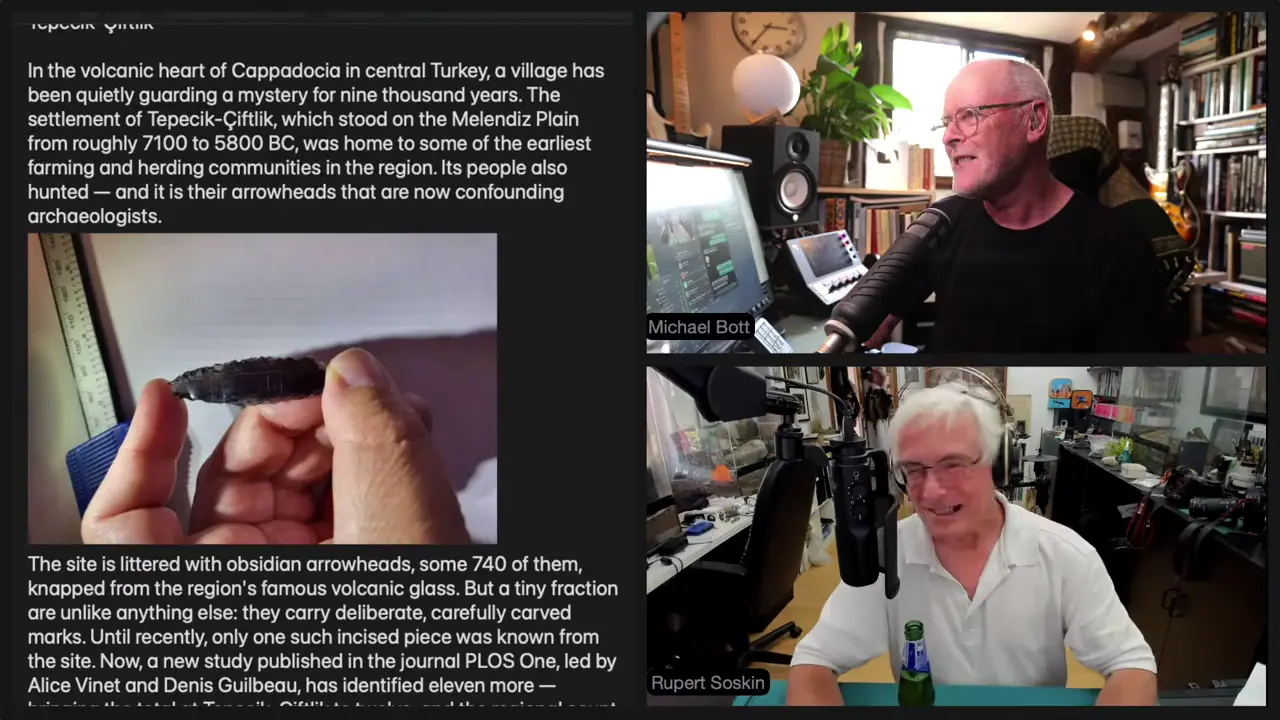
- Microscopic analysis revealed deliberate carved marks made by scoring 2-3 times to grind away dark surface and leave a pale line
- Obsidian cannot easily scratch obsidian; experiments indicate carvers deliberately chose flint, which made up barely 1% of stone at the site
- No two marks are alike; one elaborate piece has at least 20 strokes forming three squares joined by a line
- Marks were sometimes cut before, sometimes after, the point was finished
- Marked arrowheads found only in central Anatolia, with loose parallels at Çatalhöyük; found in ordinary houses, not graves or ritual settings
- Katherine Aschmann proposed in the 1980s that these were hunter's marks identifying who made or used an arrow
- Cappadocian obsidian was widely traded, reaching as far as the southern Levant
Site mentioned
📍 Tepecik-Çiftlik [Niğde Province]🌍 Show on the globe
Keep exploring
Every site on this page sits on the globe, and the people who research them are on the Discord.
3D Globe · Sites by country · Story Archive · Research Library · Weekly Journal · Search
AI-generated text · images from the original sources · always verify with the sources.