

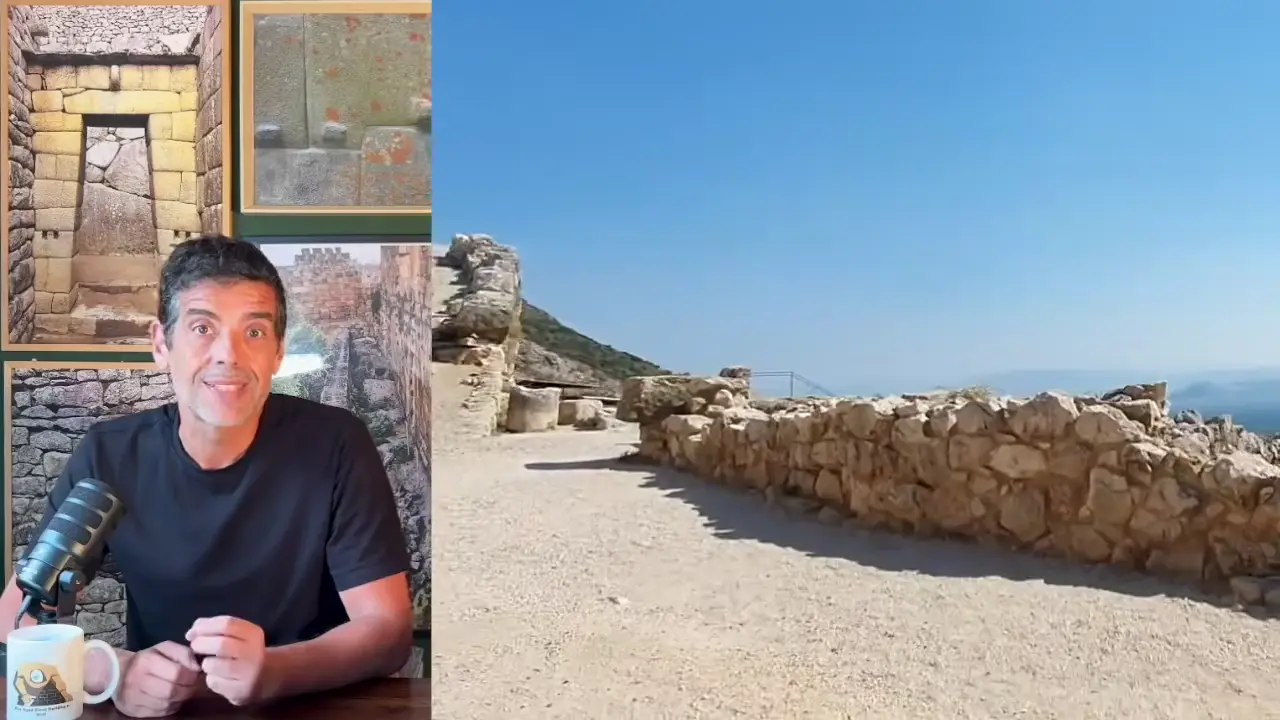
The Cyclops feature most famously in the Odyssey, though they also appear in Hesiod's Theogony as the three elder Cyclopes who forge Zeus's thunderbolt. The level seven walls of Hisarlik are not Cyclopean in any sense. Alacahöyük in Turkey showcases the characteristic puzzle-like polygonal masonry from the same era. The standard ancient etymology of 'Cyclops' (Κύκλωψ) derives it from κύκλος (circle) + ὤψ (eye), yielding 'round-eyed'—a description of their single circular eye. Homer and Virgil depicted one-eyed cave-dwellers, while Pausanias and Pliny linked them to construction.
Cyclopean walls and the misunderstood etymology of 'Cyclops'
Key facts
- The Cyclops appear only in the Odyssey, not in the Iliad
- The level seven walls of Hisarlik (Troy) are not Cyclopean, neither in the mythological sense nor in the polygonal masonry sense
- Alacahöyük in Turkey features the characteristic puzzle-like polygonal stone construction from the same Bronze Age period
- Ancient authors translated 'Cyclops' variously as 'cattle thief,' 'hand-to-mouth' (skilled worker), or 'round eyes' (from cycle)
- No ancient source translates 'Cyclops' literally as 'one-eyed' as understood in modern usage
- Homer and Virgil described Cyclopes as one-eyed monsters living in caves, while Pausanias and Pliny associated them with building ability
Sources
[PDF] The Curse of the Cyclops - CEP – Probationcep-probation.org
When the Cyclops catches sight of them and asks them who they are and what they want, Odysseus replies that they have been shipwrecked and, invoking Zeus, ...
Cyclopes - Wikipediaen.wikipedia.org
The Cyclopes of Homer's Odyssey are a group of uncivilized, cave-dwelling shepherds, including Polyphemus, whom Odysseus encounters. A third group of Cyclopes ...
Polyphemus | Cyclops, Greek Mythology, Odyssey, Galatea ...britannica.com
In Book IX of Homer's Odyssey, Polyphemus is a shepherd who is depicted as an uncivilized, man-eating giant living in isolation from other ...
7. Odysseus and the Cyclops - BBC Teachbbc.co.uk
The Cyclops - called Polyphemus - is a giant, with one eye in ... Perseus must fight Medusa, a snake-haired monster - a look and you'll be turned to stone.
Odysseus's Appearance in The Odyssey and the Iliad - 1416 Wordsbartleby.com
Odysseus's Appearance in The Odyssey and the Iliad ... For example, Odysseus outwitted the Cyclops, Polyphemus, by giving a false name to disguise his identity.
Was this story useful?
Keep exploring
Every site on this page sits on the globe, and the people who research them are on the Discord.
3D Globe · Sites by country · Story Archive · Research Library · Weekly Journal · Search
AI-generated text · images from the original sources · always verify with the sources.