

The Great Sphinx erosion debate continues: research by Robert Schoch proposes water weathering patterns on the monument, suggesting extensive erosion prior to 5000 B.C. when Egypt may have had more rainfall. However, a 2023 NYU study proposes wind erosion as a primary natural sculptor of the Sphinx's body before human carving. The two erosion hypotheses remain in contention, with Schoch's water weathering theory considered controversial and some scholars arguing a moat system could explain water patterns without requiring a wetter past. The Giza plateau's geological history and its connection to regional climate conditions continue to be debated.
Climate sequence and Sphinx-pyramid construction timeline
 EgyptTheory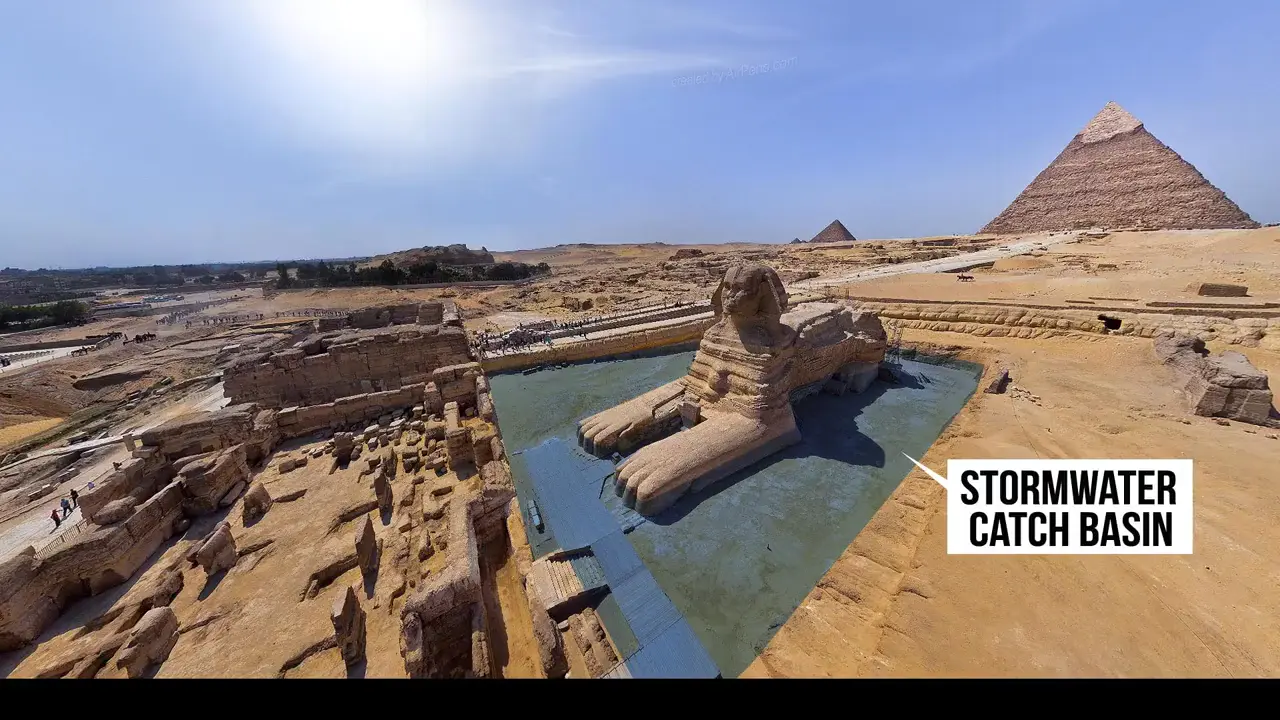
Site mentioned
Key facts
- Great Sphinx and basin endured both water and wind erosions in different times
- Climate sequence: humid period first (water erosion), then arid period second (wind erosion)
- In remote past, Giza region was humid with much more rainfall; workers excavated catch basin at bottom of plateau
- Stone from basin used to build front structures as stormwater detention facilities
- Limestone block left in center of basin functioned as flow control to manage water velocity/volume
- When climate became extremely arid, limestone block was exposed and isolated, eroded to sphinx-shaped yardang over thousands of years
- Later, wind erosion damaged bottom pyramid casings; maintenance team repaired with more durable granite and basalt
- Methods and materials of adding new casings at different Giza structures are identical, signifying pyramids were contemporaries with Sphinx basin and temples
- Sphinx basin with water erosion marks and pyramids likely created during same relatively humid era as part of giant industrial mining operation
Sources
Sphinx water erosion hypothesis - Wikipediaen.wikipedia.org
The Sphinx water erosion hypothesis is a fringe claim, contending that the Great Sphinx of Giza and its enclosing walls show erosion consistent with ...
Did Nature Help Shape the Great Sphinx of Giza? New Research ...news.artnet.com
A new study has found that the Great Sphinx of Giza may have been shaped by wind erosion before being hand-carved by ancient Egyptians.
The Sphinx Controversy: Another Look at the Geological Evidencehallofmaat.com
Schoch maintains that the more pronounced weathering seen on and around the Sphinx could only have been produced prior to 5000 B.C., when Egypt was receiving ...
The Great Sphinx - Robert M. Schochrobertschoch.com
A moat theory explains the water weathering of the Sphinx without hypothesizing that it dates back to an earlier period of more rainfall than the present.
Did natural erosion help carve Egypt's Great Sphinx? - Physics Worldphysicsworld.com
Much of the body of Egypt's Great Sphinx could have been created by the natural erosion of a rock formation, according to researchers at New York University.
Was this story useful?
Keep exploring
Every site on this page sits on the globe, and the people who research them are on the Discord.
3D Globe · Sites by country · Story Archive · Research Library · Weekly Journal · Search
AI-generated text · images from the original sources · always verify with the sources.