

Carpathian Basin settlements show remarkable cultural continuity after the Hun arrival — local pottery, housing, and burial customs persist from earlier Sarmatian, Gothic, and Roman traditions. What changes are isolated graves with horse burials, cauldrons, and artificial cranial modification — likely elite status signals rather than mass migration markers. 🔍
Carpathian Basin archaeology shows Hun elite intrusion without population replacement
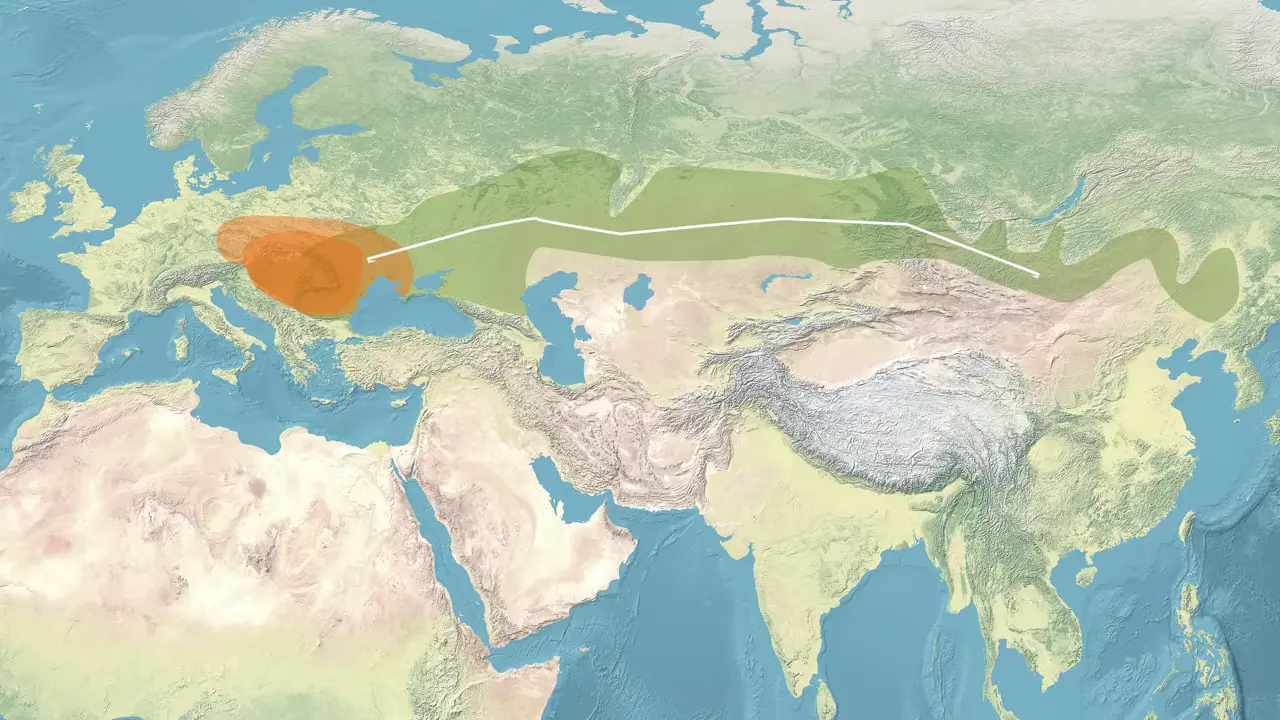
Key facts
- Settlements and cemeteries in Carpathian Basin show continuity with local pottery, housing patterns, and burial customs following earlier Sarmatian, Gothic, or Roman period traditions
- Isolated graves contain step-associated markers: partial horse burials, north-south grave orientation, certain weapons, cauldrons, and artificial cranial modification
- Artificial cranial modification appears in Eastern Europe before the Hun period among multiple groups including Sarmatians and Alans, signaling elite status rather than ethnicity
- Portable artifacts (bronze cauldrons, composite bows, horse gear, animal-style ornaments) circulated across the Eurasian step for centuries and do not belong uniquely to the Huns
- Hun-period graves in Europe lack monumentality and satellite burials and are embedded in local cemeteries, unlike Xiongnu elite burials at Noin-Ula
Sources
pubmed.ncbi.nlm.nih.gov
Linked in video description
link.springer.com
Linked in video description
pubmed.ncbi.nlm.nih.gov
Linked in video description
pmc.ncbi.nlm.nih.gov
Linked in video description
sciencedaily.com
Linked in video description
Was this story useful?
Keep exploring
Every site on this page sits on the globe, and the people who research them are on the Discord.
3D Globe · Sites by country · Story Archive · Research Library · Weekly Journal · Search
AI-generated text · images from the original sources · always verify with the sources.