

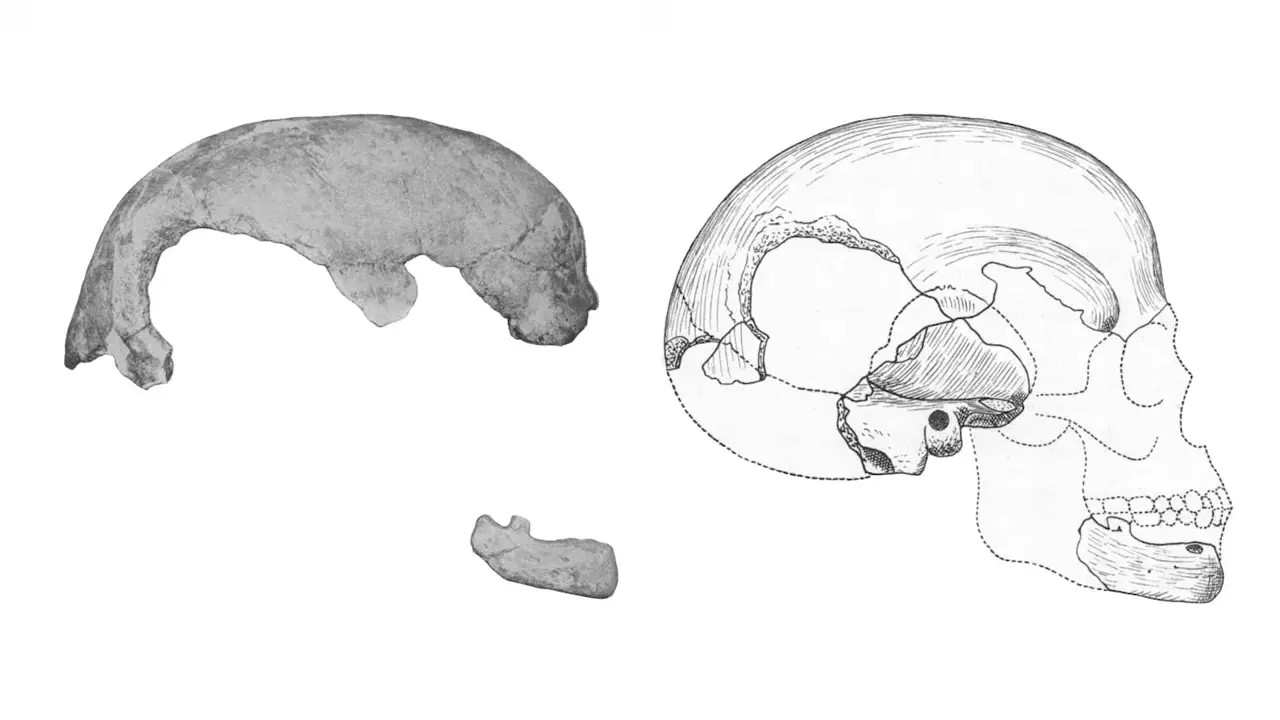
Robert Broom proposed a brand-new species in a 1917 letter: Homo capensis, the "human of the Cape." He rebuilt the missing skull sections, cast the interior cavity and got 1,960 cm³ by displaced water — the number that stuck. Competing estimates: Pycraft 1,717, G.E. Smith up to 1,900, Keith 1,832 (later revised down). Broom's own illustration shaded restored areas, something later reproductions lost. 📐
Broom named Homo capensis in 1917; brain estimates span 1,717-1,960 cm3
 EnglandTheory
Key facts
- Robert Broom, the South African paleontologist, proposed in a 1917 letter that the Boskop skull was evidence of a previously unrecognized human species, which he named Homo capensis ('human of the Cape').
- Broom reconstructed the missing portions of the skull and cast its presumed internal cavity, obtaining an estimated capacity of 1,960 cm3 by measuring displaced water - the figure most often repeated in popular and pseudo-scientific retellings.
- Competing anatomists' estimates: William Pycraft 1,717 cm3; Grafton Elliot Smith up to 1,900 cm3; Keith's original figure 1,832 cm3, which he later revised downward.
- The video stresses that even the largest published estimate is not more than about twice the normal Homo sapiens brain volume, and notes other animals have larger brains than humans.
- Keith's recorded remark on the specimen was 'Of the face, nothing remains.'
- Broom's published illustration distinguished surviving material from restored portions through shading, letting readers see how much anatomy was inferred; later reproductions lost that distinction, creating the familiar image of a delicate, childlike face on an enormous braincase.
Sources
The evidence afforded by the Boskop skull of a new species of primitive man ...biodiversitylibrary.org
Four Species of Homo You've Never Heard Of, Part IIsmithsonianmag.com
Boskop Manen.wikipedia.org
The Boskop Skullnature.com
Was this story useful?
Keep exploring
Every site on this page sits on the globe, and the people who research them are on the Discord.
3D Globe · Sites by country · Story Archive · Research Library · Weekly Journal · Search
AI-generated text · images from the original sources · always verify with the sources.