

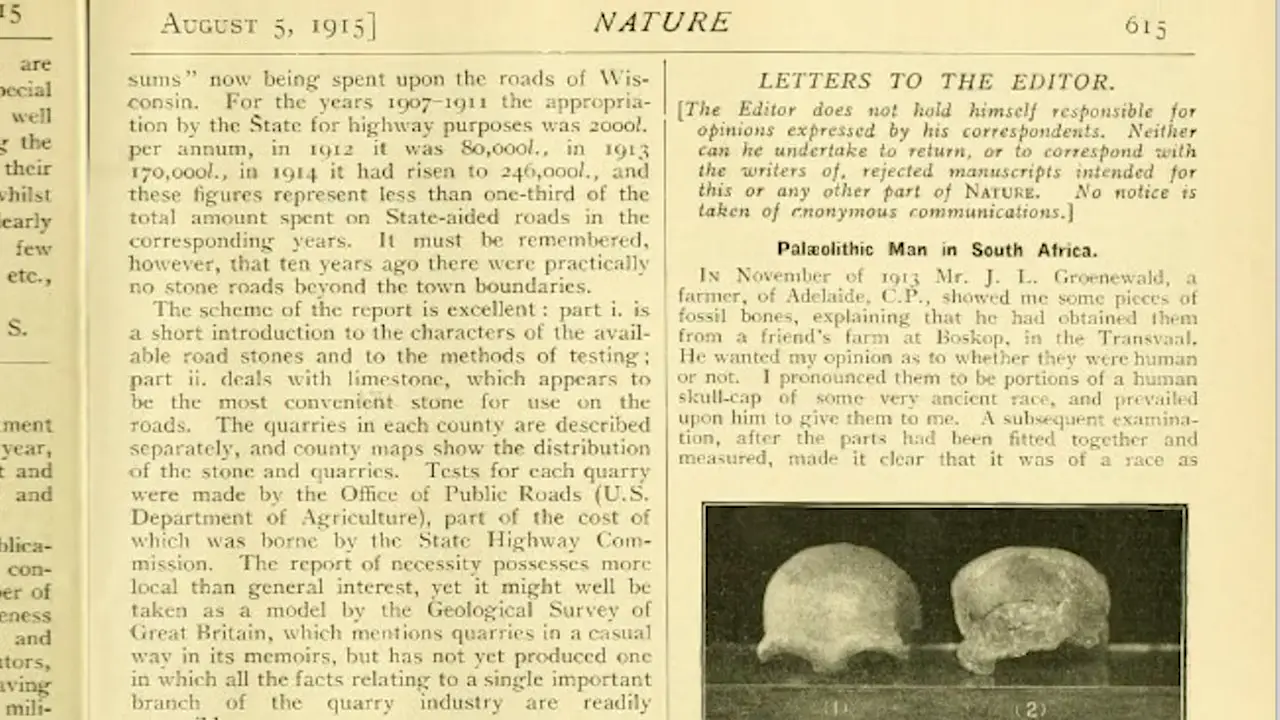
The Boskop skull turned up by accident in 1913 in river deposits near Boskop, Mpumalanga, South Africa. FitzSimmons announced it in Nature in 1915 and compared it to Neanderthals — but Arthur Keith pushed back the same year, publishing in 1917 that it was a modern human with an unusually large head. Reconstructed from what survived, it measured about 205 mm long by 154 mm wide, and was never directly dated. 🦴
1913 Boskop skull: FitzSimmons' 1915 Nature report and Keith's 1917 measurements
 EnglandBioarchaeology
Key facts
- A partial human skull was found in 1913 near Boskop, Mpumalanga, South Africa, in river deposits; the video says the find was accidental and was never directly dated.
- FitzSimmons announced the discovery in Nature in 1915, drawing comparisons with Neanderthals.
- British anatomist Arthur Keith immediately challenged that interpretation, arguing the remains were a modern human with an exceptionally large head; he published on the specimen in 1917.
- Because large portions of the skull were missing, Keith had to reconstruct the original dimensions: maximum length about 205 mm (8.1 in) and greatest width about 154 mm (6.1 in) - longer than wide but not dramatically so.
- Modern Homo sapiens brain volume is usually given as about 1,350-1,400 cm3; the video notes a 7-foot-tall person's brain is roughly 43% heavier than a 3-foot-tall person's, yet both are the same species.
- Neanderthals are thought to have had cranial capacities about the same as, or larger than, modern humans.
- The video uses the Adakina/Adakama mummy as a comparison case where modern testing showed an unusual-looking but Homo sapiens individual.
Sources
Boskop Manen.wikipedia.org
Return of the “amazing” Boskopsjohnhawks.net
Telanthropus - Prehistoric Wiki - Fandomprehistoric-wiki.fandom.com
Boskop skull | Homo sapiens, Africa, Neanderthalsbritannica.com
Was this story useful?
Keep exploring
Every site on this page sits on the globe, and the people who research them are on the Discord.
3D Globe · Sites by country · Story Archive · Research Library · Weekly Journal · Search
AI-generated text · images from the original sources · always verify with the sources.