

The Bonampak murals were painted in true fresco on wet lime plaster, each room completed in a single session by a large specialist team. A poorly built limestone vault accidentally preserved them for over a millennium through calcification. In 1996, infrared imaging revealed hidden hieroglyphic text.
Bonampak murals: true fresco technique, calcification preservation, and 1996 infrared imaging
 MexicoArt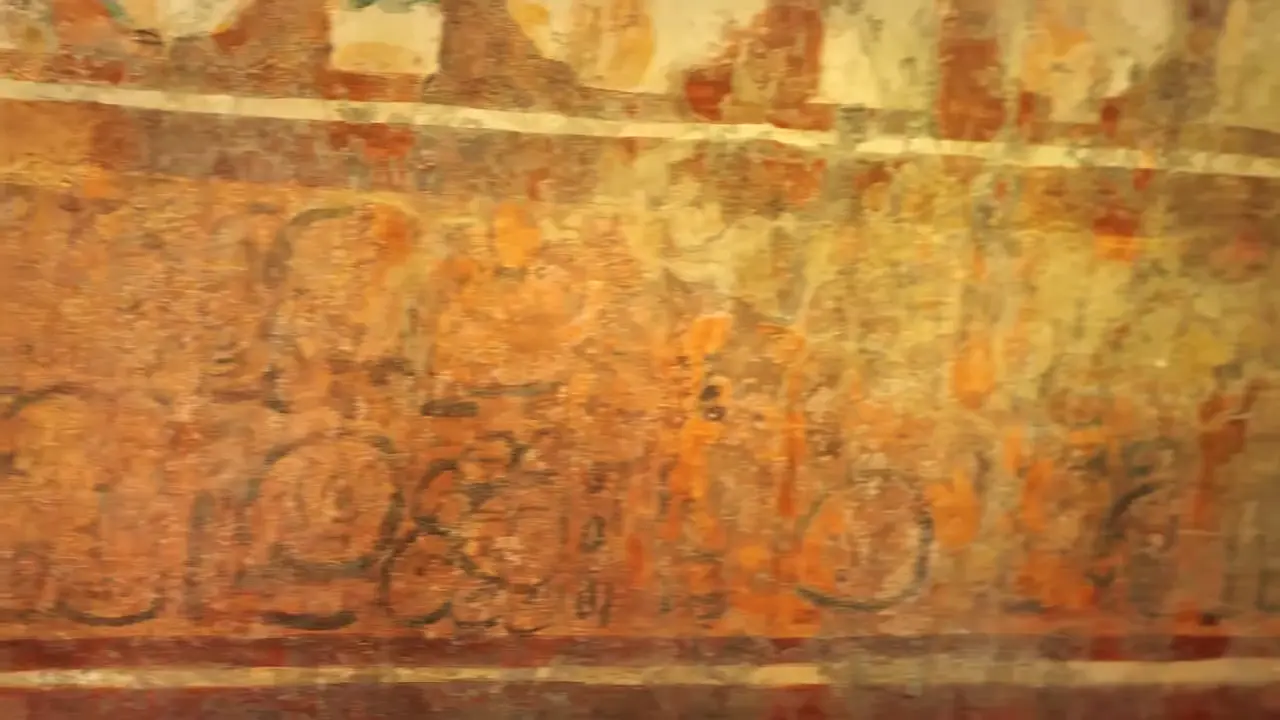
Key facts
- Structure 1, known as the Temple of the Murals, has exterior surfaces originally painted in Maya blue, blue-green, red, and yellow.
- The murals were executed using the true fresco technique, with pigments applied to wet lime plaster so they chemically bonded to the wall as it dried.
- The absence of seams in the plaster indicates each room was prepared and painted in a single continuous session by a large team of specialists.
- The paintings were preserved for over a millennium because water seeping through the poorly constructed limestone vault built up protective layers of calcification that encased the painted plaster.
- Deterioration accelerated dramatically after the chambers were opened and exposed to air circulation.
- In 1996, infrared imaging revealed details invisible to the naked eye and exposed hieroglyphic text that had previously been unreadable, enabling high-quality reconstructions such as the one at Mexico City's National Museum of Anthropology.
- The murals cover virtually every interior surface of the three chambers and contain approximately 125 hieroglyphic captions in orange and black.
Site mentioned
Sources
lugares.inah.gob.mx
Linked in video description
Was this story useful?
Keep exploring
Every site on this page sits on the globe, and the people who research them are on the Discord.
3D Globe · Sites by country · Story Archive · Research Library · Weekly Journal · Search
AI-generated text · images from the original sources · always verify with the sources.