

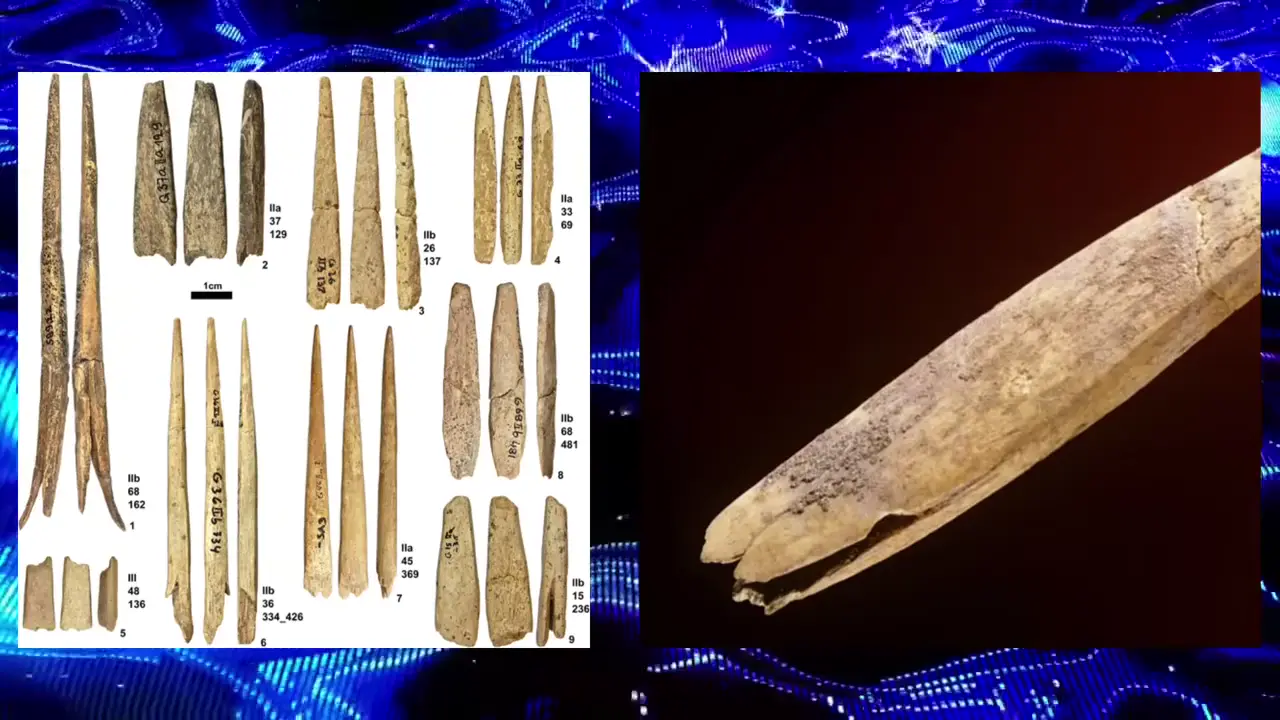
Dating the Aurignacian to roughly 43,000–35,000 BP, the tradition spread from Iberia and Italy through France and Germany into western Russia. Its toolkit combined flakes and blades—some blades made on prepared cores—with split-based points fashioned from bone or antler. Some points may have been hafted, though their exact use is debated. Its makers also produced carved and engraved art, with artistic traditions varying by region.
Aurignacian Culture: 43,000–35,000-Year-Old Toolkit and Art
Key facts
- The Chauvet chronology places the Aurignacian at approximately 43,000–35,000 BP; the Gravettian followed, so 43,000–20,000 conflates the Aurignacian with the later Gravettian.
- The tradition spread across much of Europe, from Iberia and Italy through France and Germany into western Russia.
- Aurignacian points made from bone or antler commonly had split bases; “notched bottoms” is imprecise.
- Stone-tool assemblages included both flakes and blades; some blades were made from prepared cores, so “rather than flakes” is incorrect.
- The Aurignacian is associated with carved and engraved portable art and early cave art.
- Some split-based points may have been hafted, but their exact function—and a universal projectile-point explanation—remains debated.
- Artistic and artifact traditions varied regionally.
Sources
The Aurignacians | The Chauvet-Pont d'Arc cavearcheologie.culture.gouv.fr
Aurignacian - Wikipediaen.wikipedia.org
Aurignacian, The First Modern Humans - Lithic Casting Lablithiccastinglab.com
Early European Cultures - Aurignacianhistoryfiles.co.uk
(PDF) The chronology of the Aurignacian and Transitional ...researchgate.net
Was this story useful?
Keep exploring
Every site on this page sits on the globe, and the people who research them are on the Discord.
3D Globe · Sites by country · Story Archive · Research Library · Weekly Journal · Search
AI-generated text · images from the original sources · always verify with the sources.