

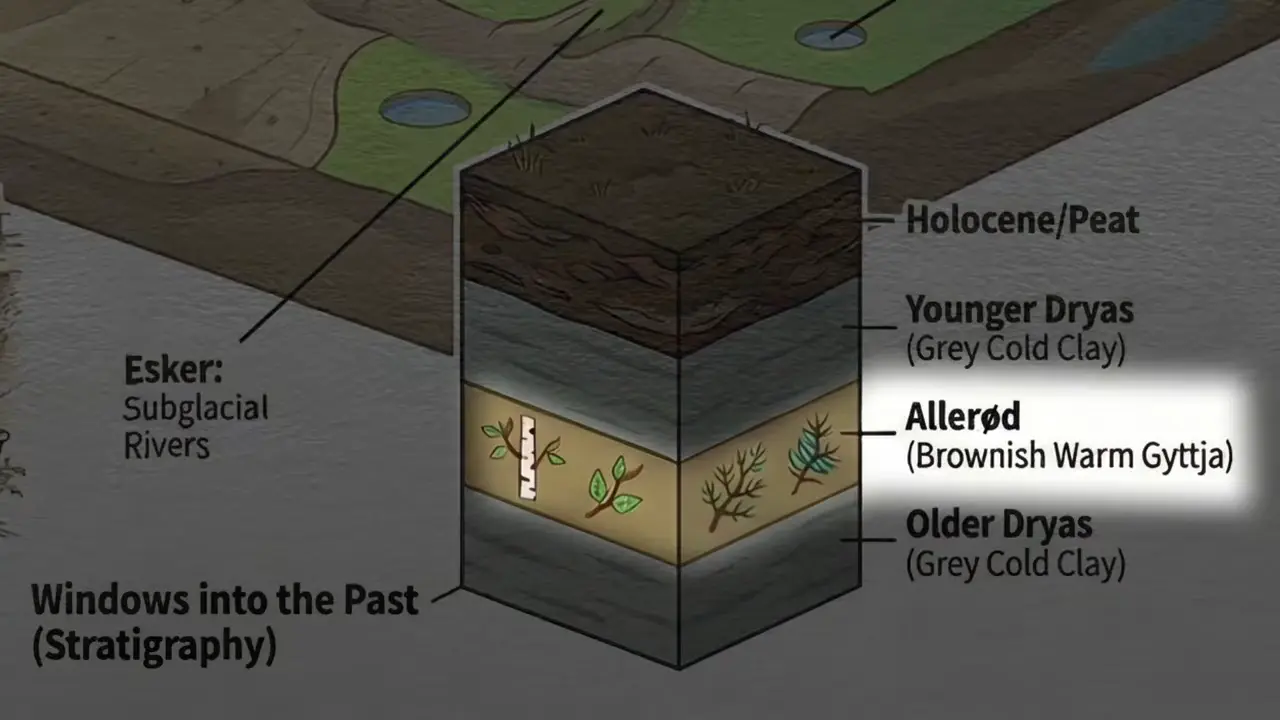
Harts and Milthers found a 30cm layer of gytja at Allerød, Denmark — sandwiched between glacial clay deposits. The gytja contained birch trees and juniper, proving milder conditions existed between two cold periods. This established the cold-warm-cold oscillation pattern we now call the Older and Younger Dryas.
Allarød gytja discovery proves climate oscillation
Site mentioned
📍 Allarød
Key facts
- In 1901, Harts and Milthers discovered a 30cm (about 1 foot) thick gytja layer at Allerød, Denmark
- Gytja is dark, oxygen-rich mud rich in organic nutrients that forms in marshes and lakes
- The gytja layer was sandwiched between glacial clay deposits below and above
- The gytja indicated climate amelioration - it cannot form under full Arctic conditions
- The flora in the gytja included birch trees and juniper, showing milder climate than the glacial clays
- This discovery established the climate oscillation pattern: cold-warm-cold
Sources
What is beneath thejggj.dk
The hills consist of sand and gravel sedimented in layers just like normal kames of stagnant glacial lake deposits, but to the contrary of these, the layers in ...
[PDF] scienceia801502.us.archive.org
... cvstinc, cj'stcme, glntation, or proteins linMiigthiol groups, and have studied ns a model experiment the reactions between thiamine and cystine, nnd between.
Was this story useful?
Keep exploring
Every site on this page sits on the globe, and the people who research them are on the Discord.
3D Globe · Sites by country · Story Archive · Research Library · Weekly Journal · Search
AI-generated text · images from the original sources · always verify with the sources.