

Yunxian 2 skull from China (discovered in 1990) got a digital makeover in 2025. CT scanning reveals a 1-million-year-old brain case as large as ours. If this Homo longi relative had modern-sized brains, our species may have split off much earlier than thought.
1-million-year-old skull suggests Homo sapiens divergence pushed back 500,000 years
 ChinaBioarchaeologySignificant Find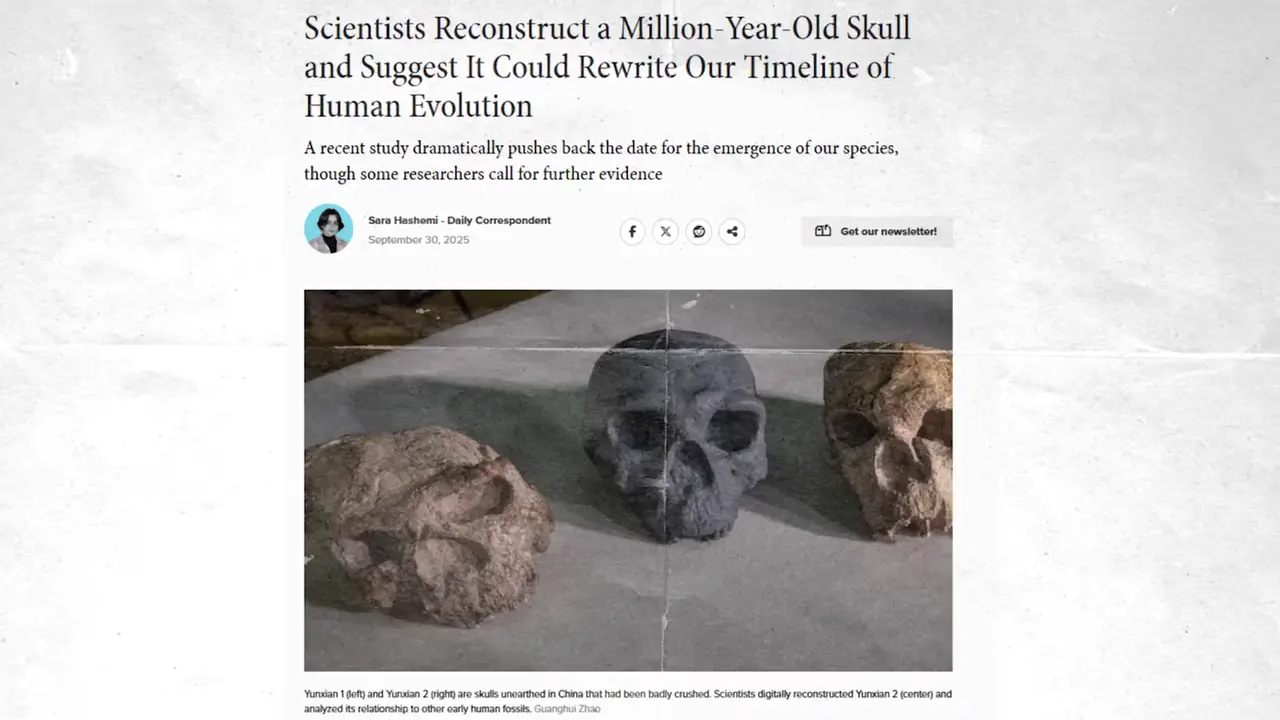
Site mentioned
Key facts
- Yunxian (Meipu) 2 skull discovered in China in 1992, heavily crushed and distorted
- In 2025, researchers applied CT scanning and digital reconstruction techniques to restore the skull
- The individual lived around 1 million years ago
- Reconstructed brain case is large, roughly the same size as modern humans
- Skull anatomy suggests it belongs to Homo longi lineage, a sister species to Denisovans
- If Yunxian (Meipu) 2 is a Denisovan-like lineage with large brain at 1 million years ago, Homo sapiens must have diverged earlier than previously thought
- Paleonthropoligist Chris Stringer suggests million-year-old Homo sapiens fossils likely exist but haven't been found yet
Sources
1 million-year-old Yunxian skull redefines human evolution and ...archaeologymag.com
Digital reconstruction of the Yunxian 2 skull reshapes human evolution timelines in Asia and Denisovan origins.
Million-year-old Skull from Central China Rewrites Human Evolution ...english.cas.cn
Discovered in Yunxian County, Hubei Province, in 1990, the "Yunxian 2" skull was crushed during the fossilization process, making detailed ...
Million-year-old skull could rewrite timeline of human origin ...abcnews.com
Digital reconstruction of a crushed skull from an ancient human relative could rewrite the timeline of human evolution, researchers said.
Million-year-old skull rewrites human evolution, say scientists - BBCbbc.com
When scientists found the skull, named Yunxian 2, they assumed it belonged to an earlier ancestor of ours, Homo erectus, the first large-brained ...
A Skull from China Rewrites the Story of Our Genus - Anthropology.netanthropology.net
The team led by Xiaobo Feng and Xijun Ni digitally “uncrumpled” the distorted Yunxian 2 cranium using high-resolution CT scans. This ...
Was this story useful?
Keep exploring
Every site on this page sits on the globe, and the people who research them are on the Discord.
3D Globe · Sites by country · Story Archive · Research Library · Weekly Journal · Search
AI-generated text · images from the original sources · always verify with the sources.