

Penghu 1, a giant jaw dredged off Taiwan in 2008, was identified as Denisovan. A 2026 preprint called a femur and tibia (~1.8–1.9 m) Denisovan — possibly huge locals. 🦴🌊
Taiwan leg bones point to Denisovans around 1.8-1.9 m tall
Key facts
- In 2008 commercial fishermen dredged a massive mandible from the Penghu Channel off Taiwan; it was kept at the National Museum of Natural Science in Taiwan and identified as archaic human seven years later as 'Penghu 1'.
- Penghu 1 was later confirmed as Denisovan; during the Ice Age lowered sea levels turned the Taiwan Strait into dry land crossed by people and animals.
- A femur ('Penghu 2') and a tibia ('Penghu 3') recovered from a dredging haul sat for years in a large private fossil collection before researchers identified them in 2010.
- In 2026 researchers re-examined these bones and reported they too are Denisovan; the finding was still a preprint at the time.
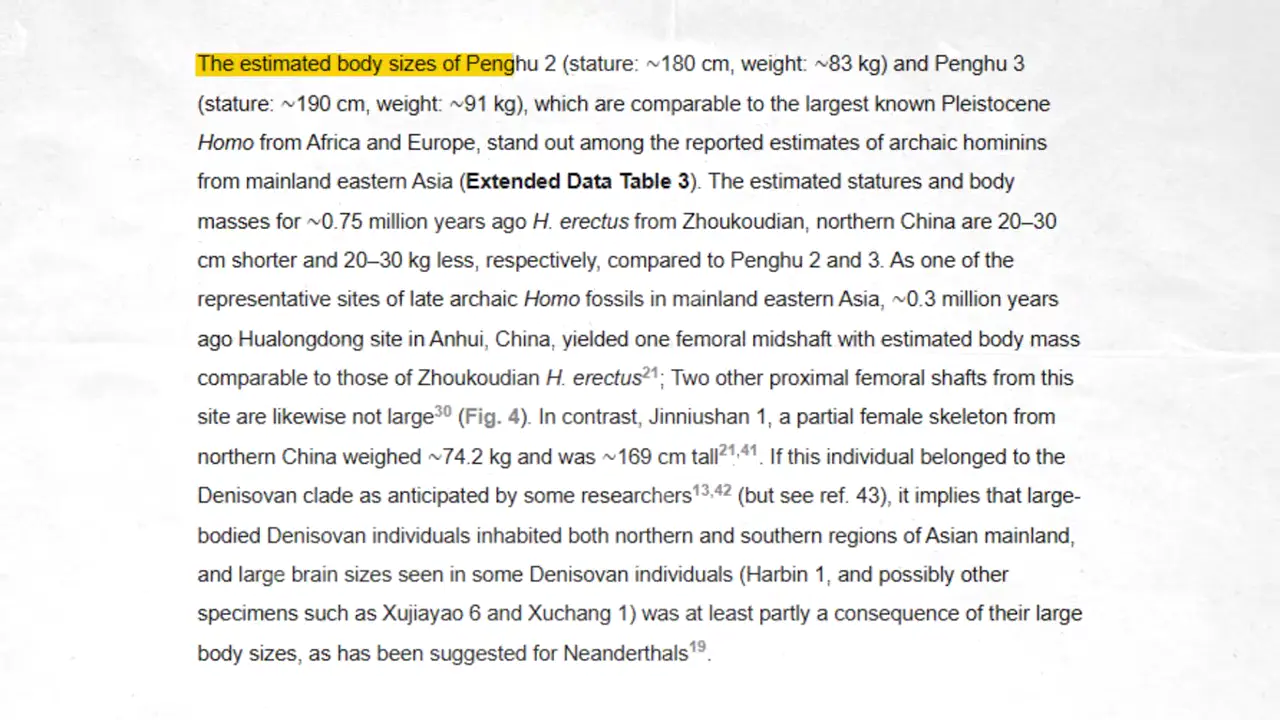
- Penghu 2's femur reconstructs to roughly 49 cm, indicating a body height of about 1.8 m and weight near 83 kg (183 lb).
- Penghu 3's tibia preserves a 34 cm shaft with an estimated complete length near 43 cm, indicating a height of about 1.9 m and weight near 91 kg (200 lb).
- One of the two leg bones shows a healed fracture, indicating its owner survived a serious injury.
- The video stresses these two individuals may be unusually large members of a local population rather than typical of all Denisovans, since Siberian fossils preserve too little of the body to estimate general Denisovan height.
Sources
nature.com
Linked in video description
nature.com
Linked in video description
The problem when all the fossils are malejohnhawks.net
This jawbone, designated as Penghu 1, came from an unusual circumstance, dredged from the bottom of the Taiwan Strait nearly twenty years ago.
A new Denisovan mandible from Taiwanpopular-archaeology.com
Penghu 1 was derived from a male Denisovan by sequencing its bone and tooth proteins.
A male Denisovan mandible from Pleistocene Taiwanscience.org
by T Tsutaya · 2025 · Cited by 87 — Penghu 1 is dated as younger than 450,000 years, with a most likely age range of 10,000 to 70,000 years or 130,000 to 190,000 years, according ...
The first archaic Homo from Taiwannature.com
by CH Chang · 2015 · Cited by 132 — Penghu 1 is more similar to the African and some European Early-Middle Pleistocene Homo mandibles rather than to Javanese and Chinese H. erectus ...
Penghu 1en.wikipedia.org
Penghu 1 is a fossil jaw (mandible) belonging to an extinct hominin species of the genus Homo. a male Denisovan. Place discovered Taiwan Strait, Pacific Ocean ...
Was this story useful?
Keep exploring
Every site on this page sits on the globe, and the people who research them are on the Discord.
3D Globe · Sites by country · Story Archive · Research Library · Weekly Journal · Search
AI-generated text · images from the original sources · always verify with the sources.