

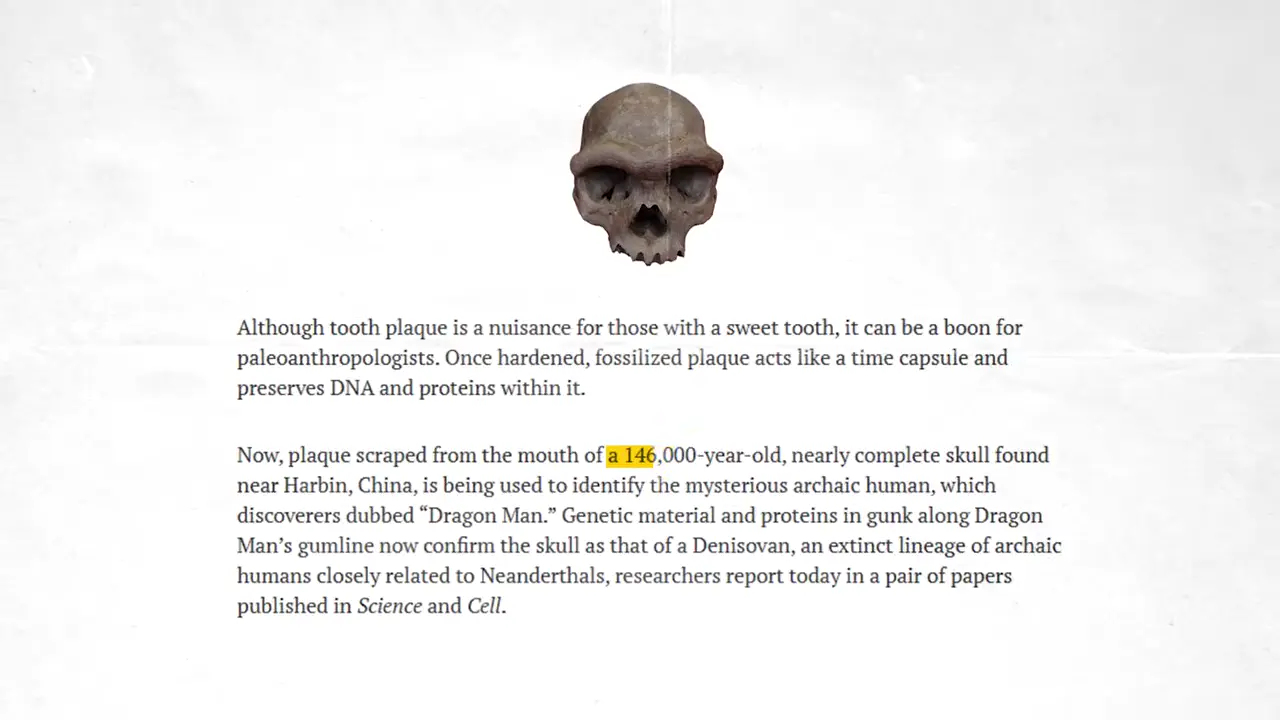
The Harbin skull from Northeast China, announced in 2021 as a new species, Homo longi, and billed as one of Asia's most complete archaic human skulls, was tied to the Denisovan lineage by protein testing in 2025. Whether Homo longi and Denisovans are one taxon is still debated, partly because DNA survives in cold settings but decays in the tropics — and other Middle Pleistocene Chinese fossils like Dali, Xuchang and Hualongdong refuse to fit neatly too. 🧩
2025 protein test links Harbin Homo longi skull to Denisovans
Key facts
- In 2021 a large, well-preserved skull from Harbin in Northeast China was announced as a new human species, Homo longi.
- It was described as one of the most complete archaic human skulls ever found in Asia.
- In 2025 researchers tested proteins from the skull and linked it to the Denisovan lineage.
- Scientists still debate whether Homo longi and the Denisovans are the same taxon, largely because DNA preserves only in cold environments and decays in tropical ones.
- Other Middle Pleistocene Chinese fossils named in the discussion, including the Dali, Xuchang and Hualongdong remains, also do not fit neatly into existing categories.
Sources
nature.com
Linked in video description
nature.com
Linked in video description
Harbin Cranium Identified as Denisovan Using PEAKS ...bioinfor.com
A new study in Science identifies the 146000-year-old Harbin cranium as Denisovan using paleoproteomics.
The proteome of the late Middle Pleistocene Harbin ...science.org
by Q Fu · 2025 · Cited by 56 — By using proteomic analysis to connect the Harbin individual's nearly complete cranium with Denisovans, we now have the first comprehensive ...
Harbin craniumen.wikipedia.org
The Harbin cranium was initially hypothesized to belong to the same species as the Denisovans, and subsequent proteomics and mitochondrial DNA analyses ...
The proteome of the late Middle Pleistocene Harbin ...pubmed.ncbi.nlm.nih.gov
by Q Fu · 2025 · Cited by 56 — Here, we report 95 endogenous proteins retrieved from a nearly complete cranium from Harbin, China, dating to at least 146,000 years ago
Denisovan mitochondrial DNA from dental calculus of the > ...cell.com
by Q Fu · 2025 · Cited by 56 — The finding that the Harbin cranium contains Denisovan mtDNA connects Denisovans with morphological traits and will help to identify other ...
Was this story useful?
Keep exploring
Every site on this page sits on the globe, and the people who research them are on the Discord.
3D Globe · Sites by country · Story Archive · Research Library · Weekly Journal · Search
AI-generated text · images from the original sources · always verify with the sources.