 ANCIENT NERDS
Cyclical World Ages in Comparative Mythology
The paper argues that cyclical world-age traditions across Greek, Aztec, Hindu, Maya, and Kabbalistic sources share genuine structural parallels — metallic succession, flood-fire alternation, declining virtue, and culture-bearing survivors — while specifically rejecting claims of mathematical transmission between distant traditions such as the Hindu-Maya 432,000-year parallel, since the underlying base architectures differ and no evidence of contact exists. It also concludes that the universal cyclical-renewal claim overgeneralizes from traditions like Hindu and Kabbalistic thought to traditions like colonial-era Nahua sources that explicitly deny a successor cycle.
Across the Atlantic, around 700 BCE, the Greek poet Hesiod laid out a structurally parallel sequence in his Works and Days: five races of humanity, gold to silver to bronze to hero to iron, each base metal worth less and harder than the one before. The unsettling part is what Hesiod could not have known – that a Sanskrit cosmology on the other side of the Old World, the four Yugas of Hindu thought, would map to the very same four metals, in the same order, with durations mathematically calibrated to a 4:3:2:1 ratio inside a 4,320,000-year cycle. [1] [2] [3] [4]
Canonical Texts and Their Numerical Cycles
Hesiod’s Works and Days, dated to approximately 700 BCE, sets out the oldest Western schema of successive world-ages: a Golden race, a Silver race, a Bronze race, a Heroic race, and the present Iron race — each ending in destruction by Zeus and replaced by a new generation. The metallic succession encodes declining value but increasing hardness — gold, silver, bronze, iron — with the Heroic generation uniquely inserted as a nobler exception rather than a metal. The numerical architecture is simpler than its Eastern counterparts: no quantified duration is assigned to each age in the Greek text, and the system lacks a final cosmic dissolution — the Iron Age simply awaits destruction by Zeus. [5]
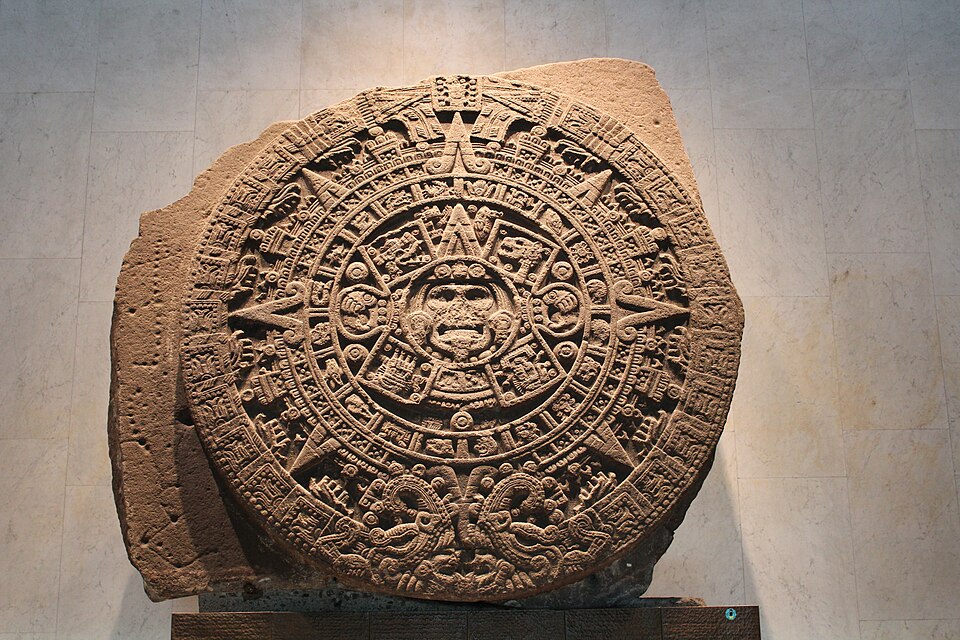
The Aztec tradition documents five successive Suns, each presided over by a different deity and each ending in a distinct elemental cataclysm: the four prior Suns destroyed respectively by jaguars (earth/beasts), wind, fire-rain, and flood. The present Fifth Sun is sustained by continuous human sacrifice against celestial forces (stars and moon) that would otherwise extinguish it through earthquakes. The numerical architecture is asymmetrical, with the four prior eras assigned unequal durations calibrated to a cyclical calendar system. [6] [7] [8] [9]
Hindu cosmology structures cosmic time into a Yuga Cycle of 4,320,000 human years (12,000 divine years), comprising four yugas whose durations follow a strict 4:3:2:1 ratio, with Kali Yuga at 432,000 years and Dvapara at 864,000. Each successive yuga loses both duration and dharma — symbolized as a Dharma-bull standing on four legs in Satya, three in Treta, two in Dvapara, and one in Kali. Vishnu incarnates repeatedly across yugas to restore Dharma via the Dashavatara, and the cycle resets after Pralaya (cosmic dissolution) at the end of Kali Yuga. [10]
The Maya Long Count calendar marks a 5,126-year cycle whose completion (13.0.0.0.0 on December 21, 2012) was interpreted by some as the end of a world-age, though Mayan scholars reject the ‘doomsday’ framing as a misrepresentation, noting that Long Count inscriptions extend far beyond the 13-baktun cycle. The K’iche’ Maya Popol Vuh describes multiple failed creation attempts — animals, mud people, wooden ‘doll people’ — before the successful creation of true humans from yellow and white maize, establishing this as the ‘Fourth Creation of the Maya’. The Hero Twins narrative (Hunahpu and Xbalanque) forms a cyclical underworld-and-renewal myth, with the Twins defeating the Lords of Xibalba, being resurrected, and rising as the Sun and Moon to anchor the present cosmic order. [11]
A recurring pattern across traditions is elemental cataclysm as agent of world-transition: the Aztec Suns are destroyed by jaguars (earth/beasts), wind, fire-rain, and flood; the Hindu yugas end with Pralaya; and Greek ages are terminated by Zeus through violence, deluge, or divine displeasure. What further distinguishes these systems is the quantification of cosmic time into cyclical architectures — the Hindu Yuga Cycle, the Maya Long Count, and parallel schemas elsewhere — each expressing a culture’s attempt to mathematize cosmic time. The metallic succession (gold→silver→bronze→iron) appears independently in both Hesiod’s Greek tradition and the Hindu Yuga system, suggesting a shared Indo-European structural pattern in representing temporal decline. Whether these parallel architectures reflect common Indo-European inheritance, diffusion through trade routes, or independent human response to astronomical observation remains unresolved — the evidence documents the numerical precision of each tradition but cannot definitively trace transmission routes between them. [7] [8] [3] [12] [2]
Destruction Mechanisms and Material Evidence
A 24-ton, 11½-foot-diameter basalt slab was rediscovered in December 1790 in the Zócalo of Mexico City, where Spanish colonial authorities had buried it face-down. The massive disk — which doubled as a sacrificial altar (cuauhxicalli) — was carved between approximately 1502 and 1521 CE and arranges four cartouches around its central Nahui Ollin glyph. Each cartouche represents a destroyed prior sun: 4-Jaguar, 4-Wind, 4-Rain-of-Fire, and 4-Water. These four prior suns map onto the four classical elements and the four cardinal directions, each tied to one of four Tezcatlipoca brothers and a specific color, locking elemental and directional structure directly into temporal sequence. 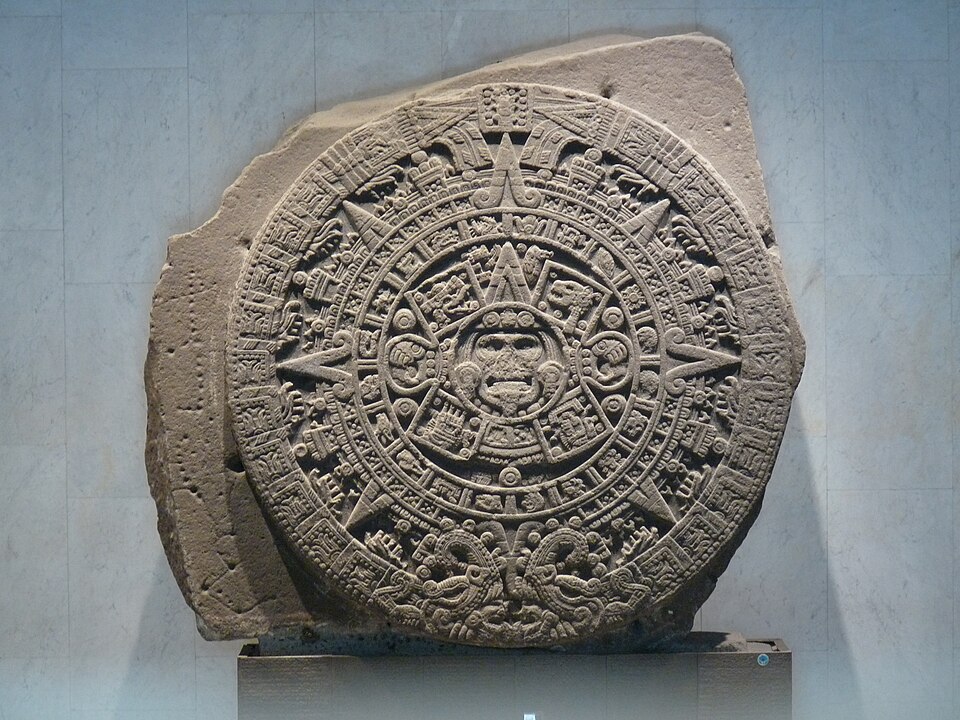 [13] [14]
Monolito de la Piedra del Sol. Photo: El Comandante / Wikimedia Commons. Image placed by the paper writer as visual evidence for this passage. Source The Sun Stone is documentary as well as monumental: the same doctrine appears in Books 1 and 7 of Bernardino de Sahagún’s Florentine Codex (compiled 1540s–1577 with Nahua collaborators) and in the Leyenda de los Soles within the Codex Chimalpopoca (dated 1558), the primary Nahuatl-language source for the Five Suns.
The destruction typology crystallizes around five named mechanisms, each tied to an element and producing a specific animal transformation. Jaguars consumed the giants of the First Sun; the Second Sun was destroyed by hurricanes that turned humans into monkeys; the Third by fire-rain that turned humans into birds or turkeys (sources conflict on the specifics); and the Fourth by flood that turned humans into fish. The Fifth Sun, the present one, is prophesied to end in earthquakes, with its calendrical death pegged to the 4 Ollin day-sign recurring every 260 days in the tonalpohualli. The Hindu Naimittika pralaya at the close of each kalpa — every 4.32 billion human years — unfolds through a parallel elemental sequence: a hundred-year drought, manifestation of seven suns, world-engulfing fire, flooding by Samvartaka clouds, and dispersal by cosmic winds. In both traditions the destruction list is also a regeneration list — each cataclysm produces a new cosmos, and survival is metamorphosis into a new form. [15] [16]
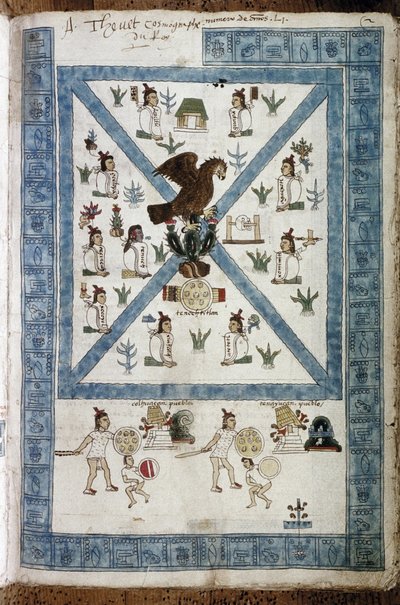
The ‘Codex Mendoza’, pt. I. Photo: Europeana. Codex Borgia is the premier pictorial source for the Five Suns destruction sequence, allowing readers…. Source
Maya material evidence preserves the same conviction through a different medium. Quiriguá Stela C, erected around 775 CE, anchors the current era to the primordial date 13.0.0.0.0 4 Ajaw 8 Kumk’u, corresponding (GMT correlation) to August 11, 3114 BCE, and narrates the creation event as the ‘planting of three stones’ by Jaguar Paddler, Stingray Spine Paddler, and Itzamna. At Palenque, the Cross Group temples integrate the 819-day cycle — encoding Mars, Mercury, Venus, the Haab, the tun, and the Tzolk’in into a single Maya supernumber — with the k’atun-ending 9.13.0.0.0 tying royal accession ritual to cosmic time. Farther north, the Xultun astronomical murals (presented in Science in 2012) carry pre-Columbian planetary ephemeris tables spanning decades — evidence that the calendrical infrastructure behind Maya cyclical time was observational and computational rather than purely symbolic. Aztec pictorial books, Maya carved stela, and post-conquest manuscripts of the Popol Vuh instantiate the same conviction: cosmic time is bounded, numerate, and bound to ritual action. [17]
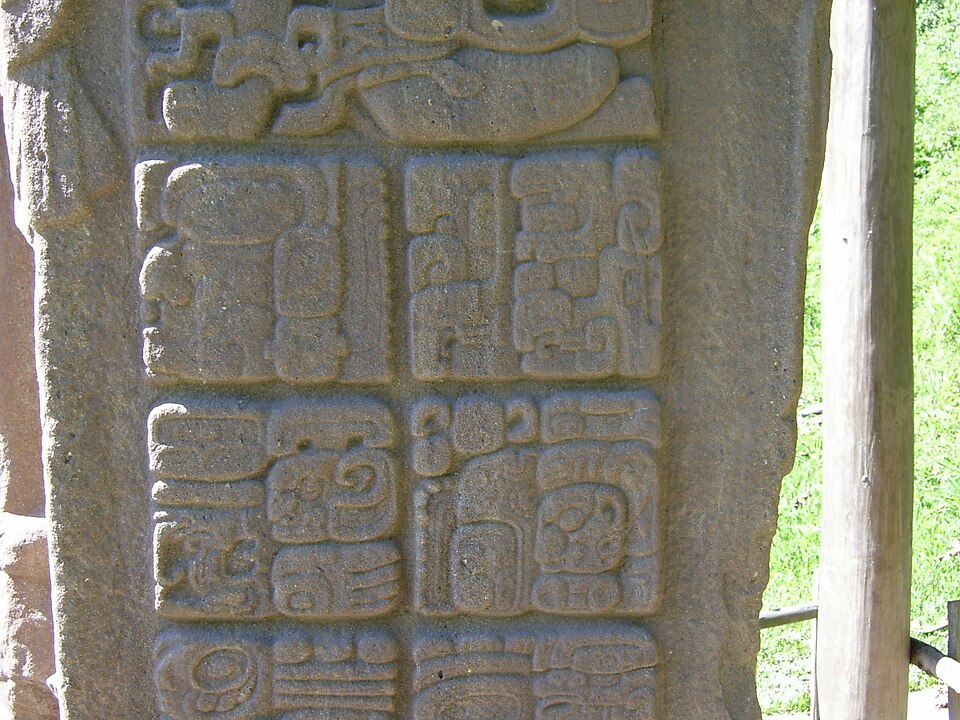
GT Quirigua StelaD detail. Photo: Jan Pešula / Wikimedia Commons. Stela C is the named monument that anchors the current era to 11 August 3114…. Source
Hesiod’s Works and Days (c. 700 BCE) provides the parallel Greek schema: five races — Golden, Silver, Bronze, Heroic demi-gods, and Iron — in declining sequence, each destroyed by Zeus for specific cause or by self-mutual slaughter. The Silver race was annihilated for impiety in failing to honor the Olympians; the Bronze race destroyed itself through internal violence; the Iron race is prophesied to end when humans are born with gray hair and moral law is abandoned. The Heroic Age is uniquely Hesiodic — Ovid omits it in the Metamorphoses (c. 8 CE), condensing the five-age schema into four. The closest Classic Maya epigraphic parallel to the Aztec Sun Stone is Tortuguero Monument 6, erected c. 667 CE and dedicated January 11, 669 CE — the only documented text referencing the 13.0.0.0.0 4 Ahaw 3 K’ank’in date corresponding to December 21, 2012. Maya epigrapher David Stuart now argues that the 13.0.0.0.0 reference functions as a rhetorical chronological anchor for the building dedication, not as a prophecy of world-ending. “The Maya never actually predicted the end of times,” Stuart states flatly. [18]
The material record converges on a structural consensus: cosmic time is bounded, numerate, and recurrent across these traditions, and current ritual action — blood sacrifice in Aztec practice, mitzvot in Lurianic Kabbalah, royal monument-dedication in Classic Maya practice — is required to hold it in place. The Hindu yuga system supplies the most extreme numerical scaffolding: Kali Yuga at 432,000 years, Maha Yuga at 4,320,000, kalpa at 4.32 billion, the conversion running through one divine year equal to 360 human years. Hesiod offers metal as metaphor where Hindu tradition offers digits. The Kabbalistic Sefer HaTemunah (composed late 13th–early 14th century) supplies yet another scaffolding — seven cosmic Sabbatical cycles of 7,000 years each, totaling 49,000 years before cosmic Jubilee. The evidence doesn’t resolve whether these cycles preserve memory of real geological-climatic ruptures (Younger Dryas impact, post-glacial sea-level rise), encode empirically observed orbital periodicities in the late-Pleistocene Earth system, or operate as purely structural metaphysical scaffolds. What the record establishes is that the convergence is real: cyclic destruction, elemental rotation, ritual-required renewal, and deep-time numeracy appear across Aztec stone, Maya stela, Hesiodic hexameter, Vedic and Puranic texts, and Lurianic Safed — geographical and temporal traditions spanning the Mediterranean, Mesoamerica, and South Asia. [19]
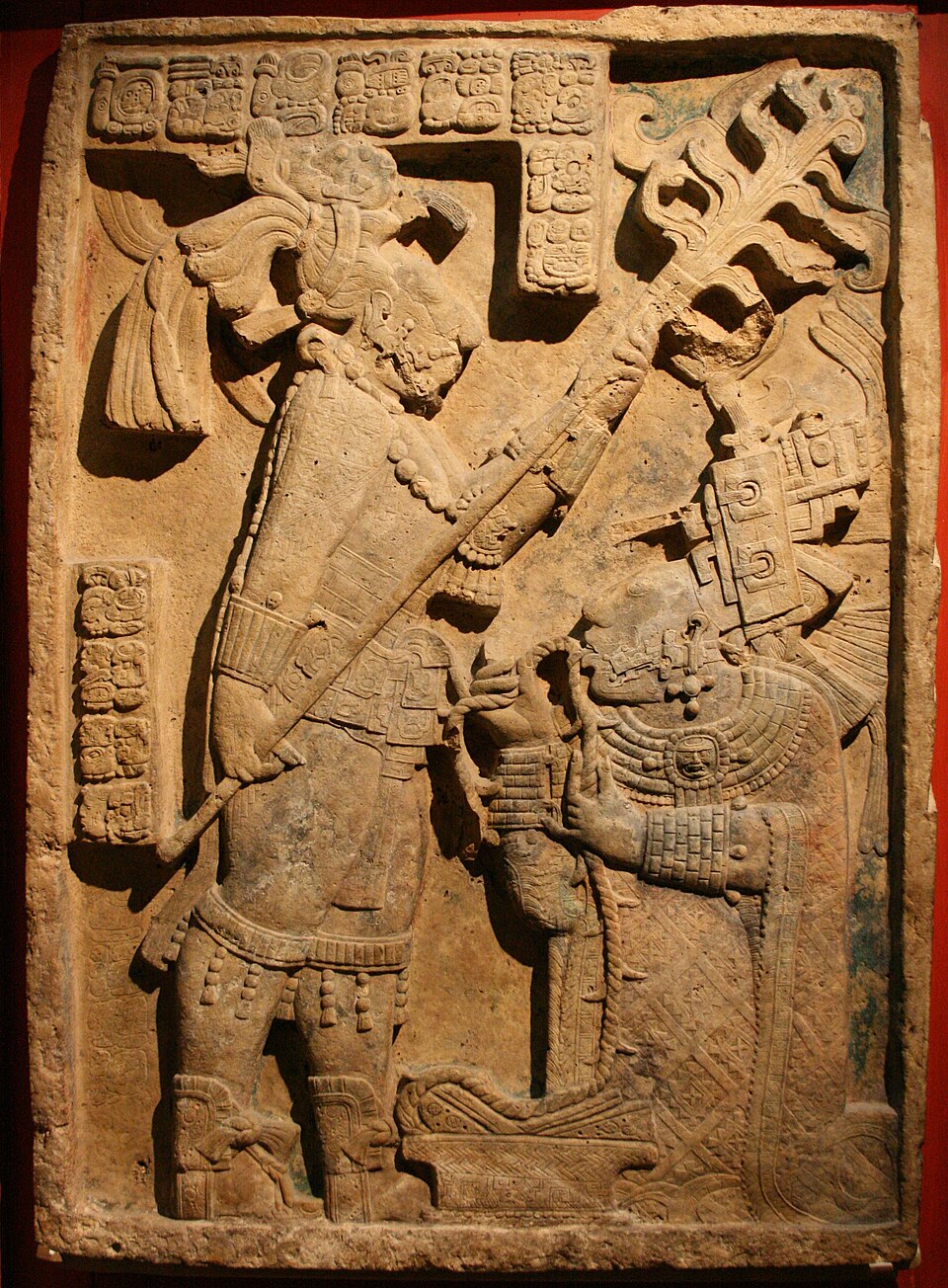
Yaxchilan Lintel 24. Photo: Wikidata. The paragraph identifies royal monument-dedication as Classic Maya ritual practice holding cosmic time in place;…. Source
Connecting the Dots
The mundane expectation is that civilizations separated by oceans and millennia would develop divergent cosmologies — and Aztec, Hindu, and Kabbalistic traditions do differ in their particulars. Yet when the destruction sequences are placed side by side, a structural pattern emerges that resists coincidence. The Hindu Naimittika pralaya unfolds in a fixed elemental order: prolonged drought, intensification into seven suns, world-engulfing fire, then floods from Samvartaka clouds and dispersal by cosmic winds. The Aztec tradition records an analogous rotation of wind, fire, and water destroying four previous Suns. The match is not abstract. Both traditions enumerate a sequential elemental catastrophe moving from drought through fire to flood, with each cosmos terminated by a distinct physical mechanism rather than by moral or narrative causes. [15] [16] [6]
Mathematical architecture provides the second thread. The four Hindu Yugas follow a strict declining ratio of 4:3:2:1, with durations of 1,728,000 : 1,296,000 : 864,000 : 432,000 years [20]. Mesoamerican builders, working in an entirely different calendrical tradition, constructed a Long Count that telescopes upward through base-20 (with one base-18 exception) units into cycles reaching an alautun of 63 million years, with Coba stelae recording dates spanning twenty 13s — more than 28 octillion years. Maya scholars explicitly reject the popular interpretation that the 13-baktun cycle ending December 21, 2012 forecast catastrophe, stating no Classic Maya accounts predict impending doom [21]. Two independent traditions, both encoding cosmic time as nested, mathematically precise, and effectively infinite rather than linear.
Across these traditions, the present creation is repeatedly declared the last. Aztec cosmology holds that the universe requires continuous human blood sacrifice to keep the sun moving against celestial forces that would otherwise extinguish it. Lurianic Kabbalah, arriving at the same structural conclusion through a different path, posits that Shevirat haKelim — the primordial breaking of the vessels — introduced permanent brokenness into creation that demands tikkun, cosmic rectification through human action. Maya royal ritual echoed this through Period-Ending ceremonies at each k’atun close, explicitly aimed at renewing time so the cycle could continue. The Sun Stone physically encodes this conviction: four previous Suns destroyed by elemental cataclysms, the current Fifth Sun surrounded by iconography linking to ritual sacrifice on the 260-day cycle. When the Maya Long Count inscription at Quiriguá Stela C records the creation date 13.0.0.0.0 4 Ajaw 8 Kumk’u and the Sun Stone encodes five cosmic eras within concentric rings, the same conviction appears carved in stone and written in codex: time must be perpetually renewed, or it ends. [17] [6]
The Other Side
The Mesoamerican sources are similarly less cyclical than the comparative framework implies. Summarizing the Maya Popol Vuh and the Aztec Leyenda de los Soles, Mexicolore argues that both Maya and Aztec texts encode terminal closure rather than infinite repetition, with each successive creation being an improvement over the last and the present being positioned as the final one, not another link in an unbounded series. The “2012 Maya apocalypse” reading is rejected by every major Mayanist scholar who has weighed in: David Stuart, Gerardo Aldana, Sandra Noble, and E. Wyllys Andrews V all reject the doomsday interpretation. Stuart reads the Tortuguero Monument 6 reference to 13.0.0.0.0 4 Ahaw 3 Kankin as “a chronological anchor within a larger narrative about a building dedication” rather than as a 2012 prophecy. Aldana challenges the GMT correlation by 50–100 years, which alone is enough to dissolve the date-specific apocalyptic reading. The numerical parallels between Hindu yuga durations (the 432,000-year Kali Yuga, the 4,320,000-year Maha Yuga) and Maya Long Count units remain a post-hoc structural comparison rather than a documented cross-cultural pattern. [22]
The very category of “cyclical world ages” as a comparative-mythology type may itself be an essentializing overlay, traceable in part to Mircea Eliade’s mid-twentieth-century synthesis. Thomas Cahill’s widely cited thesis in The Gifts of the Jews argues that linear time was a radical Jewish-axial innovation departing from the cyclical time of surrounding Mesopotamian cultures, eventually shaping Western civilization through Christianity. If Cahill is correct that ancient world-time was not uniformly cyclical, the comparative-mythology category may be a construct layered onto traditions that internally had mixed cyclic-linear structures. Jain cosmology directly contradicts the predicted pattern: the loka is held to be “an uncreated entity, existing since infinity, having neither beginning nor end,” paired with its own internal Kāl Chakra time cycles rather than a create-destroy-recreate pattern [23]. Not all traditions classified as “Eastern” or “archaic” privilege cyclical cosmology at the level of universe origination.
Within Jewish tradition itself, the Cosmic Shemittot doctrine is contested rather than canonical: Isaac Luria (the Arizal) reportedly rejected it as a misunderstanding, and Moses Cordovero (the Ramak) likewise opposed it. Sefer HaTemunah’s shemitot doctrine represents the position of a specific strand, while Ramban, Rabbeinu Bechaye, and Ibn Ezra held divergent positions on which shemittah we currently inhabit. The mapping of the four previous Aztec Suns onto the four classical elements is itself at least partly a post-conquest European interpretive overlay: the indigenous Nahua categories named specific deities (Tezcatlipoca for the Jaguar Sun, Quetzalcoatl-as-Ehecatl for the Wind Sun, Tlaloc for the Rain of Suns, Chalchiuhtlicue for the Water Sun), and Sahagún’s Florentine Codex was composed by a friar trained in Aristotelian elemental theory. These methodological problems compound: a comparative category imported from Eliade-style phenomenology, applied to traditions that internally encode closure or reversal rather than unbounded repetition, and overlaid onto sources whose elemental framing is colonial. The hypothesis under investigation rests on assumptions that require defense before its structural claims can be evaluated. [8]
What We Actually Know
The case for recurring structural patterns across world-age mythologies rests on solid comparative ground. The most striking finding is that Hesiod’s metallic succession (gold, silver, bronze, iron) and the Hindu Yuga system map onto each other one-to-one: Satya/Krita = Golden, Treta = Silver, Dvapara = Bronze, Kali = Iron, with both encoding progressive decline of human moral value across ages. This is not later syncretic borrowing — the systems developed independently — but a shared structural schema of temporal decline that emerged in two distant civilizations. The Aztec Five Suns add a third independent system, with four prior world-ages ending through elementally-distinct catastrophes (jaguars, hurricanes, volcanic fire-rain, flood) arranged in a rotation that also maps the four cardinal directions onto the four classical elements. [3] [4] [24] [25] [26] [27] [2]
The documented record supports the broad cyclical framework across multiple traditions. The Aztec/Nahua Five Suns doctrine describes five successive creation-destruction cycles with the present age being the Fifth Sun (Nahui Ollin), prophesied to end in earthquakes. The Sun Stone physically encodes this cosmology in concentric rings. The Maya Long Count tracked a 5,126-year cycle from a recorded creation date of August 11, 3114 BCE. The Kabbalistic Cosmic Shemittot tradition describes a 7,000-year cycle (6,000 years + 1,000-year rest) based in Second Enoch, Talmud Sanhedrin 97a-b, and the Sefer HaTemunah, explicitly implying prior world-cycles. The Hindu system is mathematically the most elaborate, with a strict 4:3:2:1 ratio of yuga durations (1,728,000 : 1,296,000 : 864,000 : 432,000 years) inside a 4,320,000-year Maha Yuga, and a separate pralaya at the end of each kalpa dissolving and re-creating the universe. Hesiod’s Works and Days structures Greek history as five races in declension from Golden Age to Iron Age toil, with each metal decreasing in worth while increasing in hardness. The New Fire ceremony refreshed the 52-year xiuhmolpilli cycle by extinguishing and rekindling all fires, and the Fifth Sun was inaugurated through divine self-sacrifice at Teotihuacan, with the Nahuatl term nextlaoaliztli (“the act of paying a debt”) framing reciprocal obligation between gods and humans. [6] [14] [8] [13] [28]
Several patterns recur with medium-strength evidence. A flood-fire alternation has been traced from ancient Babylonia and Iran through Pythagorean and Stoic philosophy into the medieval world. The Naimittika pralaya’s sequential pattern (prolonged drought → seven suns → world-engulfing fire → Samvartaka flood → cosmic winds) parallels the Aztec elemental rotation. Survivors across multiple world-destruction myths repeatedly serve as culture-bearers transmitting knowledge, agriculture, or cosmic order to the new age (Quetzalcoatl, Oannes, Viracocha in Mesoamerican and Near Eastern traditions; Manu and the Saptarishi in Hindu tradition). The Maya Long Count and the 819-day cycle are described as structurally analogous calendrical systems built on cycles of the Sun, Venus, Jupiter, and Saturn. The presiding deity for each prior Aztec Sun, the zoomorphic survivor transformations (humans into monkeys, turkeys, fish), and the destruction-as-metamorphosis motif (not simple annihilation) are documented in Codex Chimalpopoca and Codex Vaticanus A. Maya creation at Quiriguá (Stela C, AD 775) describes the “planting of three stones” by Jaguar Paddler, Stingray Spine Paddler, and Itzamna, marking the establishment of the present world, and the Aztecs/Mexica regarded themselves as one of seven tribes emerging from Chicomoztoc after a global catastrophe. The Cross Group temples at Palenque were dedicated on January 8, 692, integrating dynastic history with primordial mythology, and the Hindu Varaha myth embodies the dissolution-and-restoration cycle with Vishnu retrieving Bhumi from primordial waters. [29]
The cyclical-versus-linear framing itself sits in contested territory. Colonial-era Nahuatl sources state the present creation “is the LAST” with no successor cycle, while Maya Books of Chilam Balam describe “the cyclical nature of all things,” and the New Fire ceremony was reset to zero after each cycle, with the Long Count architecture extending into trillions of years. Thomas Rosenmeyer argues that Hesiod “was neither reliant on a fixed scheme” and that the future for him was not predetermined, supporting a non-deterministic declensionary theodicy rather than strict cyclical recurrence. The Heroic Age insertion, unique to Hesiod, complicates any strict linear reading of his schema. The Hindu-Maya numerical parallelism (432,000; 4,320,000) was flagged but the underlying mathematical architectures differ (Maya base-20 with base-18 modification; Hindu decimal multiples organized by 4:3:2:1 ratio), with no shared ceramic technology, trade-good evidence, or documented transmission route connecting Indus/Gangetic civilizations with Classic Maya civilization. The claim that every tradition includes inbuilt cyclical renewal overgeneralizes from traditions that do feature it (Hindu, Kabbalistic Cosmic Shemittot) to traditions that explicitly deny successor cycles for the current age. A modern catastrophist attempt to correlate four Hindu yugas with five hypothesized Earth crustal displacement events over 130,000 years remains fringe, and Susan Milbrath’s reading of the Sun Stone’s central image as a dying Tonatiuh during an eclipse is one specialist’s interpretation rather than consensus. [30]
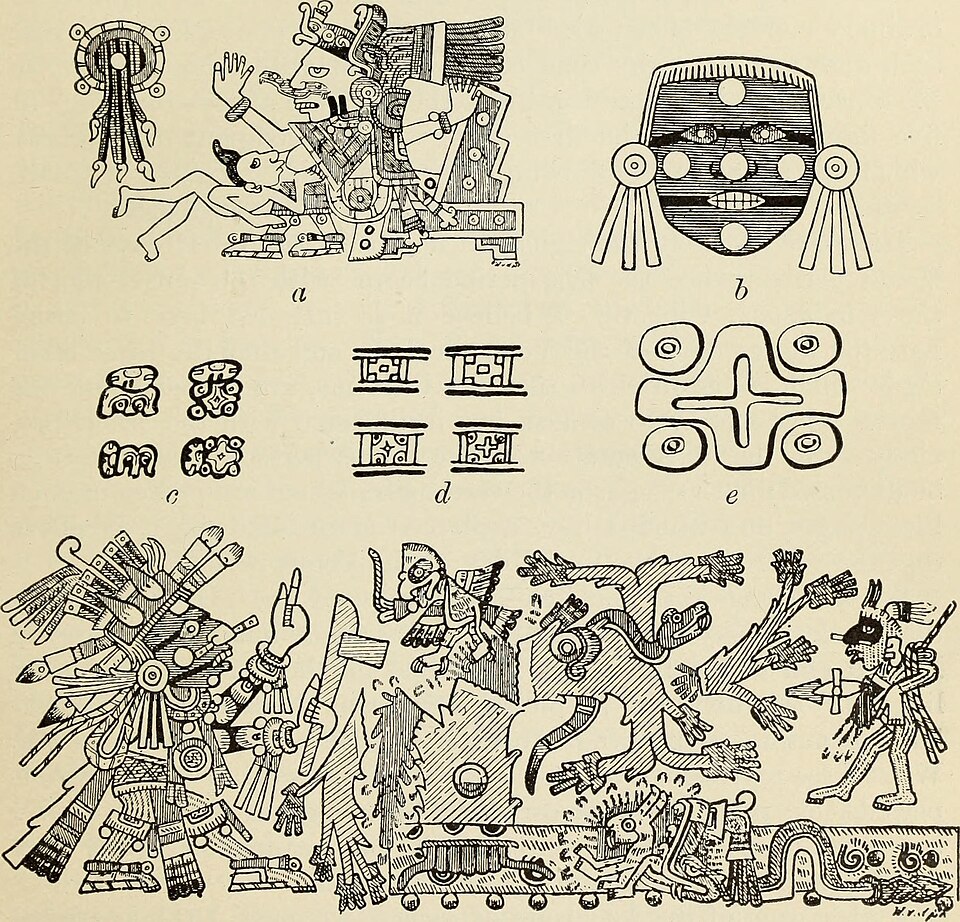
Mexican and Central American antiquities, calendar systems, and history; (1904). Photo: Internet Archive Book Images / Wikimedia Commons. The paragraph cites Cosmic Shemittot as a tradition that explicitly features inbuilt cyclical renewal; a…. Source

Mexico City, Museo Nacional de Antropologia, Stone of the Sun. Photo: Arian Zwegers from Brussels, Belgium / Wikimedia Commons. The paragraph notes Milbrath’s contested reading of the central image as a dying Tonatiuh during…. Source
References
[1] The Shaman and The Philosopher. Ep.26 [68:18-70:39] — Institute for Natural Philosophy (YouTube) — https://youtu.be/5gsu2uIEEW8?t=4098 (accessed 2026-07-20)
[2] 4 Yugas: Satya Yuga, Treta Yuga, Dwapara Yuga, Kali Yuga — https://www.rudraksha-ratna.com/articles/the-four-yugas?srsltid=AfmBOopG4V6OgI3F-HHhxGUIifiDVr9wNS8NY7HQ8gNFuZJOBjRrOR6s (accessed 2026-07-20)
[3] HESIOD, WORKS AND DAYS - Theoi Classical Texts Library — https://www.theoi.com/Text/HesiodWorksDays.html (accessed 2026-07-20)
[4] Ages of Man — https://en.wikipedia.org/wiki/Ages_of_Man (accessed 2026-07-20) [Reputable]
[5] The Five Ages of Man According to Hesiod’s Works and … — https://faculty.washington.edu/alain/Clas430/AgesofMan.htm (accessed 2026-07-20) [Academic]
[6] Five Suns — https://en.wikipedia.org/wiki/Five_Suns (accessed 2026-07-20) [Reputable]
[7] Aztec Creation Myth (full version) - Gybmith — https://www.bigmyth.com/myths/english/2_aztec_full.htm (accessed 2026-07-20)
[8] Legend of the Fifth Sun (Mesoamerican myth) — https://www.ebsco.com/research-starters/religion-and-philosophy/legend-fifth-sun-mesoamerican-myth (accessed 2026-07-20)
[9] The Five Suns: the End of the World as We Know It. — https://mythcrafts.com/2019/03/12/the-five-suns-the-end-of-the-world-as-we-know-it/ (accessed 2026-07-20)
[10] From the Matsya Purana (“The Yuga Cycle”) — https://open.maricopa.edu/worldmythologyvolume1godsandcreation/chapter/from-the-matsya-purana/ (accessed 2026-07-20) [Academic]
[11] Creation Story of the Maya | Living Maya Time — https://maya.nmai.si.edu/the-maya/creation-story-maya (accessed 2026-07-20) [Academic]
[12] Hesiod & The Five Ages of Mankind - EverythingLatin — https://everythinglatin.co.uk/2025/08/09/hesiod-the-five-ages-of-mankind/ (accessed 2026-07-20)
[13] The Lords of the Fifth Sun — https://popular-archaeology.com/article/the-lords-of-the-fifth-sun/ (accessed 2026-07-20)
[14] RESOURCE: Maya and Aztec creation cycles compared — https://www.mexicolore.co.uk/maya/teachers/maya-and-aztec-creation-myths (accessed 2026-07-20)
[15] From where does the water come at the end of Kalpa? — https://hinduism.stackexchange.com/questions/9322/from-where-does-the-water-come-at-the-end-of-kalpa (accessed 2026-07-20)
[16] Pralaya — https://grokipedia.com/page/Pralaya (accessed 2026-07-20)
[17] Quiriguá | Living Maya Time - Smithsonian Institution — https://maya.nmai.si.edu/gallery/quirigua (accessed 2026-07-20) [Academic]
[18] Monument 6 at Tortuguero and the Maya Predictions about … — https://www.academia.edu/2295372/Monument_6_at_Tortuguero_and_the_Maya_Predictions_about_December_21st_2012 (accessed 2026-07-20) [Academic]
[19] Where has it said in the authentic scriptures, that a year … — https://hinduism.stackexchange.com/questions/48960/where-has-it-said-in-the-authentic-scriptures-that-a-year-in-the-yuga-schematic (accessed 2026-07-20)
[20] Indian Macro-Time Intervals (“Yugas, Sandhyās” and “Kalpas”) as … — https://www.jstor.org/stable/43496652 (accessed 2026-07-20) [Academic]
[21] 2012 phenomenon — https://en.wikipedia.org/wiki/2012_phenomenon (accessed 2026-07-20) [Reputable]
[22] More on Tortuguero’s Monument 6 and the Prophecy that … — https://mayadecipherment.com/2011/10/04/more-on-tortugueros-monument-6-and-the-prophecy-that-wasnt/ (accessed 2026-07-20)
[23] Jain Cosmology — https://www.herenow4u.net/index.php?id=83337 (accessed 2026-07-20)
[24] Satya Yuga — https://en.wikipedia.org/wiki/Satya_Yuga (accessed 2026-07-20) [Reputable]
[25] Treta Yuga — https://en.wikipedia.org/wiki/Treta_Yuga (accessed 2026-07-20) [Reputable]
[26] Dvapara Yuga — https://en.wikipedia.org/wiki/Dvapara_Yuga (accessed 2026-07-20) [Reputable]
[27] Kali Yuga — https://en.wikipedia.org/wiki/Kali_Yuga (accessed 2026-07-20) [Reputable]
[28] The Legend of the Fifth Sun — https://www.thoughtco.com/aztec-creation-myth-169337 (accessed 2026-07-20)
[29] Dragons Weren’t Mythical, They Were Catastrophic | Randall Carlson at Cosmic Summit 2024 [9:23-11:17] — The Randall Carlson (YouTube) — https://youtu.be/09uVPTfXKZU?t=563 (accessed 2026-07-20)
[30] (PDF) Yugas, Climate Cycles, and World Ages — https://www.researchgate.net/publication/393219439_Yugas_Climate_Cycles_and_World_Ages (accessed 2026-07-20)
Keep exploring
Every site on this page sits on the globe, and the people who research them are on the Discord.
3D Globe · Sites by country · Story Archive · Research Library · Weekly Journal · Search