

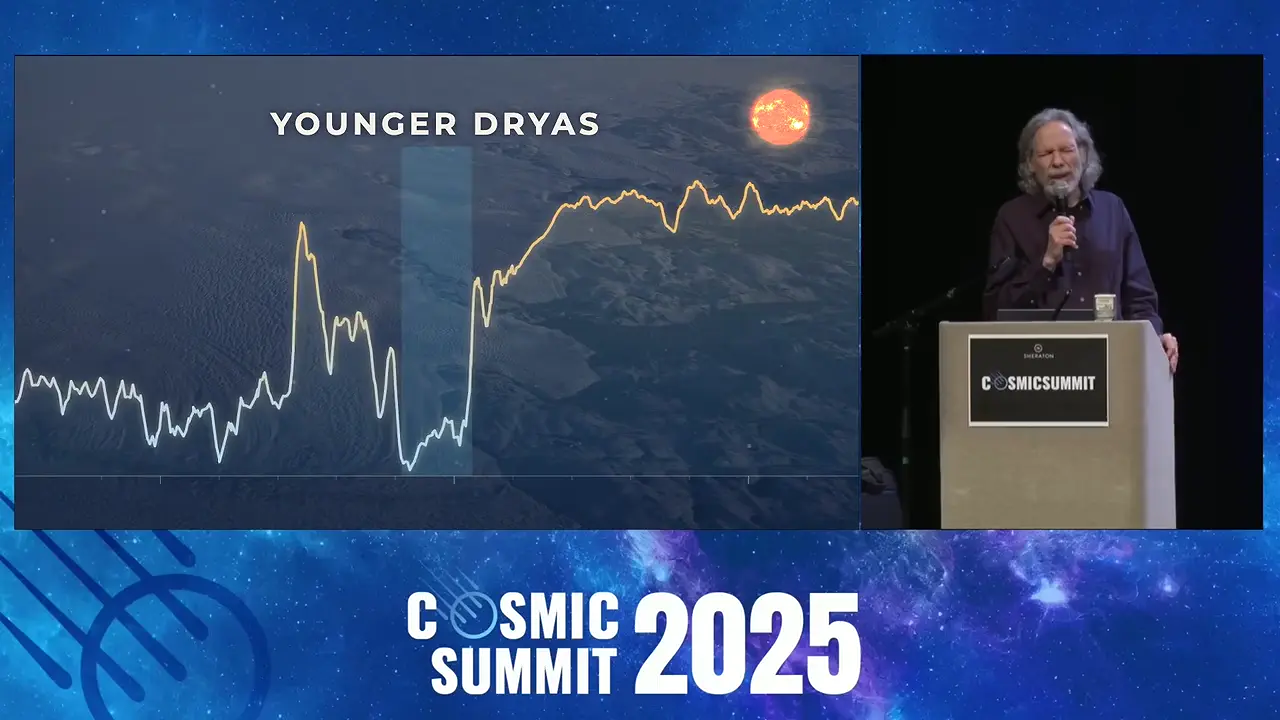
Schoch dates the Younger Dryas cold snap to about 10,900–9,700 BC using standard geological methods, and cites a 2008 Greenland ice-core paper suggesting the Ice Age could have ended in just 3–5 years, or even a fraction of a year within two weeks. His proposed mechanism: a solar plasma outburst injecting moisture, torrential rain, and a signature of vitrification — rock or sand melted and re-congealed as natural glass. Libyan Desert Glass blankets roughly 2,500 sq km of Egypt's Libyan Desert, and the Inventory Stela (Giza plateau, now Cairo Museum) reportedly says the Sphinx was struck by a thunderbolt that Khufu came to see. Schoch reads the Sphinx as plasma-hit before Khufu's reign, citing a filled fissure in the enclosure wall, ancient mud brick remnants, and 'rotten' vitrified rock under the enclosure floor. Treat as a bold hypothesis, not settled fact. ⚡
Younger Dryas solar-outburst hypothesis: vitrification, desert glass and the Sphinx stela
 EgyptTheory
Key facts
- Schoch dates the Younger Dryas cold snap at about 10,900 to 9,700 BC using standard geological dating, noting other dates run a century or two off.
- A 2008 paper based on Greenland ice cores is cited as arguing the Ice Age ended within a very short span, possibly three to five years or even a fraction of a year within a two-week window.
- The video's hypothesis is that a major solar plasma outburst ended the Ice Age by injecting moisture into the atmosphere, producing torrential rain, and that the sign to look for is vitrification, where rock or sand melted and re-congealed as natural glass.
- Libyan Desert Glass is described as covering approximately 2,500 square kilometres of Egypt's Libyan Desert.
- The Inventory Stela, found on the Giza plateau and now in the Cairo Museum, is cited as stating that the Great Sphinx was struck by a thunderbolt and that Khufu came to see the Sphinx and the thunderbolt.
- The video interprets the Sphinx as having been hit by plasma before Khufu's reign, and points to a gash fissure in the enclosure wall that was later filled in with cement, plus remnants of ancient mud bricks on the Sphinx body.
- Schoch describes megalithic blocks beneath the enclosure floor at the Sphinx, calling the rock beneath them 'rotten' but interpreting it as vitrified, sacred stone, and notes a carved curvature cut into a megalith for protection.
- A solar isotope-activity record is presented as showing erratic solar behaviour for thousands of years after the Ice Age, settling down as civilization re-emerged around 3,500 BC.
Sources
Younger Dryasen.wikipedia.org
The Younger Dryas … was the final climatic phase of the Last Glacial Period that occurred from around 12,900 to 11,700 c. 10,900 – c. 9,700 BC). [3] It is ...
Younger Dryas | Definition, Causes, & Terminationbritannica.com
The Younger Dryas was a cool period that interrupted the warming trend at the end of the Pleistocene Epoch, roughly 12,900 to 11,600 years ago.
Two examples of abrupt climate changeocp.ldeo.columbia.edu
An event that occurred about 12,800 years before present (BP), termed the Younger Dryas (YD), is the canonical example of abrupt climate change.
The Younger Dryasncei.noaa.gov
This near-glacial period is called the Younger Dryas, named after a flower (Dryas octopetala) that grows in cold conditions and that became common in Europe ...
Cataclysms of Antiquity - by Nick Collinsnickcollins1953.substack.com
The Younger Dryas (c. 10,900–9,700 BC), a significant climatic reversal at the end of the Ice Age, has been posited by Graham Hancock as a ...
Was this story useful?
Keep exploring
Every site on this page sits on the globe, and the people who research them are on the Discord.
3D Globe · Sites by country · Story Archive · Research Library · Weekly Journal · Search
AI-generated text · images from the original sources · always verify with the sources.