

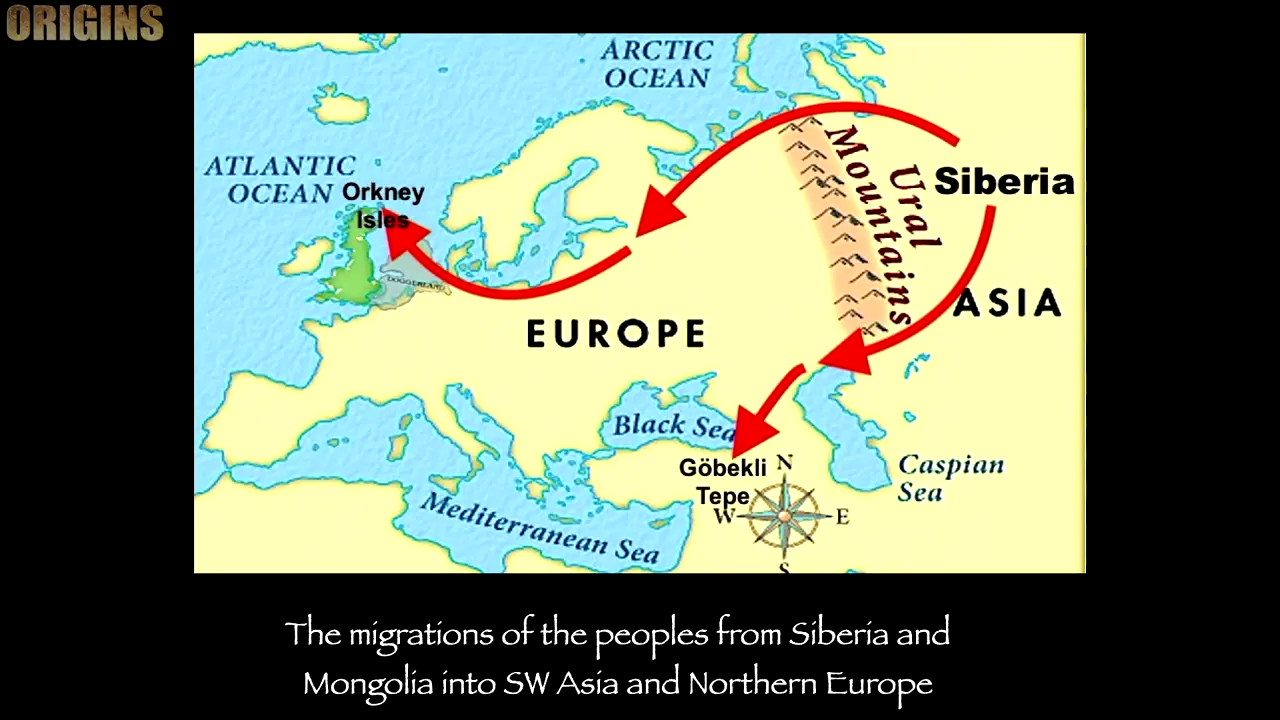
Denisova Cave in southern Siberia yielded Denisovan DNA and associated artefacts, including a tooth pendant, portable art and some of the oldest bone needles. Collins argues that a Denisovan-related stone-tool tradition reached southwest Asia and was used by the builders of Göbekli Tepe. He interprets a notched bone object dated to at least 45,000 years ago as a possible solar or lunar record, and cites 2022 research and Anatolian cave evidence for a Siberian contribution to Göbekli Tepe. His proposed routes run around the Caspian into Anatolia and north of the Urals toward Europe, with a possible onward route to Britain through Doggerland. Collins also argues that Orkney's Grooved Ware people moved south and influenced older sacred sites and the Stonehenge landscape. These migration and cultural links are the video presenter's interpretations, not established archaeological conclusions. 🧬
Video presenter proposes Denisovan Siberian links to Tas Tepeler and Orkney's Grooved Ware
Key facts
- Denisova Cave in Russia's Altai Republic has yielded Denisovan DNA and associated layers containing a tooth pendant, portable art and bone tools, including very early needles. Not every artefact can be attributed directly to Denisovans.
- A notched bone object from Denisova Cave, dated to at least 45,000 years ago, has been proposed as a possible record of solar or lunar movements; that interpretation is not established.
- Collins cites a 2022 report and evidence from an Anatolian cave to argue that Siberian migration contributed to Göbekli Tepe and that seasonal Siberian movements occurred before the Younger Dryas.
- Collins proposes routes south of the Urals and around the Caspian into Anatolia, and north across the Urals toward northern Europe. He also proposes a route to Britain through Doggerland and cites Graham Phillips's writing on Britain's megalithic landscape.
- Grooved Ware in Orkney is dated roughly to 3100–2400 BC, with some use continuing to around 2200 BC. The claimed southward migration, occupation of older sacred sites and links with Stonehenge and Scotland's central lowlands are the presenter's interpretations.
- The proposed Denisovan connection to Tas Tepeler and the claimed primacy of eastern elements there are likewise the video presenter's interpretations.
Sources
andrewcollins.com
Linked in video description
megalithomania.co.uk
Linked in video description
(PDF) Unshaped Bone Tools from Denisova Cave, Altaiacademia.edu
Denisova Cave reveals unshaped bone tools, indicating a developed industry in the Upper Paleolithic. Study analyzes 51 selected specimens from over 10,000 bone ...
The earliest Denisovans and their cultural adaptation - PMCpmc.ncbi.nlm.nih.gov
by S Brown · 2021 · Cited by 87 — Non-diagnostic bone fragments, an important untapped source of potential human fossils, represent 95% of the bones excavated at Denisova Cave. We applied ZooMS ...
Denisova Caveen.wikipedia.org
In 2010, a toe bone was discovered in the cave, in layer 11.4 of the East Gallery, and therefore contemporary with the Denisovan finger bone. Preliminary ...
New Studies Reveal the History of Denisova Caveleakeyfoundation.org
In 2010, the genetic analysis of a fragment of pinky finger bone prompted the identification and naming of the Denisovans, a sister group to ...
Tag: Denisova Cave - Earth-logsearthlogs.org
Elk-tooth pendant found at Denisova cave, before cleaning and DNA extraction (top) and after the 'washing' procedure (bottom). Credit: Essel et al., Fig 1.
Was this story useful?
Keep exploring
Every site on this page sits on the globe, and the people who research them are on the Discord.
3D Globe · Sites by country · Story Archive · Research Library · Weekly Journal · Search
AI-generated text · images from the original sources · always verify with the sources.