

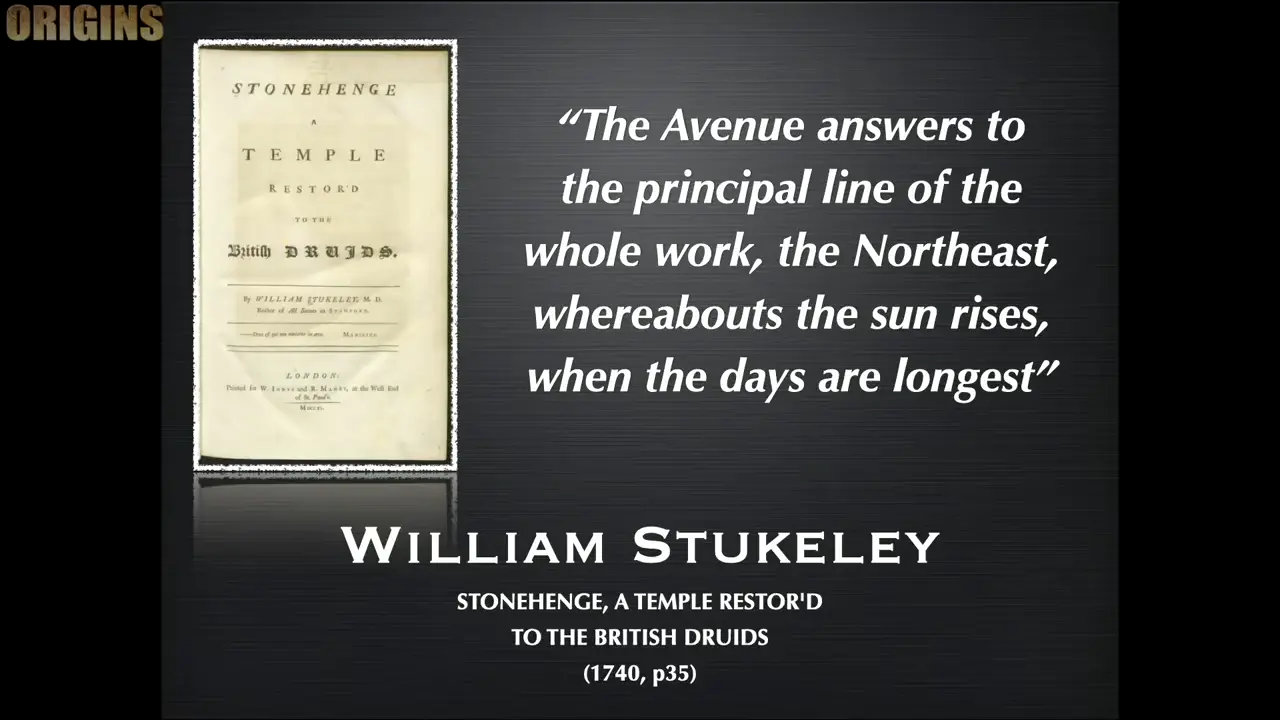
Stonehenge’s main solar axis follows the Avenue, linking the summer-solstice sunrise with the southwest winter-solstice sunset. A video argues that the Heel Stone sits east of that centre line and that Earth’s slightly greater axial tilt 4,500 years ago placed the solstice sun to its left, casting the Heel Stone’s shadow through the entrance toward the Altar Stone. It also credits William Stukeley with identifying the alignment before John Smith claimed priority. Excavations and modern observations support the broad solstice axis; the detailed Heel Stone shadow reconstruction and historical priority claim are the video’s interpretation.
Video argues Stonehenge’s 4,500-year-old solstice axis follows the Avenue
 EnglandArchaeoastronomy
Site mentioned
Key facts
- William Stukeley—not “Stoley”—is credited by the video with identifying the alignment before John Smith. Stukeley’s Description of Stonehenge was published in 1747.
- The video says John Smith later claimed priority for the Heel Stone and solstice-alignment discovery.
- Excavations support the broad summer-solstice sunrise and winter-solstice sunset axis along the Avenue, while modern observations support the southwest winter-solstice sunset alignment.
- The video argues that the Heel Stone lies east of the Avenue’s centre line and does not define the primary axis.
- Earth’s obliquity was about 24° 4,500 years ago and about 23.44° today, changing the sunrise azimuth at Stonehenge by roughly 1°.
- The claim that the earlier solstice sun rose left of the Heel Stone and that its shadow ran through the entrance toward the Altar Stone is the video’s geometric reconstruction, not a verified archaeological finding. The supplied source places the Altar Stone about 80° to the main axis.
Sources
stonesofstonehenge.org.uk
Linked in video description
Stonehenge Avenuetwentytrees.co.uk
It is neither straight or level. It descends from Stonehenge oriented to the angle of the Midsummer sunrise then turns towards the east continuing upslope after ...
Stonehenge World Heritage Property, United Kingdomweb.astronomicalheritage.net
Part of the Stonehenge Avenue (c. 2,300 BC) itself is aligned along the main 'solstitial axis' of Stonehenge (Fig. 3), and this part is still visible as an ...
Stonehenge was built on solstice axis, dig confirmstheguardian.com
Stonehenge was built along an ice age landform that happened to be on the solstice axis. The Avenue was an earthwork route that extended 1.5 ...
The Secondary Solstice Axis at Stonehengejournal.equinoxpub.com
Observations carried out in July 2025 confirm that the suggested sightline is closely aligned to the winter solstice sunrise at the time ...
Stonehenge's Avenue and 'Bluestonehenge'pure.uhi.ac.uk
by MJ Allen · 2016 · Cited by 38 — Their alignment on Stonehenge's solstitial axis (midwinter sunset-midsummer sunrise) raises questions about the early origins of this ritual ...
Stonehenge, A Temple Restor'd to the British Druidsbooks.google.com
Title, Stonehenge, A Temple Restor'd to the British Druids: in large print ; Author, William Stukeley ; Publisher, BoD – Books on Demand, 2025.
Stukeley Studies Stonehenge and Avebury | Historyebsco.com
William Stukeley was a pioneering figure in the study of two of England's most famous prehistoric sites, Stonehenge and Avebury.
Was this story useful?
Keep exploring
Every site on this page sits on the globe, and the people who research them are on the Discord.
3D Globe · Sites by country · Story Archive · Research Library · Weekly Journal · Search
AI-generated text · images from the original sources · always verify with the sources.