

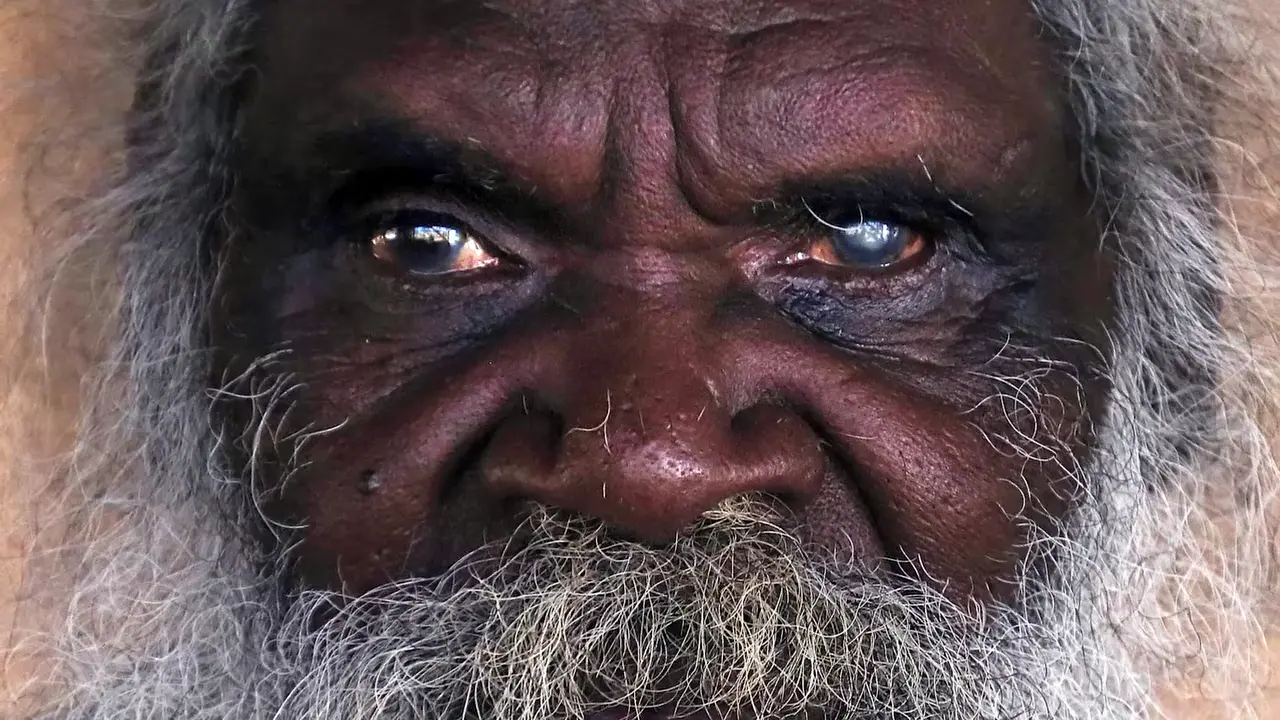
The video argues that many blue-eyed Aboriginal Australians reflect European admixture after 1788 rather than a shared out-of-Africa blue-eye allele. Genomic data link the common HERC2 blue-eye-associated allele with European ancestry, while Aboriginal and Papuan ancestors diverged from European and Asian lineages by at least 51,000 years ago. Recessive HERC2 and OCA2 variants can remain unexpressed for generations, and Waardenburg syndrome can independently cause blue eyes. The commonly cited 6,000–10,000-year date applies to the European-associated HERC2 allele, not every cause of blue eyes. Claims based on UV exposure or pre-farming diets are unsupported.
Video argues admixture explains many Aboriginal blue-eye cases
Key facts
- A whole-genome study found that the blue-eye-associated HERC2 allele in sampled Aboriginal Australians tracked with European ancestry, consistent with colonial-era admixture; it does not establish that every Aboriginal person with blue eyes has European ancestry.
- Recessive HERC2 and OCA2 alleles can be carried without a blue-eyed phenotype. Waardenburg syndrome is an independent cause of blue or heterochromic eyes in some Aboriginal Australians.
- Aboriginal Australian and Papuan ancestors had split from European and Asian lineages by at least 51,000 years ago. This supports the absence of a demonstrably shared recent European origin but does not diagnose the cause of an individual's eye colour.
- The often-cited 6,000–10,000-year estimate concerns the common European-associated HERC2 allele, not every genetic route to blue eyes.
- The claim that intense UV exposure and a lack of farming diets explain the genetics of Aboriginal blue eyes is unsupported.
Sources
A global view of the OCA2-HERC2 region and pigmentation - PMCpmc.ncbi.nlm.nih.gov
Blue eye color in human may be caused by a perfectly associated founder mutation in a regulatory element located within the HERC2 gene inhibiting OCA2 ...
Behind Blue Eyes: A Look at the Genetic and Cultural Components ...cpp-college.netlify.app
Blue eye color in humans may be caused by a perfectly associated founder mutation in a regulatory element located within the HERC2 gene ...
Fact 8: Inheritance - Genome BCgenomebc.ca
What is most amazing is that this one specific mutation in HERC2 is present in all people with blue eyes (with the exception of those with blue eyes as a result ...
Blue-eyed humans have a single, common ancestor | ScienceDailysciencedaily.com
Everyone with blue eyes inherited a tiny genetic "switch" that dilutes brown pigment in the iris. This mutation, found in all blue-eyed people, ...
Aborigines and Melanesians: Naturally Blonde Hair and Dark ...1blessednatural.com
Melanesians have dark skin, blue eyes, and blonde hair. The blonde hair in Melanesians are linked to the gene TYRP1. Others say it is due to a ...
Whole-Genome Genetic Diversity in a Sample of Australians ...pmc.ncbi.nlm.nih.gov
by BP McEvoy · 2010 · Cited by 120 — blue-eye-associated allele of the. The Australian component ranged from 28% to 100% with an average of 64%
The genetic history of Aboriginal Australians and Papuanssanger.ac.uk
The DNA sequences showed that the ancestors of Aboriginal Australians and Papuans had then split from Europeans and Asians by at least 51,000 ...
The genetics of the Australian aboriginesscilit.com
Study of the various crosses leads to the conclusion that a single main gene for melanin in the skin is present in the aborigines, together with a minor gene ...
Was this story useful?
Keep exploring
Every site on this page sits on the globe, and the people who research them are on the Discord.
3D Globe · Sites by country · Story Archive · Research Library · Weekly Journal · Search
AI-generated text · images from the original sources · always verify with the sources.