

European blue eyes trace to a single regulatory mutation in the HERC2 gene (RS12913832) that emerged earlier than 10,000 years ago, likely in West Eurasia. This variant spread through founder effects, farming expansions, and steppe migrations. Nearly all blue-eyed Europeans carry this one ancestral mutation. 👁️
European blue eye gene emerged 8,000-12,000 years ago in West Eurasia
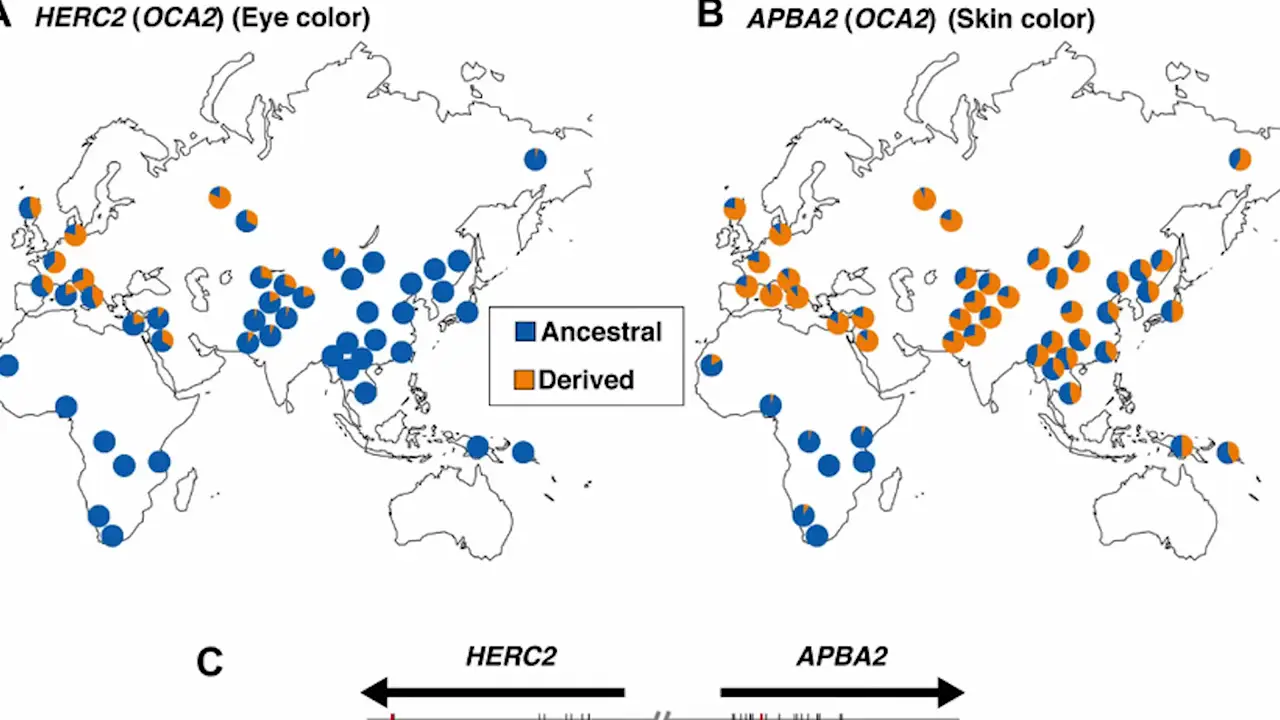
Key facts
- European blue eye variant is tied to a regulatory mutation in the HERC2 gene (RS12913832)
- This mutation reduces melanin production in the iris, allowing light scattering perceived as blue
- The variant emerged around 8,000 to 12,000 years ago in West Eurasia (Eastern Europe or Pontic Caspian region)
- Spread was due to founder effect, Neolithic farmer expansions, steppe groups, and sexual selection
- Nearly all blue-eyed Europeans today trace back to this single ancestral mutation
- The gene also spread to Near East, Caucasus, Central Asia, and parts of South Asia through migration
Sources
Further insight into the global variability of the OCA2-HERC2 locus ...nature.com
The rs12913832 C-derived allele is highly associated with European blue eye color as a recessive trait. The ability of this conserved element to ...
Blue eye color in humans may be caused by a perfectly associated ...researchgate.net
Blue eye color in humans may be caused by a perfectly associated founder mutation in a regulatory element located within the HERC2 gene inhibiting OCA2 ...
Everyone with blue eyes is related - BODY WORLDS Amsterdambodyworlds.nl
Once upon a time everyone had brown eyes but around 10,000 years ago a genetic mutation gave someone in Europe blue eyes. Now there are about 150 million people ...
A Single SNP in an Evolutionary Conserved Region within Intron 86 ...pmc.ncbi.nlm.nih.gov
We screened an additional 92 SNPs in 300–3000 European individuals and found that a single SNP in intron 86 of HERC2, rs12913832, predicted eye color ...
Blue-eyed humans have a single, common ancestor | ScienceDailysciencedaily.com
New research shows that people with blue eyes have a single, common ancestor. A team at the University of Copenhagen have tracked down a genetic mutation.
Was this story useful?
Keep exploring
Every site on this page sits on the globe, and the people who research them are on the Discord.
3D Globe · Sites by country · Story Archive · Research Library · Weekly Journal · Search
AI-generated text · images from the original sources · always verify with the sources.