

The Venus of Laussel, a limestone bas-relief from abri de Laussel - site de fouilles préhistoriques, France, estimated to be 20,000-25,000 years old, depicts a nude woman with exaggerated reproductive features holding a horn. The horn is often thought to represent the crescent moon, though the claim of exactly 13 marks carved into it—frequently cited to match lunar or menstrual cycles—remains a subject of scholarly debate, with some researchers noting this interpretation may be overstated.
Venus of Laussel: 13 Marks Connect Moon to Reproduction
 FranceTheory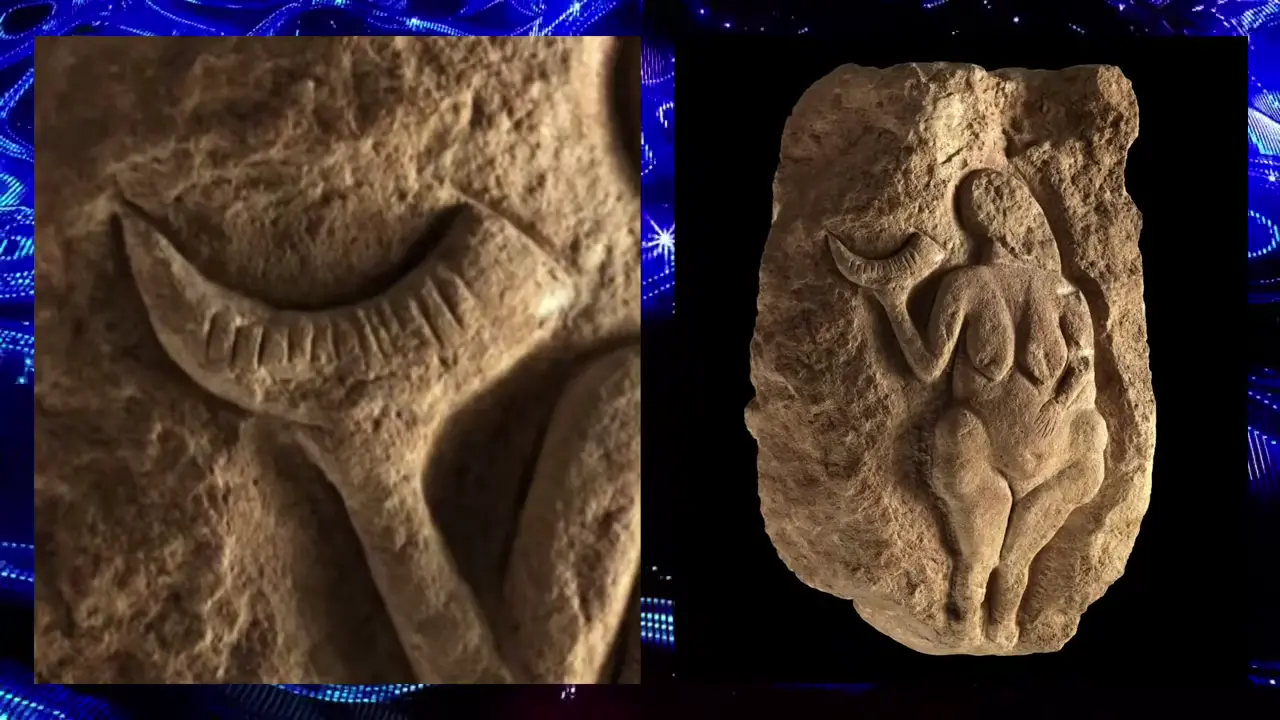
Key facts
- Venus figurine from abri de Laussel - site de fouilles préhistoriques, France
- Depicts woman with exaggerated reproductive features
- Holds a horn with 13 marks carved into it
- Horn represents crescent moon, notches represent menstrual cycles
- 13 marks correspond to menstrual cycles per year or lunations
- Menstrual cycle and lunar cycle are the same period of time
- Many hunter-gatherer cultures believed moon influences pregnancy
- Ancient peoples may have used moon to time and manage pregnancies
Site mentioned
Sources
Laussel Venus: Upper Paleolithic Goddess with a Horn - ThoughtCothoughtco.com
The Venus of Laussel is a 20,000-year-old carving of a woman holding a horn. The horn held by the Venus may represent a moon, cornucopia, or a ...
The Venus of Laussel - La Femme a la Corne - Don's Mapsdonsmaps.com
The Venus of Laussel is a limestone bas-relief of a nude female figure, 46 cm high, painted with red ochre. It was carved into a large block of fallen ...
Venus of Laussel - Wikipediaen.wikipedia.org
The Venus of Laussel is an 18.11-inch-high (46.0-centimetre) limestone bas-relief of a nude woman. It is painted with red ochre and was carved into the ...
Laussel Woman - Holding a Bison Horn - Bradshaw Foundationbradshawfoundation.com
The woman holding a bison horn is pregnant and the shape of her waist and hips suggest that she had already had children.
VENUS of Laussel - Womenbodimentwomenbodiment.com
Depiction · she holds a crescent horn in her right hand, possibly a bison horn, or a cornucopia · it has 13 notches, according to some researchers ...
Was this story useful?
Keep exploring
Every site on this page sits on the globe, and the people who research them are on the Discord.
3D Globe · Sites by country · Story Archive · Research Library · Weekly Journal · Search
AI-generated text · images from the original sources · always verify with the sources.