

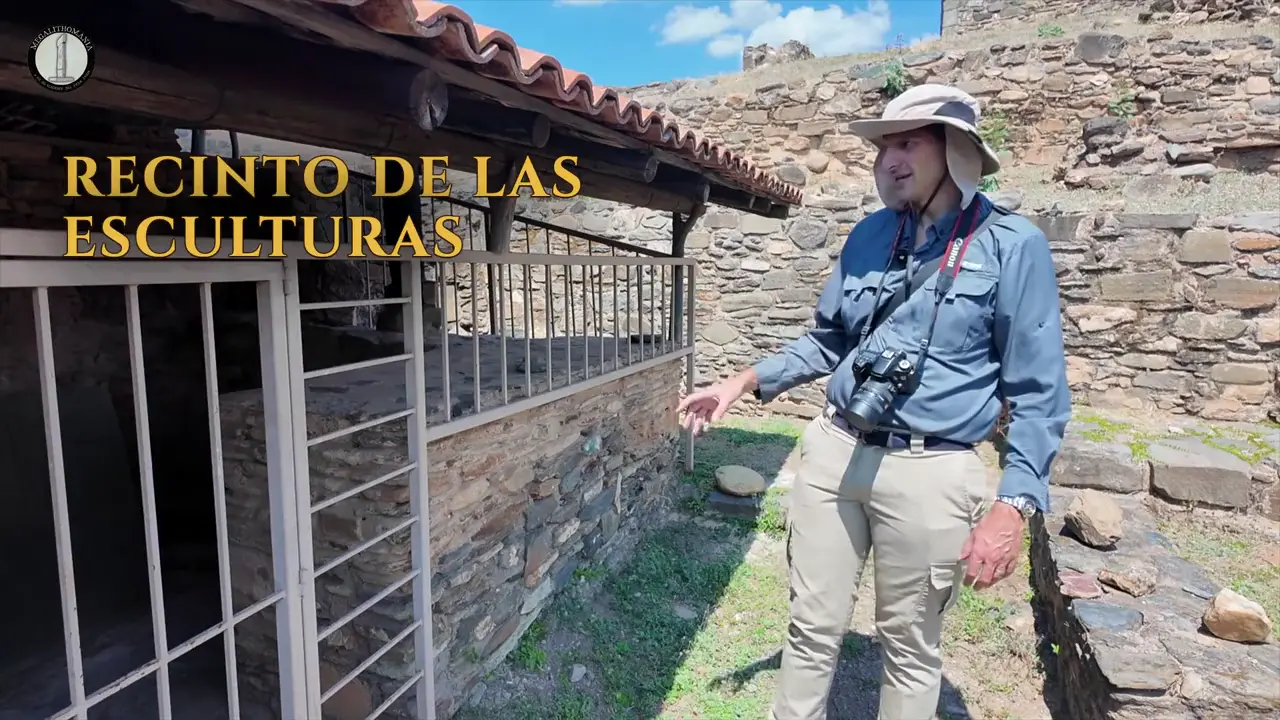
At the Recinto de las Esculturas area of the San Miguel Ixtapan pyramid, Mexico State, excavators found two monumental slabs at the base of 52 stucco false floors carbon dated to about 700 AD. Both were already weathered and patched with stucco when sealed — so they predate the colonial era. 🪨
Two monolithic slabs sealed in a 700 AD chamber at San Miguel Ixtapan
 MexicoExcavationSignificant Find
Site mentioned
Key facts
- The Recinto de las Esculturas area is one of the most recently uncovered parts of the San Miguel Ixtapan pyramid complex in Mexico State.
- A room there was buried beneath 52 successive stucco floors (false floors) carbon dated to around 700 AD.
- At the base of that sequence excavators found two massive monolithic slabs bearing figures with crossed arms.
- One slab is a green stone, possibly serpentine, not known locally within several tens of miles of the site; the other is basalt, possibly andesite.
- Both slabs carry a T-shaped or inverted-T motif set on a rectangle with raised edges.
- Both slabs were already weathered and had been repaired with stucco at the moment of burial, indicating they were old when sealed.
- Before this find, the only known examples were slabs inside the church, and Mexican archaeologists had argued the slabs must be colonial; the 700 AD sealed context establishes them as pre-Hispanic.
- The video argues that the slabs' fabrication has no known precedent in Mesoamerica and that they may be considerably older than the 700 AD burial context.
Sources
San Miguel Ixtapanlugares.inah.gob.mx
"Recuperan zona de San Miguel Ixtapan"noroeste.com.mx
San Miguel Ixtapan, Estado de Méxicoarqueologiamexicana.mx
Zona arqueológica de San Miguel Ixtapanes.wikipedia.org
San Miguel Ixtapan | Patrimonio y Servicios Culturales del Valle de ...patrimonioyserviciosc.edomex.gob.mx
Was this story useful?
Keep exploring
Every site on this page sits on the globe, and the people who research them are on the Discord.
3D Globe · Sites by country · Story Archive · Research Library · Weekly Journal · Search
AI-generated text · images from the original sources · always verify with the sources.