

Fingerprint analysis of 36 statues from Pit 1 of the Qin terracotta army near Xi'an turned up 91 prints, 79 usable. A Bayesian mixture model estimated the workforce as 45% adult men, 32% adult women and 22% children under 15 — a striking challenge to the idea that only men built the 2,200-year-old funerary complex 🏺
Terracotta Army fingerprints show women and children in Qin workforce
Site mentioned
Key facts
- The research examined 36 statues recovered from Pit 1, the largest pit of the Qin terracotta army, the 2,200-year-old funerary complex of China's first emperor at Xi'an.
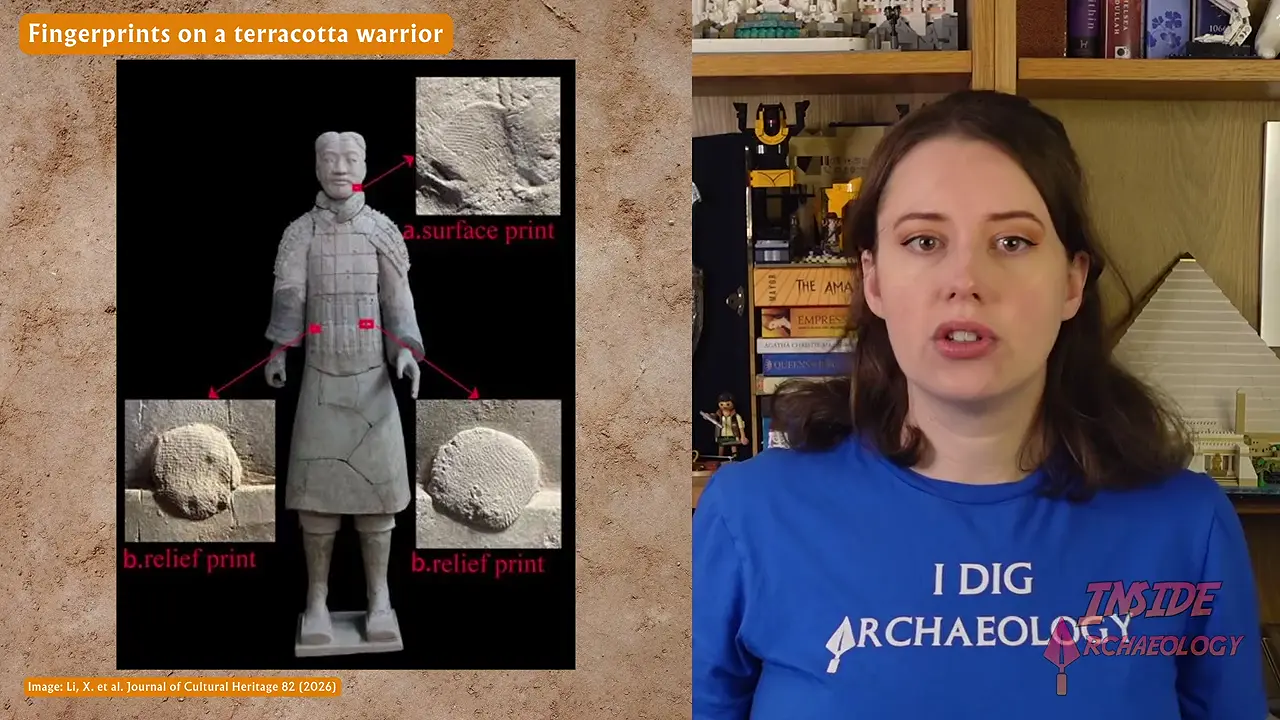
- 91 fingerprints were identified on the statues, of which 79 were preserved well enough for analysis.
- 73 were surface prints pressed directly into wet clay during modelling and trimming; the other 6 came from craftspeople gripping small pre-shaped clay pieces such as armour studs and belts.
- Age and sex were estimated by measuring ridge distance and density and feeding the values into a Bayesian mixture model.
- Results estimated the fingerprint assemblage was 45% adult males, 32% adult females and 22% children under 15, challenging the assumption that the workforce was adult male.
- The researchers interpret the children as apprentices, a practice described in Qin court records.
- Qin lacquerware of the period bears inscriptions naming adult women, young girls and young boys who participated in lacquer production.
- Earlier analysis of inscriptions on the warriors divided their makers into royal and local potters.
Sources
nature.com
Linked in video description
frontiersin.org
Linked in video description
bbc.co.uk
Linked in video description
arkeonews.net
Linked in video description
unitru.edu.pe
Linked in video description
sheffield.ac.uk
Linked in video description
China's Terracotta Warriors: The First Emperor's Legacyexhibitions.asianart.org
To date, four pits have been partially excavated. Three contain terracotta soldiers, horse-drawn chariots and weapons. The fourth pit was found empty, a ...
Who really made China's Terracotta Army? Fingerprints ...phys.org
The team studied 79 fingerprints from 36 figures in a single excavation pit. These prints were pressed into the clay in different parts of the ...
Was this story useful?
Keep exploring
Every site on this page sits on the globe, and the people who research them are on the Discord.
3D Globe · Sites by country · Story Archive · Research Library · Weekly Journal · Search
AI-generated text · images from the original sources · always verify with the sources.