

Ancient DNA from Shimao, a stone-walled city in northern China (c. 2300–1800 BCE) with 80+ skulls near its east gate, shows 9 of 10 sampled gate victims were male. Elite tombs contrast sharply: victims there were mostly female, suggesting descent-centred, patrilineal elite organisation 🗿
Shimao DNA study: gate sacrifices mostly male, elite tomb victims mostly female
Site mentioned
Key facts
- Near the eastern gate of Shimao, a large stone-walled settlement in northern China, archaeologists found more than 80 human skulls; the city flourished roughly 2300-1800 BCE.
- The skull deposits are interpreted as human sacrifices associated with the gate, with human heads placed at the city's entrance.
- A new study used ancient DNA to investigate relationships across Shimao and neighbouring sites, including people buried as sacrificial victims in elite tombs.
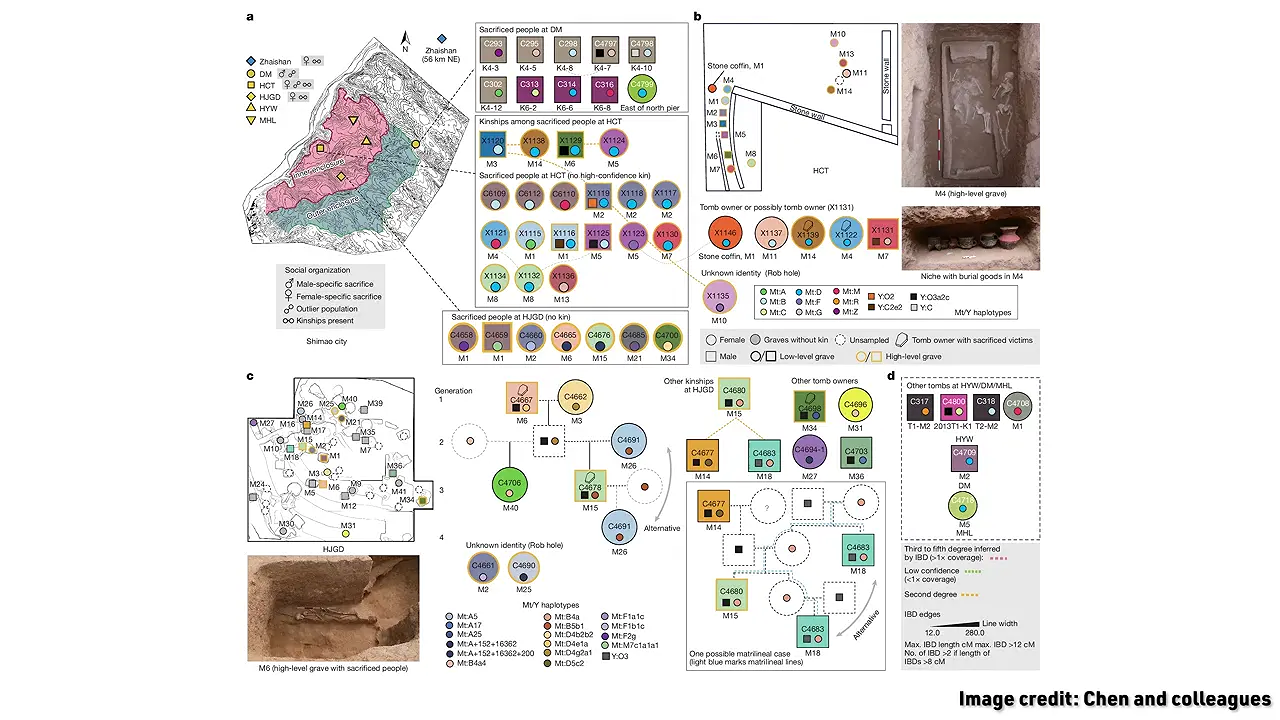
- Nine of the 10 sampled gate victims were male, and three individuals previously classified as female were found to be male.
- Elite burials showed a contrasting pattern: in one cemetery six of seven sampled victims were female and unrelated to the tomb owner, and in another elite area 14 of 19 were female, some related to one another but not to the person they accompanied.
- The team interpreted the contrast as evidence that sex helped determine who was sacrificed in different ritual settings.
- The DNA study reconstructed family connections among the wider population, including elite pedigrees spanning several generations, supporting a society organised predominantly around descent through men and inherited status, with exceptions where wealthy women also occupied tombs with sacrificial victims.
- The gate victims were not a genetically distinct group of outsiders; most shared ancestry with local or regional populations, although one showed a different ancestry signal.
- Unlike elite tomb burials, the gate sacrifices are interpreted as part of a construction ritual intended to protect the gate, though how the victims were chosen remains unknown.
Sources
(PDF) Ancient DNA from Shimao city records kinship ...researchgate.net
These findings reveal a predominantly patrilineal descent structure across Shimao communities, and possibly sex-specific sacrificial rituals. We ...
Male skulls at Shimao gate rewrite story of Neolithic human ...phys.org
The study identified a clear sex-specific pattern: Male sacrifices were concentrated at the East Gate, while female sacrificial remains were ...
Ancient DNA reveals a chilling secret at China's 4000-year- ...sciencedaily.com
Male Sacrifice at Shimao's East Gate. The findings also overturn a long-held idea about the people sacrificed near Shimao's East Gate.
Ancient genomes rewrite the story of Shimao's origins and ...archaeologymag.com
Ancient DNA from Shimao reveals its builders' origins, patrilineal society, and gendered ritual practices in Neolithic northern China.
Ancient DNA Reshapes the Story of Shimao's Neolithic Worldanthropology.net
Inside the walls, a contrasting practice emerges. High-status tombs contain sacrificed women who show no genetic ties to the families they were ...
Was this story useful?
Keep exploring
Every site on this page sits on the globe, and the people who research them are on the Discord.
3D Globe · Sites by country · Story Archive · Research Library · Weekly Journal · Search
AI-generated text · images from the original sources · always verify with the sources.