

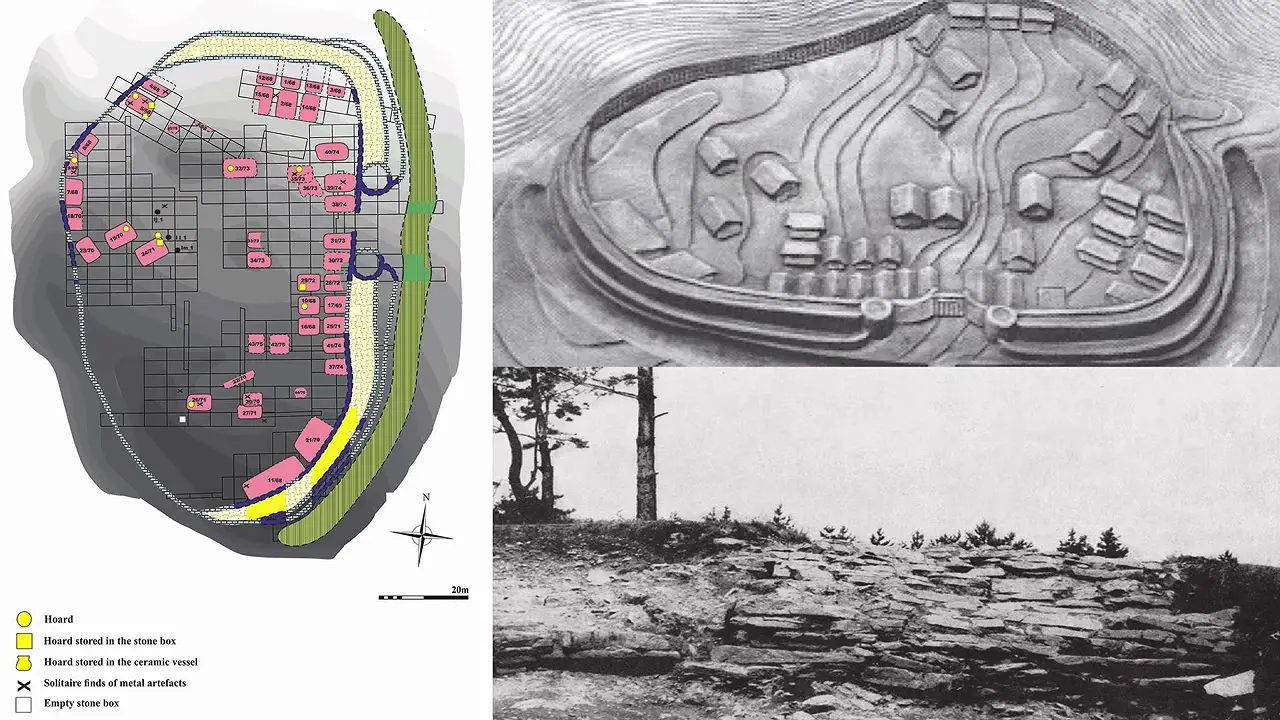
Typical Otomani fortifications used earth-and-clay ramparts reinforced with timber, built from material excavated from ditches. Sites like Kosiche Barka, Nisela Misela, and Rose Navoce followed this pattern, all perched on hills above valleys. Spissky Stvrtok stands out dramatically. Its walls are built from small, carefully worked stone slabs hauled 3-4 km from quarries. The northern and southern walls have stone bases about 5 m wide and 4 m tall, with a ditch 6 m wide in front. 🪨
Spissky Stvrtok's unique stone fortifications differ from standard Otomani earth-and-timber defenses
Site mentioned
📍 Spišský hrad🌍 Show on the globe
Key facts
- Typical Otomani fortifications feature a rampart of earth and clay reinforced with timber, with a ditch used to construct the rampart
- Kosiche Barka had a ditch reduced from 18 m wide and 2.5 m deep to about 10 m wide and 2 m deep after rebuilding
- Nisela Misela had an older ditch of about 20 m wide and 6 m deep, later widened to 25 m, with a wall estimated at 8-10 m wide
- Rose Navoce had a defensive ditch about 18 m wide and 4 m deep, but no rampart or palisade
- All three comparison sites were located on hills overlooking valleys and waterways
- Spissky Stvrtok's wall is almost entirely made of dressed, worked stone slabs quarried and transported from 3-4 km away
- The western wall had a stone base with a wooden palisade on top; the northern and southern sides had stone bases about 5 m wide and 4 m tall, with a presumed palisade bringing total height to about 6 m
- The eastern side featured a secondary stone wall about 120 m long and two bastions about 6 m in diameter guarding the gate
- A ditch about 6 m wide and 2 m deep was placed in front of the fortifications
Sources
Ottomány cultureen.wikipedia.org
The Ottomány culture, also known as Otomani culture in Romania or Otomani-Füzesabony culture in Hungary, was an early Bronze Age culture ( c. 2100–1400 BC) in ...
Category:Ottomány culture in Beskidscommons.wikimedia.org
Their settlements, often high-altitude and heavily fortified, reflected a highly organized society led by a warrior-elite. The decline of the ...
Otomani Cultureoxfordreference.com
Settlements were generally fortified and set on low hills. Others lay on promontories, by rivers, or in marshland.
Stone fortifications of the settlement in Spišský Štvrtok. A ...repozytorium.amu.edu.pl
by M Jaeger · 2014 · Cited by 14 — Stone fortifications of the settlement in Spišský Štvrtok. A contribution to the discussion on the long-ranging contacts of the Otomani-Füzesabony culture.
The stone fortifications of the settlement at Spišský Štvrtok. ...academia.edu
The Spišský Štvrtok fortifications are discussed in a comparative approach, set against other settlement structures known from the Otomani-Füzesabony culture
Was this story useful?
Keep exploring
Every site on this page sits on the globe, and the people who research them are on the Discord.
3D Globe · Sites by country · Story Archive · Research Library · Weekly Journal · Search
AI-generated text · images from the original sources · always verify with the sources.