

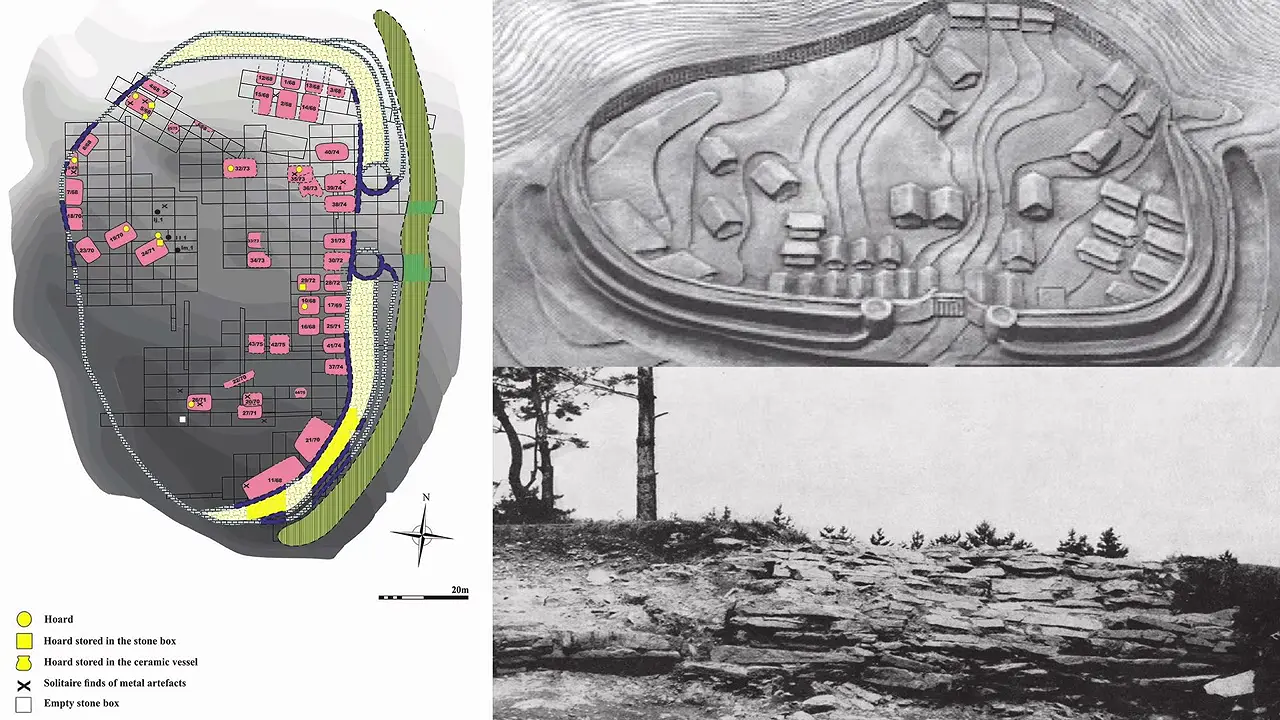
Excavated in the 1970s, Spišský Štvrtok was dated to the Otomani culture and linked to Mycenaean Greek architecture via the Amber Road. But artifacts from the later Púchov culture (2nd century BC to 1st century AD) have been found inside the walls, over 1,200 years after the Otomani ended. Púchov defensive features, including a primary wall behind a larger secondary wall, small worked stone slabs, and ditches, match Spišský Štvrtok closely. If Púchov, the site leaves Bronze Age entirely. 🤔
Spissky Stvrtok may belong to Puchav culture, not Otomani, reclassifying it to Iron Age
Site mentioned
📍 Spišský hrad🌍 Show on the globe
Key facts
- When discovered in the early 1970s, the site was dated to the Otomani culture and interpreted as Greek-derived architecture due to known amber and metal trade networks connecting Europe to the Eastern Mediterranean
- Linear B was deciphered in 1952, significantly expanding knowledge of Mycenaean Greece since the original 1970s excavation
- Unlike Mycenaean citadels used by aristocrats, Spissky Stvrtok was fully surrounded by fortifications containing housing, craft production, and possible ritual activity for common people
- Greek fortified settlements on islands like Paristria (c. 1700-1500 BC), with a 30 m dressed stone wall, and Kyifth, with a 145 m wall and two towers, are more comparable in function but evidence remains limited
- Spissky Stvrtok used timber, earth, and clay alongside stone, materials not found in comparable quantities in Greece; stone sizes were small, worked, and consistent, unlike Greek examples; the Aegean region did not use defensive ditches on the scale of Otomani sites
- Artifacts of the Puchav culture (2nd century BC to 1st century AD) have been documented within the fortifications, suggesting the site may date more than 1,200 years after the Otomani culture ended
- Puchav defensive architecture features a primary wall behind a larger secondary wall, stone worked into small slabs, and ditches, all of which match Spissky Stvrtok's fortifications
- If Puchav attribution is correct, the site would be removed from the Bronze Age entirely and would not derive from Mycenaean architecture
Sources
Spišský Štvrtok and the myth surrounding itbronzkor.hu
Spišský Štvrtok and the myth surrounding it ... A contribution to the discussion on the long distance contacts of the Otomani-Füzesabony culture.
Ottomány cultureen.wikipedia.org
The Ottomány culture, also known as Otomani culture in Romania or esabony culture in Hungary, was an early Bronze Age culture ( c. 2100–1400 BC) in Central ...
Stone fortifications of the settlement in Spišský Štvrtok. A ...repozytorium.amu.edu.pl
by M Jaeger · 2014 · Cited by 14 — Stone fortifications of the settlement in Spišský Štvrtok. A contribution to the discussion on the long-ranging contacts of the Otomani-Füzesabony culture.
(PDF) Chronological framework of the fortified settlement in ...academia.edu
The fortified settlement in Spišský Štvrtok is crucial for understanding the Otomani-Füzesabony cultural complex (OFCC). The relative chronology of the OFCC ...
The stone fortifications of the settlement at Spišský Štvrtok. ...researchgate.net
The Spišský Štvrtok fortifications are discussed in a comparative approach, set against other settlement structures known from the Otomani-Füzesabony culture. ...
Was this story useful?
Keep exploring
Every site on this page sits on the globe, and the people who research them are on the Discord.
3D Globe · Sites by country · Story Archive · Research Library · Weekly Journal · Search
AI-generated text · images from the original sources · always verify with the sources.