

Geologist Robert Schoch's research proposes water erosion gouges on the Great Sphinx's enclosure walls required a semi-arid climate with 10-20 inches of annual rainfall to form. Today's hyper-arid Giza climate receives only 1 inch per year — far too dry. Schoch's fringe hypothesis suggests the Sphinx was carved during a wetter period, with the quarry ditch acting as a catch basin for seasonal rainfall at Giza. Some researchers, including Schoch himself, have proposed a moat theory that could explain water weathering without requiring an earlier dating. The water erosion hypothesis remains contested within mainstream Egyptology.
Sphinx water erosion indicates semi-arid climate during construction
 EgyptTheory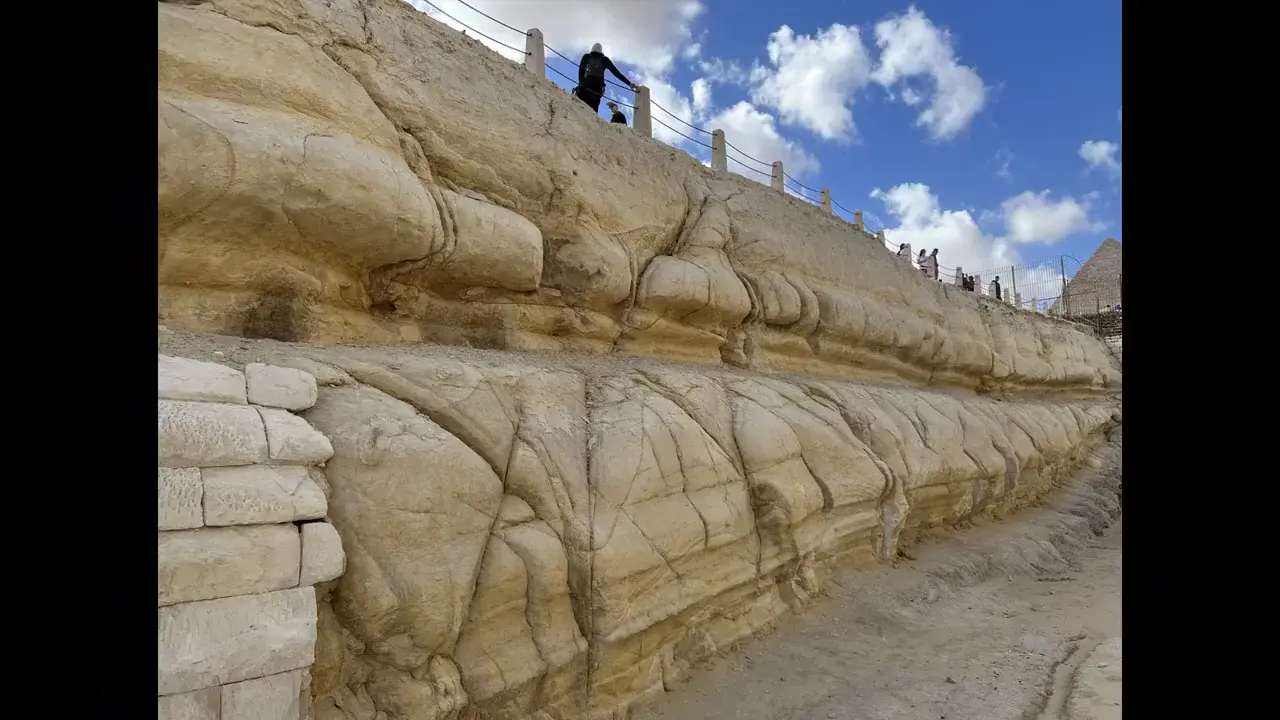
Site mentioned
Key facts
- Water erosion marks on Sphinx enclosure walls caused by long-term rainwater runoff
- Semi-arid climate with 10-20 inches annual rain required to create gully erosion
- Current hyper-arid Giza climate with 1 inch annual rainfall cannot produce such erosion
- Sphinx catch basin excavated during semi-arid period with intense seasonal rainfall
- Climate transitioned from humid to super arid after pyramid construction
- Wind erosion damaged pyramid structures during dry period, repairs made with granite and basalt
Sources
The Sphinx Controversy: Another Look at the Geological Evidencehallofmaat.com
Dr. Schoch interprets seismic profiles made on all sides of the Sphinx as indicating that a zone of weathered limestone exists below the floor of the enclosure ...
The Great Sphinx - Robert M. Schochrobertschoch.com
A moat theory explains the water weathering of the Sphinx without hypothesizing that it dates back to an earlier period of more rainfall than the present.
Did natural erosion help carve Egypt's Great Sphinx? - Physics Worldphysicsworld.com
Much of the body of Egypt's Great Sphinx could have been created by the natural erosion of a rock formation, according to researchers at New York University.
Videos - How the great pyramids were built using watersecretofthepyramids.com
Again, the implication is that rainfall is the culprit responsible for the erosion of the Sphinx enclosure walls. No, a stubborn rain cloud didn't take ...
The Great Sphinx Erosion Debate: Rain or Sand? - The Archaeologistthearchaeologist.org
Proponents of the water erosion theory argue that the Sphinx's erosion patterns were caused by prolonged exposure to heavy rainfall, suggesting ...
Was this story useful?
Keep exploring
Every site on this page sits on the globe, and the people who research them are on the Discord.
3D Globe · Sites by country · Story Archive · Research Library · Weekly Journal · Search
AI-generated text · images from the original sources · always verify with the sources.