

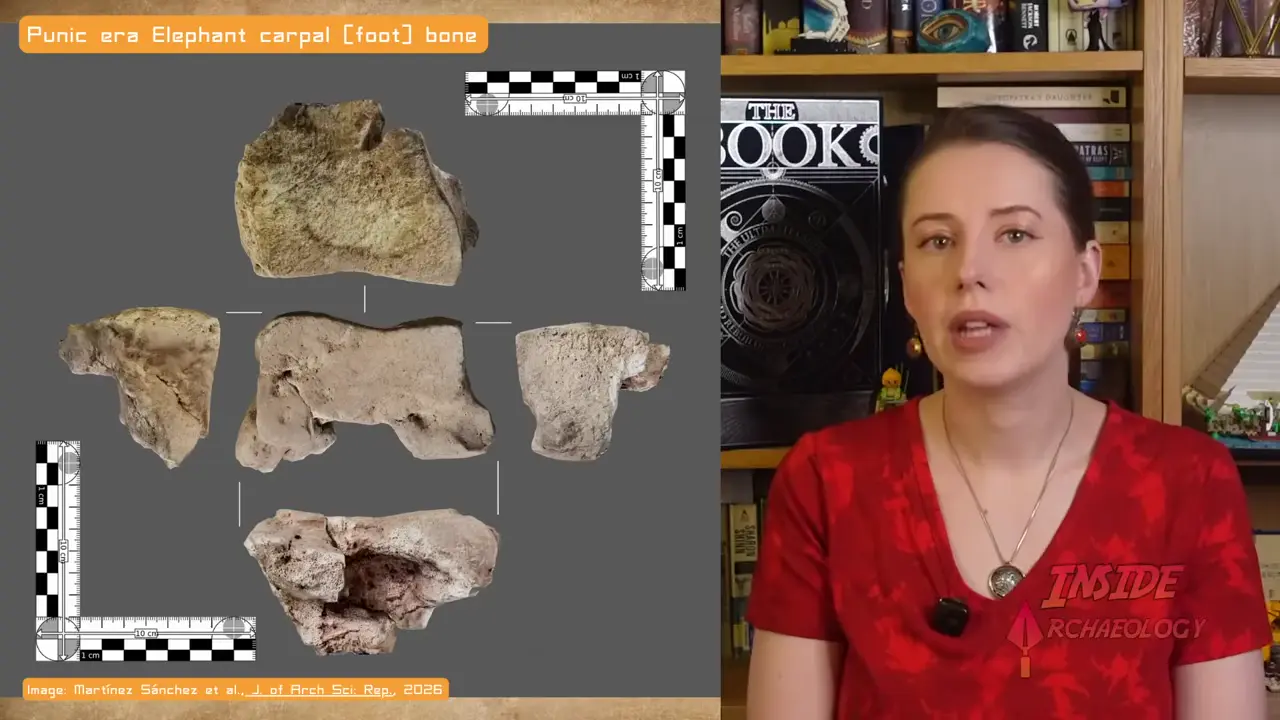
An elephant carpal bone from the right forefoot, recovered at the Hill of the Burned site near Córdoba, Spain, was radiocarbon dated to roughly 2,200 years ago. Researchers say it may be the first direct archaeological evidence of a Punic War elephant in Europe. It was found in a context with 12 spherical stones interpreted as stone-thrower projectiles. The link to Hannibal’s Carthaginian forces in the Second Punic War remains an interpretation; the date and context alone do not prove the animal’s military role or exclude alternatives.
Spanish elephant bone may be first evidence of Hannibal’s war elephants
Site mentioned
📍 Hill of the Burned
Key facts
- The carpal bone came from an elephant’s right forefoot and was recovered at the Hill of the Burned archaeological site near Córdoba, Spain.
- Radiocarbon dating placed the bone at roughly 2,200 years old, broadly compatible with the Punic Wars.
- Researchers describe the find as potentially the first direct archaeological evidence of a Punic War elephant in Europe; it does not prove that the animal belonged to Hannibal.
- The bone was recovered in a context containing 12 spherical stones interpreted as stone-thrower projectiles.
- Pliny’s account of Alexandria on the Tigris and that city’s urban remains are separate evidence and do not connect it to the Córdoba find.
- The dating alone does not exclude a Roman gladiatorial context, while a Numidian origin would not contradict a Carthaginian military association.
- The find does not establish that the elephant died on Hannibal’s route to Rome.
Sources
Elephant bone found in Spain provides rare evidence of ...archaeologymag.com
Ancient bone may be first physical evidence of ... - CNNedition.cnn.com
Small Bone from Possible War Elephant Identified in Spainarchaeology.org
Was this story useful?
Keep exploring
Every site on this page sits on the globe, and the people who research them are on the Discord.
3D Globe · Sites by country · Story Archive · Research Library · Weekly Journal · Search
AI-generated text · images from the original sources · always verify with the sources.