

The video argues that Teotihuacan's AD 378 military entrada at Tikal triggered a roughly two-century civil war between Teotihuacan-aligned and Maya independence factions, accelerating the Classic Maya collapse. Archaeology supports an armed intervention and leadership change at Tikal in 378, and documents Teotihuacan links at Copán and Calakmul. It does not establish a continuous 200-year war between fixed camps or show that the invasion caused the collapse. Calakmul's Kan dynasty itself had Teotihuacan connections. Later Tikal–Calakmul conflict and the Terminal Classic collapse involved drought, ecological stress, warfare and political fragmentation, while city abandonment was uneven. Teotihuacan's principal destruction and abandonment date to about 550–650 CE, not a citywide burning around 800.
Video Argues Teotihuacan's 378 Tikal Intervention Sparked Maya War
 Mexicounverified
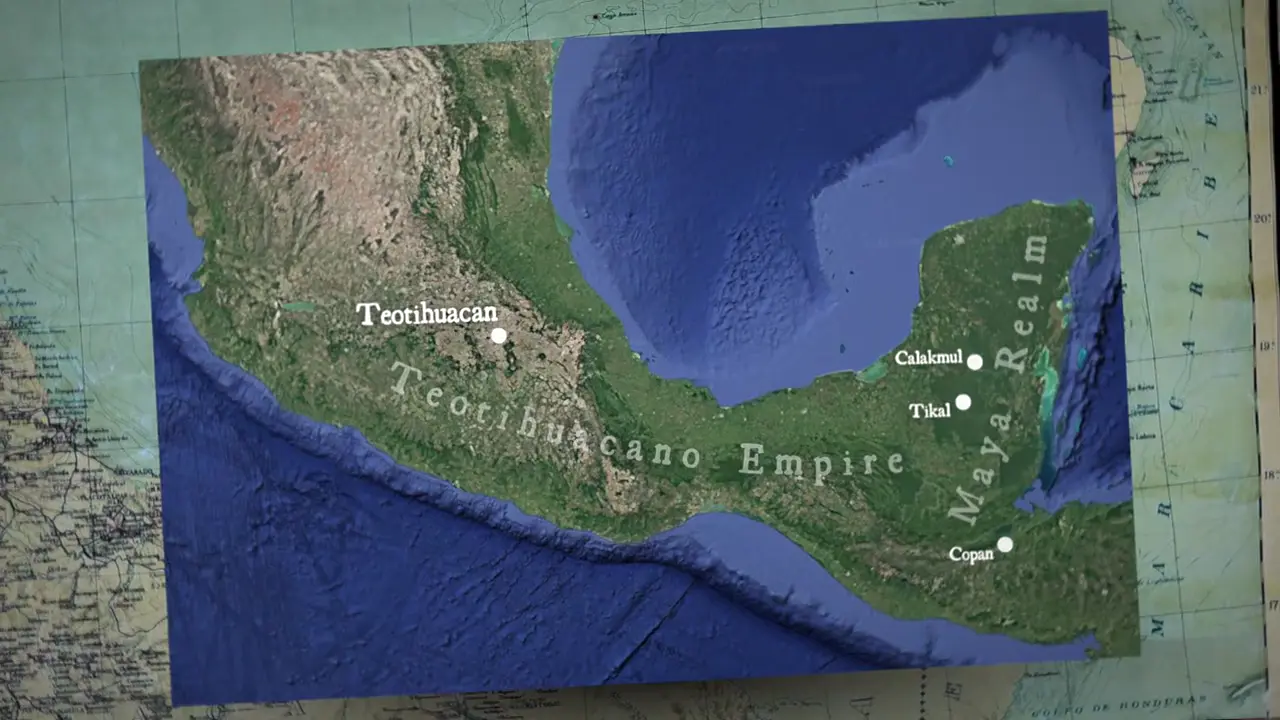
Site mentioned
Key facts
- Archaeological evidence supports a Teotihuacan military entrada at Tikal in 378 CE and a change of ruler; wider colonization and direct Teotihuacan administration are not established.
- Teotihuacan influence is documented at Copán and Calakmul. Calacmul's Kan dynasty had Teotihuacan connections and is not established as the leader of a pro-Maya independence faction.
- The proposed roughly two-century war between pro-Teotihuacan and pro-independence factions is the video's interpretation, not an established archaeological finding.
- Later Tikal–Calakmul warfare and the Terminal Classic collapse had multiple causes, including drought, ecological stress, warfare and political fragmentation.
- Urban abandonment was regional and uneven, not a single 800–900 CE event in which all winners and losers abandoned their cities.
- Teotihuacan's main destruction and large-scale abandonment occurred around 550–650 CE, not in a citywide burning around 800 CE.
Sources
Teotihuacan - Smarthistorysmarthistory.org
Teotihuacan, as the city is called, is a Nahuatl name that means “the place where the gods were created” and was given by the Mexica (sometimes called Aztec) ...
The Aztecs at Teotihuacanshesc.asu.edu
The Teotihuacan Valley's importance to the Aztec empire was proven when it became the first of the core provinces to secede from the empire, siding against ...
Was Teotihuacán an Aztec or Maya City? - Andrew Travelingandrewtraveling.com
Located a short distance from Mexico City, the ancient and mysterious ruins of Teotihuacán once harbored Mesoamerica's most influential civilization.
'Astounding new finds' suggest ancient empire may be ... - Sciencescience.org
The Maya city of Tikal rose to the height of its power and prominence after what may have been a conquest by Teotihuacan in 378 C.E.. W. E. ...
Interactions Between The Ancient Maya And The City Of ... - Forbesforbes.com
These early dates tantalizingly suggest interactions between the Maya and Teotihuacan prior to the AD 378 invasion of the city of Tikal. It ...
Naachtun's Stela 24 and the Entrada of 378mayadecipherment.com
A recent press announcement in Guatemala revealed the discovery of two important early stelae at the site of Naachtun. The monuments are in bad ...
Painted altar found in Tikal reveals Teotihuacan influence ...archaeologymag.com
The discovery of the altar also lends weight to long-standing speculation of a coup that reshaped Tikal's leadership around CE 378. Decades of ...
Staging Maya Warfare: The Landscape of the AD 378 Entrada ...art.utexas.edu
It has been two decades since David Stuart first historicized Teotihuacan's invasion of Tikal by deciphering texts associated with an ...
Was this story useful?
Keep exploring
Every site on this page sits on the globe, and the people who research them are on the Discord.
3D Globe · Sites by country · Story Archive · Research Library · Weekly Journal · Search
AI-generated text · images from the original sources · always verify with the sources.