

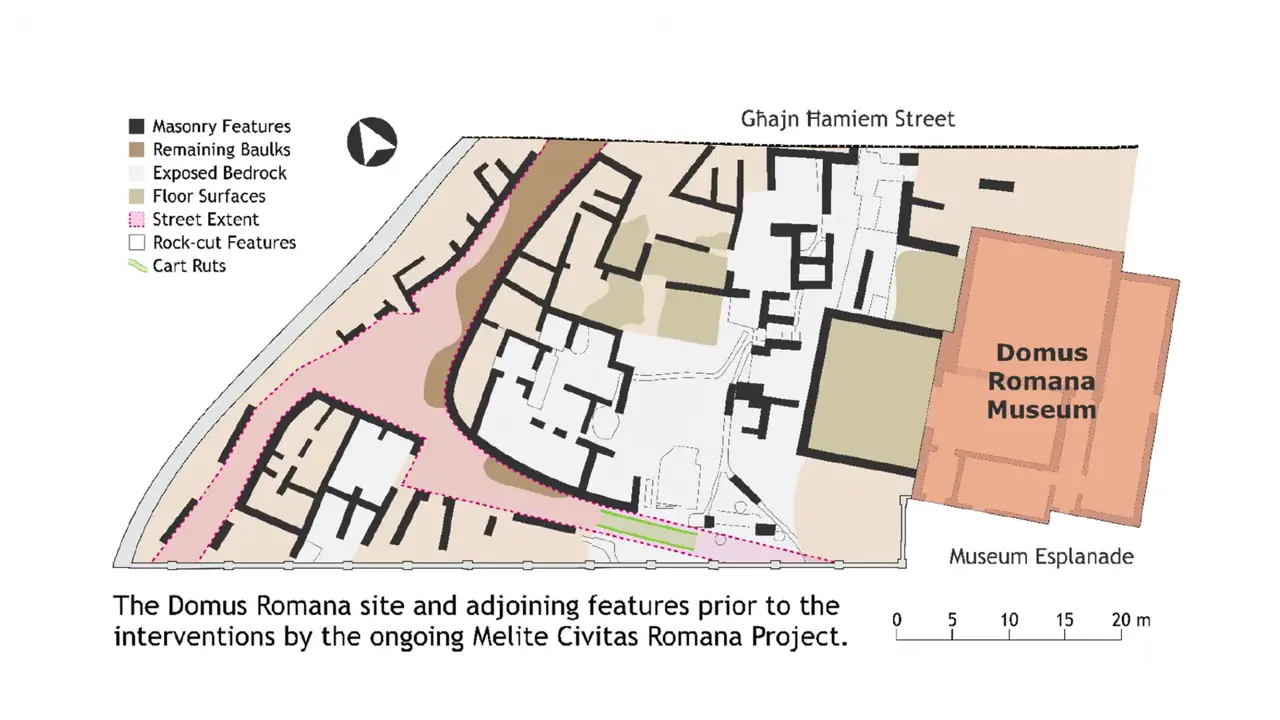
Some of the best evidence comes from Domus Romana, where a pair of ruts survives in a street between Roman buildings — and successive road surfaces were laid right over them, hinting they may have been the very first road surface there. At Il Corton in Marsaxlokk, an 18th-century record describes Roman warehouses beside the harbour, and ruts cross a warehouse threshold. Grima argues metal-rimmed wheels wore these grooves into soft limestone over centuries. 🏛️
Ruts beneath Roman streets and warehouses tie parts of the network to Roman use
 MaltaTheoryNew Research
Site mentioned
Key facts
- At the Domus Romana archaeological site a pair of cart ruts survives within a street bordered by Roman buildings.
- Successive Roman road surfaces covered the ruts on the original exposed limestone, indicating the grooves may have been the first road surface in a succession, later worn away and replaced.
- At Il Corton in Marsaxlokk, an 18th-century historical record documents substantial Roman warehouse buildings beside the Grand Harbour; the ruts appear to connect the complex with harbour facilities and continue across the threshold stone of one warehouse and inside it.
- At the quarry site referred to as Talaroka, one route crosses the floor of an earlier quarry and was later interrupted by a second phase of quarrying, bracketing the track between two classical-period quarrying phases.
- Roman burial grounds were located close to some rut trackways, matching the classical practice of building cemeteries beside roads.
- Sea level around Malta has risen by about 1.3 metres over the past 2,000 years and the submerged grooves extend only about 30 cm below the present water level, so ruts running into the sea would have been on dry land 2,000 years ago.
- Grima favours repeated wheel traffic over deliberately carved guide grooves, arguing that classical-period wheels had metal rims that would wear down soft limestone; comparable grooves in the basalt streets of Pompeii exceed 20 cm in depth.
- The tracks likely developed beneath shallow soil cover and over many centuries, connecting farms, quarries, cemeteries, towns and harbours; horses lacked metal shoes, which the video suggests explains the absence of animal prints.
- The video notes the study does not claim every Maltese cart rut is Roman and that earlier origins cannot be entirely ruled out for some, but that there is no evidence for a prehistoric origin for the network.
Sources
Rabat south | Malta Cart Rutsmalta-cartruts.ch
To the gallery. Domus romana: 35.885225 14.399925. A short and shallow pair passes just behind the museum. Għar Ilma A network with two very long stretches ...
Romans May Be Behind Malta's Thousands of Mysterious ...arkeonews.net
At the Domus Romana archaeological site, a pair of cart ruts survives within a street bordered by Roman buildings. Excavations documented ...
Most Maltese cart ruts date to the Classical era, not ...archaeologymag.com
A survey of 2628 tracks finds most Maltese cart ruts date to the Classical era, with no solid proof of a prehistoric origin.
Misraħ Għar il-Kbiren.wikipedia.org
It is best known for its "cart ruts", a complex network of tracks carved in the rock. The age and purpose of the tracks is uncertain with estimates of their ...
The Chronology of the Maltese Cart Ruts - Joel Grimapapers.ssrn.com
The Maltese cart ruts are pairs of grooves worn into the archipelago's bedrock surfaces, whose exact age, formation, and function have been ...
Was this story useful?
Keep exploring
Every site on this page sits on the globe, and the people who research them are on the Discord.
3D Globe · Sites by country · Story Archive · Research Library · Weekly Journal · Search
AI-generated text · images from the original sources · always verify with the sources.