

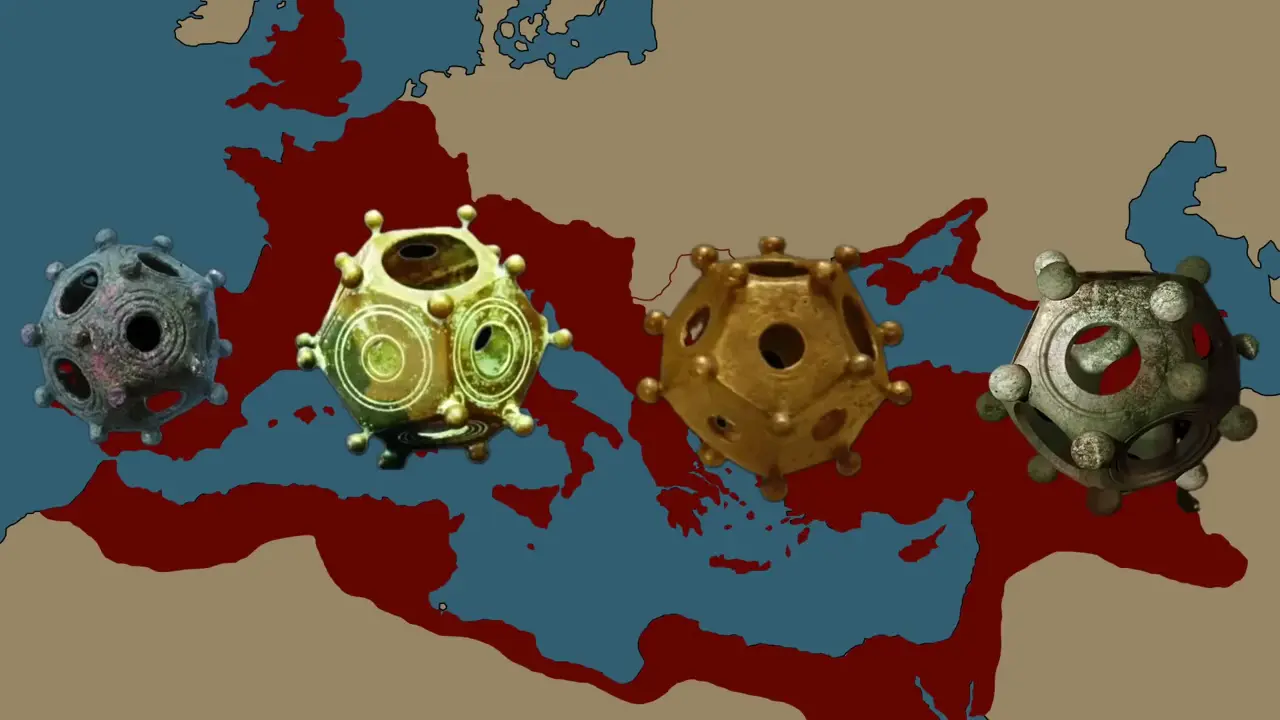
Roman dodecahedra are hollow copper-alloy objects, mostly bronze, with rare iron, silver and gold examples. Each has 12 pentagonal faces, 30 edges and 20 corners, marked by knobs; one London example has three knobs per corner. They measure 40–110 mm and weigh 35–580 g, with one 1,044 g outlier. Their faces carry differently sized holes. Most known examples come from Western Europe, and they were made using lost-wax casting.
Roman Dodecahedra: Hollow Objects With 12 Pentagonal Faces
Key facts
- Roman dodecahedra are hollow copper-alloy objects, mostly bronze, with rare iron, silver and gold examples.
- They have 12 pentagonal faces, 30 edges and 20 corners, with knobs at the corners; one London example has three knobs per corner.
- Known examples measure about 40–110 mm in height and generally weigh 35–580 g; one exceptional example weighs 1,044 g.
- Their faces have differently sized holes, and most known examples come from Western Europe.
- They were made using lost-wax casting.
Sources
The Decahedr-What? - Pages By Pagephspagesbypage.com
[PDF] middle/late iron age site and anglo-saxon cemetery - UCL Discoverydiscovery.ucl.ac.uk
Roman dodecahedronen.wikipedia.org
(PDF) GALLO-ROMAN DODECAHEDRONacademia.edu
The Roman Dodecahedronvixra.org
Was this story useful?
Keep exploring
Every site on this page sits on the globe, and the people who research them are on the Discord.
3D Globe · Sites by country · Story Archive · Research Library · Weekly Journal · Search
AI-generated text · images from the original sources · always verify with the sources.