

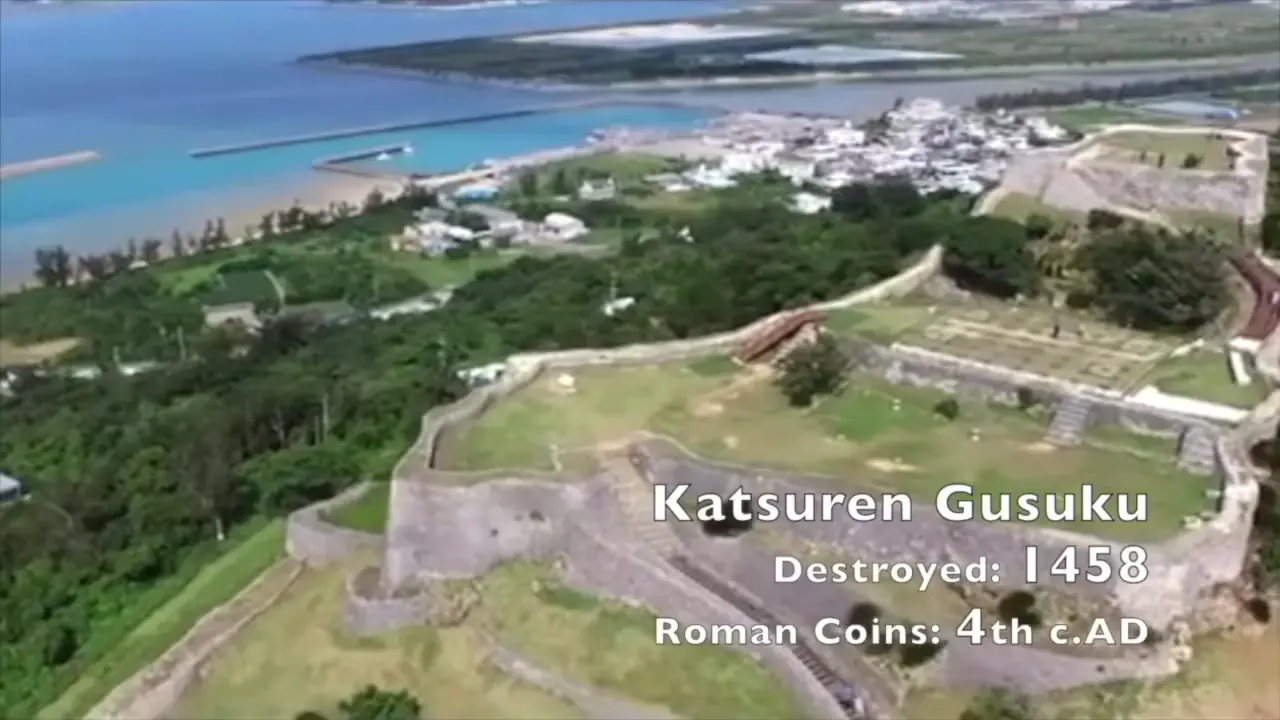
Okinawa’s Gusuku Period ran roughly from the 12th to 15th centuries. Archaeologists found one Roman coin minted in the 4th century AD in a 12th–13th-century layer at Katsuren Castle, roughly 1,000 years before the 14th-century castle was built. The coin does not date the walls or prove Roman builders reached Okinawa. Earlier islanders included settled shell-midden communities and farming villages, and dozens of Gusuku sites survive. The 1609 invasion and World War II caused major damage, but not a survival total of six. The video’s Italian comparison and global-masonry claim remain interpretations, not established facts.
Roman coin found at Okinawa’s Katsuren Castle dates to the 4th century
Site mentioned
📍 Katsuren Castle
Key facts
- The Gusuku Period is generally dated from about the 12th to the 15th centuries; many surviving Gusuku date from the 14th to 16th centuries.
- At Katsuren Castle, archaeologists found one Roman coin minted in the 4th century AD in a 12th–13th-century layer, predating construction of the 14th-century fortress by roughly 1,000 years.
- The coin does not date the castle walls or demonstrate that Roman builders reached Okinawa.
- No archaeological evidence establishes that Gusuku walls predate Japanese mainland masonry by at least 400 years.
- Before the Gusuku Period, Okinawa had settled shell-midden communities and later agricultural villages; the claim that islanders lived without architecture for 6,000 years is unsupported.
- Local stone was used in distinctive Ryukyuan masonry. The video argues that the technique was global and that Gusuku resemble Italian rather than Chinese architecture, but those are interpretations rather than established archaeological conclusions.
- Dozens of Gusuku sites survive. UNESCO’s serial listing includes 22 Gusuku among 42 components; the 1609 invasion and World War II caused damage but did not leave only six.
- The Katsuren discovery is a single 4th-century Roman coin, not a collection of Roman coins.
Sources
Katsuren Castle - Wikipediaen.wikipedia.org
"Ancient Roman coins unearthed from castle ruins in Okinawa". Japan Times Online. Kyodo. 26 September 2016. Retrieved 13 August 2018. ↑ Jozuka, Emiko (27 ...
Coins From The Roman Empire Found In Ruins Of Japanese Castlenpr.org
The four Roman coins were found at the Katsuren Castle — a World Heritage Site in Japan's southwestern city of Uruma. The excavation was ...
Ancient Roman coins found in an old Japanese castle - CNNedition.cnn.com
When archeologist Hiroyuki Miyagi heard that a bunch of ancient Roman and Ottoman coins had been unearthed from the ruins of an old castle in Okinawa, ...
Roman coins ID'd in Japanese ruins, but their origin baffles - Phys.orgphys.org
The 10 copper coins were unearthed in December 2013 at the 12th-15th century Katsuren Castle, a UNESCO World Heritage site, during an annual ...
How did Roman coins from the fourth century get to a castle in Japan?coinworld.com
10 ancient coins from the Roman and Ottoman empires were unearthed in the ruins of a Japanese castle, thousands of miles from their place of origin.
Gusuku Perioden.wikipedia.org
By the 14th century, three kingdoms (the Sanzan) emerged on Okinawa as tributary kingdoms to the Ming Dynasty of China. Rather than territorial states, these ...
(PDF) Introduction to the Gusuku Period, with a focus on ...academia.edu
The Gusuku Period spans approximately from the 12th to the 15th century, marked by distinctive stone fortresses. Agricultural production shifts significantly ...
Gusukuen.wikipedia.org
In fact, gusuku with established dates were mostly from the 14th to 16th centuries. While other archaeologists had focused on mountain fortifications, he paid ...
Was this story useful?
Keep exploring
Every site on this page sits on the globe, and the people who research them are on the Discord.
3D Globe · Sites by country · Story Archive · Research Library · Weekly Journal · Search
AI-generated text · images from the original sources · always verify with the sources.