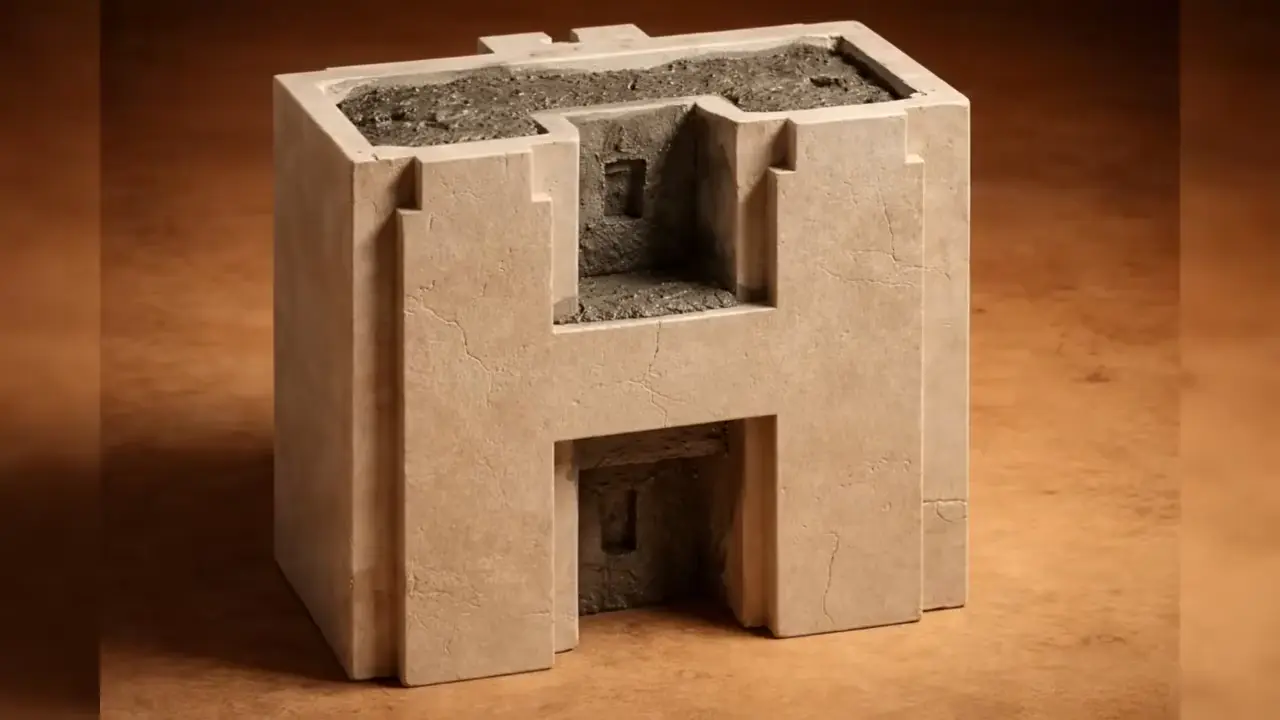
Mainstream archaeology places Pumapunku, a major Tiwanaku complex in Bolivia, in the sixth century CE. Construction began after AD 536, and a 2023 Bayesian chronology puts the start near AD 580. The site has finely dressed andesite and sandstone blocks, with the heaviest estimated at roughly 130-180 tonnes. Their quarrying, transport, lifting and fitting remain debated.
Arthur Posnansky, an Austrian-born engineer and self-taught archaeologist, studied Tiwanaku for about four decades and published the four-volume "Tihuanacu: The Cradle of American Man." He argued that Kalasasaya's alignments dated to around 15,000 BCE. The video invokes that rejected chronology to argue for a vastly older Tiwanaku or lost construction methods. Modern dating places the complex in the first millennium CE.
The site's high-altitude grassland setting does not support the blanket claim that no timber was available. The specific 1960s army trial is not substantiated by the cited research and cannot by itself reconstruct ancient logistics. Hammerstones and abrasive grit can shape andesite; no evidence shows that Bronze Age builders needed diamond tools, heat or vibration. Posnansky's proposed enlarged prehistoric Lake Titicaca and flood origin remain hypotheses, and comparisons with other megalithic sites do not demonstrate a shared lost civilisation.
Sources
geopolymer.orgLinked in video description
natrontheory.comLinked in video description
Tiahuanaco Monuments (Tiwanaku / Pumapunku), Bolivia ...geopolymer.orgTo make their geopolymer sandstone concrete, the builders may have transported finely weathered, kaolinitized sandstone from the Kallamarka site ...
Pumapunkuen.wikipedia.orgModern engineers argue that the base of Pumapunku was constructed using a technique called layering and depositing. By alternating layers of sand from the ...
(DOC) The Enduring Enigma Of Puma Punku in Boliviaacademia.eduInitial construction at Puma Punku dates around 1510 ±25 B.P., revealing its ancient origins. Only 2% of Puma Punku has been excavated, limiting accurate dating ...
Pumapunku Reconstructionidialab.orgFillwalk and his team used photogrammetry—a technique that uses overlapping photos to create models, laser scanning, measured hand modeling, and ...
The Mystery Behind Pumapunku's Remarkably Precise ...history.comNevertheless, Pumapunku was never completed. The structure was modified and remodeled as the city continued to grow. At some point, the builders ...
A Bayesian chronology for the collapse of Tiwanaku - PMC - NIHpmc.ncbi.nlm.nih.govby EJ Marsh · 2023 · Cited by 21 — The Pumapunku is a stepped platform that stands out for its large and finely carved blocks [49, 75, 76]. Construction began ~AD 580, according to the model's ...
AI-generated text · images from the original sources · always verify with the sources.