

The 40‑kyr‑old Peștera cu Oase jaw from Romania carries 6‑9%% Neanderthal DNA, with three long segments (50 cM) indicating a Neanderthal ancestor just 4‑6 generations back – a striking contrast to the tiny, fragmented Neanderthal fragments in modern non‑Africans.
Peștera cu Oase fossil shows recent Neanderthal admixture
 RomaniaBioarchaeology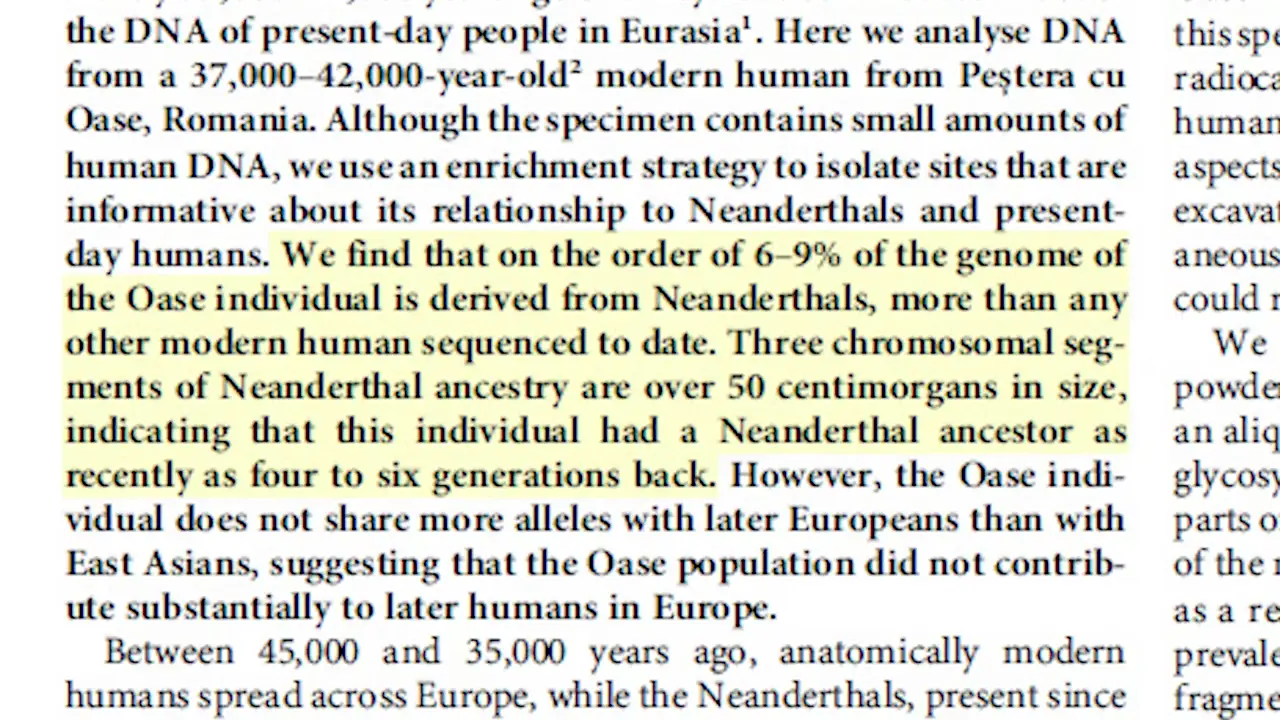
Site mentioned
Key facts
- Peștera cu Oase jaw from Romania dates to around 40,000 years ago
- This individual had a Neanderthal ancestor 4-6 generations earlier (approximately 200 years)
- The Oase 1 individual had 6-9% Neanderthal ancestry, higher than modern non-Africans (~2%)
- Researchers identified three Neanderthal DNA segments over 50 centimorgans in length
- The length of these segments indicates recent interbreeding rather than ancient admixture
- Modern humans carry many small fragmented Neanderthal DNA segments from thousands of generations of recombination
- An estimated 20-40% of the Neanderthal genome survives in modern humans
Sources
nature.com
Linked in video description
journals.openedition.org
Linked in video description
pmc.ncbi.nlm.nih.gov
Linked in video description
dspace.library.uvic.ca
Linked in video description
link.springer.com
Linked in video description
nature.com
Linked in video description
pmc.ncbi.nlm.nih.gov
Linked in video description
Was this story useful?
Keep exploring
Every site on this page sits on the globe, and the people who research them are on the Discord.
3D Globe · Sites by country · Story Archive · Research Library · Weekly Journal · Search
AI-generated text · images from the original sources · always verify with the sources.