

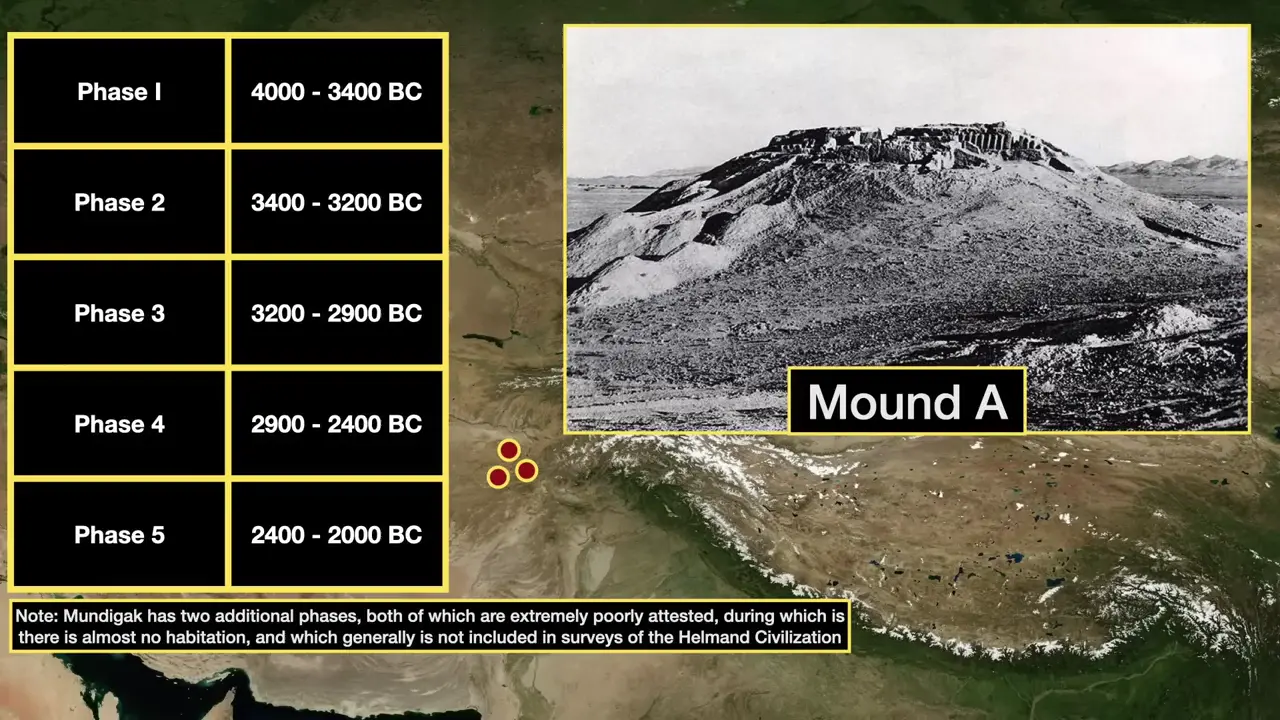
Mundigak, near Shahari Sukta in Kandahar Province, Afghanistan, lies roughly 55 km northwest of Kandahar city. The site was occupied from about 3500 BC to about 1000 BC, spanning late Chalcolithic and Bronze Age phases; the Helmand cultural phase itself dates to about 3300–2350 BCE. Mud-brick houses gave way to denser buildings with smaller rooms, indicating changing building functions. Mound C is a large cemetery, while Mound G has remains interpreted as a temple. Female figurines and seals provide evidence for symbolic or religious practices.
Mundigak (Mundagok): occupation, architecture and cultural evidence
 AfghanistanGeneral
Key facts
- Mundigak lies near Shahari Sukta in Kandahar Province, roughly 55 km northwest of Kandahar city, with occupation from about 3500 BC to about 1000 BC.
- The Helmand cultural phase dates to roughly 3300–2350 BCE; later occupation continued beyond that phase.
- Early mud-brick houses were followed by denser buildings with smaller rooms, indicating changes in building use.
- Mound C contains a large cemetery, while Mound G has remains interpreted as a temple.
- Female figurines and seals provide evidence for symbolic or religious practices.
Sources
Mundigak Palace II 5 - Harappaharappa.com
The Pre-Historic Period in Afghanistan - alamahabibi.netalamahabibi.net
Mundigak - Wikipediaen.wikipedia.org
Helmand Civilizationen.wikipedia.org
Other Indus related vessels from Shahr-i Sokhta and ...researchgate.net
Mundigak - by Pete Kelly - History Time Newsletterhistorytimewithpete.substack.com
Was this story useful?
Keep exploring
Every site on this page sits on the globe, and the people who research them are on the Discord.
3D Globe · Sites by country · Story Archive · Research Library · Weekly Journal · Search
AI-generated text · images from the original sources · always verify with the sources.