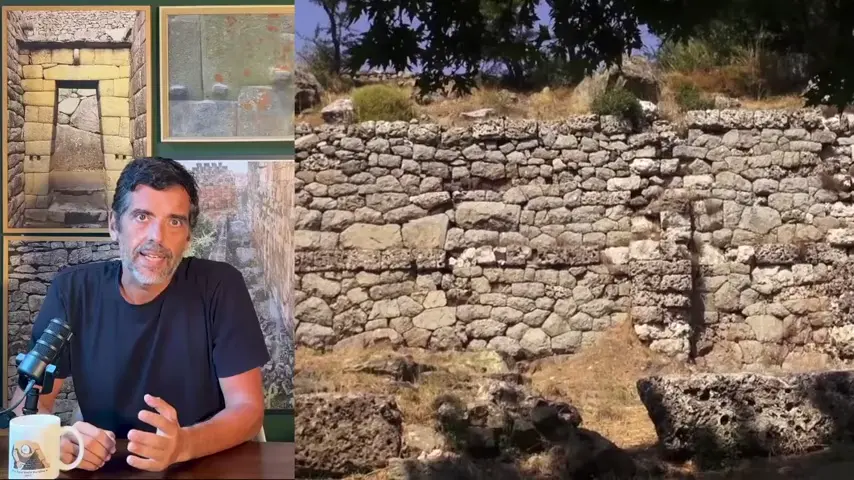
Cyclopean masonry is securely associated with Bronze Age Mycenaean citadels such as Mycenae, Tiryns and Midea. At Mycenae, huge limestone blocks were stacked without mortar to form walls up to about eight metres thick.
The video maps “empty quarters” and argues that their distribution reveals cultural boundaries and points to a pre-Phoenician origin. That interpretation goes beyond the cited evidence. South Bolivia, Ecuador and northern Peru were core Inca territories with monumental large-stone masonry, including Sacsayhuamán and Machu Picchu, so they cannot be counted as empty quarters. The cited results also do not prove a Europe-wide 44° north limit, the total absence of comparable construction in the Maghreb, or that Phoenicians never built such walls. Those broader distribution and chronology claims remain the video’s argument.
Sources
earth.google.comLinked in video description
The Art and Science of Cyclopean Masonry In Mycenaeolympia-museum.grMycenaean engineers raised stone fortifications that have survived for over three millennia. were built by Cyclopes—mythical one-eyed giants. s ...
Cyclopean masonryen.wikipedia.org"Cyclopean", the term normally applied to the masonry style characteristic of Mycenaean fortification systems, describes walls built of huge, unworked limestone ...
Fortifications of Mycenaeen.wikipedia.orgThe fortifications of Mycenae were built with the use of Cyclopean masonry. With the citadel built on a cliff, the architects created protection
Mycenaean Architecture: Cyclopean Walls, Lion Gate & Ancient ...tickets-athens.comThe Cyclopean walls of Mycenae were built with limestone boulders weighing up to 20 tons, stacked without mortar. These walls, up to 8 meters thick, enclosed ...
(PDF) MYCENAE: FORTIFICATIONS AND INTRA MUROS RELATED ...academia.eduMycenaean Cyclopean fortifications were built primarily to symbolize power, with military function being secondary. Mycenae's walls underwent three distinct ...
AI-generated text · images from the original sources · always verify with the sources.