

At Wedbet, a ridge-top settlement in north-west Morocco, trenches dug in 2023 gave the first solid evidence people still lived there in the second millennium BC — centuries after its Neolithic farming heyday. Massive structure known locally as Wall B was built in stages: an earth rampart after 2000 BC, later a stone wall with ditch and embankment. 🏺 17 new radiocarbon dates place it early-to-mid 2nd millennium BC, hinting a Bronze Age society emerging alongside related ones across the Strait in southern Spain.
Moroccan site reveals Bronze Age occupation continuing after its Neolithic heyday
Site mentioned
📍 Wedbet
Key facts
- At Wedbet, a settlement on a ridge above a river in north-west Morocco, a 2022 excavation revealed a large final Neolithic farming settlement of 9 to 10 hectares dating from the mid-4th to the early 3rd millennium BC
- The Wedbet archaeological project returned from October to November 2023 to dig six new trenches
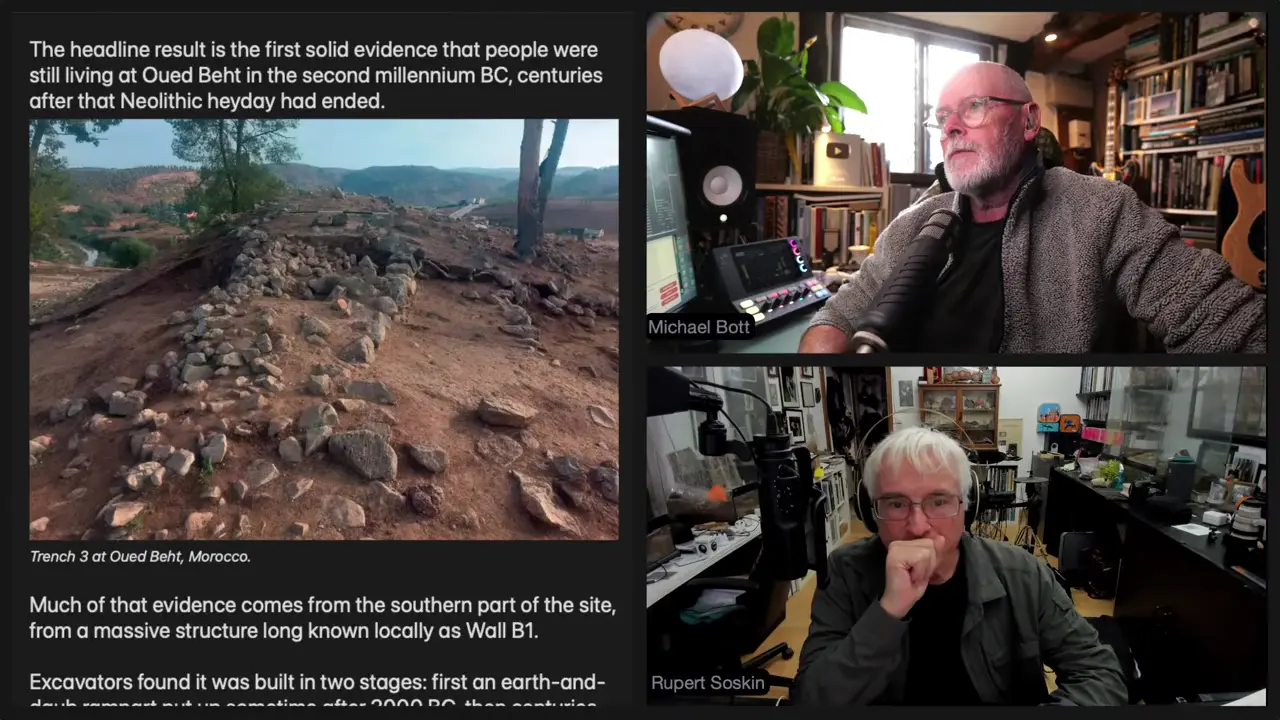
- The headline result is the first solid evidence that people were still living at Wedbet in the second millennium BC, centuries after the Neolithic heyday had ended
- A massive structure in the southern part of the site, long known locally as Wall B, was built in two stages: first an earth rampart put up after 2000 BC, then centuries later a stone wall fronted by a ditch and an earth embankment
- 17 new radiocarbon dates place the complex in the early to mid-second millennium BC; excavators describe it as among the oldest confirmed constructions of its kind in the region, suggesting a Bronze Age society was emerging in north-west Morocco at much the same time as related societies across the Strait in southern Spain
- At the northern end of the site, three polished stone axes were found still lying where they were left in prehistory, the first such tools found in place at Wedbet; nearby pits held pottery dated to about 3100-2900 BC
- Several east-west aligned burials were uncovered where local residents had reported human bones during house building; an AMS date from one burial returned AD 1221-1279, and the cemetery may cover about 40 by 40 metres and hold hundreds of graves
- A survey of 260 hectares around the site found no other prehistoric settlement nearby, though it did record an 11th-13th century rural settlement, old cemeteries and a stone road; geological work traced the sources of clay and stone used for ancient pottery and tools
Sources
Top Three Reports in Biblical Archaeology – August 2023biblearchaeologyreport.com
A seven-day, around-the-clock excavation was recently carried out at the Church of the Holy Sepulchre by a team from the Department of ...
"Bet She'an A-9586/2023" by Gur Peledpublications.iaa.org.il
In July 2023, a trial excavation was conducted in south of Bet She'an (Permit No. A-9586/2023; Map ref. 246330-545/710040-256). The excavation, on behalf ...
Khirbet Beit Netofabiblicalarchaeology.org
For the 2023 season, we plan to excavate an area that looks like the remains of a tower and possibly village houses. It is also possible ...
All set for the official start of the excavation season 2023sudansurvey.gwi.uni-muenchen.de
All set for the official start of the excavation season 2023 ... We will start with extended excavation in the small settlement AtW 001 ...
Excavations at Khirbet 'Aujah el-Foqa: The 2023-2025 ...cris.ariel.ac.il
The article describes and discusses the results of excavations at the fortified Iron Age II site of Khirbet 'Aujah el-Foqa during the 2023-2025 seasons.
Was this story useful?
Keep exploring
Every site on this page sits on the globe, and the people who research them are on the Discord.
3D Globe · Sites by country · Story Archive · Research Library · Weekly Journal · Search
AI-generated text · images from the original sources · always verify with the sources.