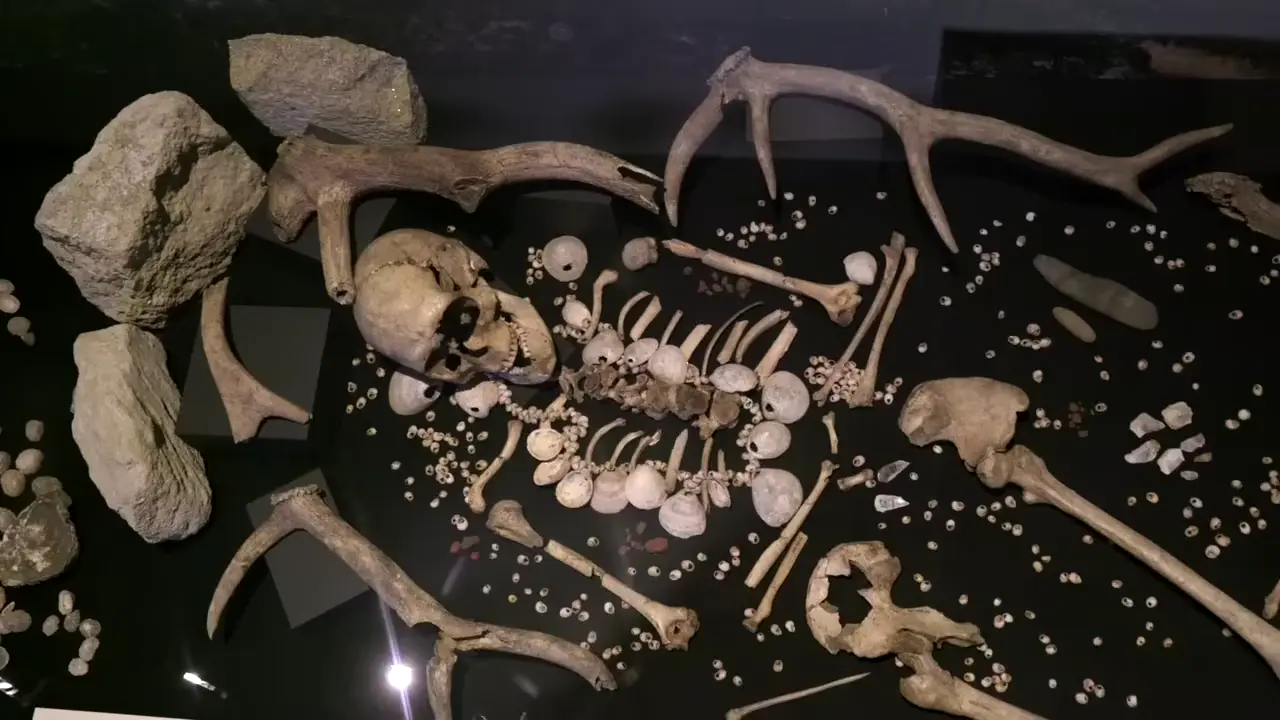
Two small Brittany islands hold some of prehistory's most remarkable burials! Dated to ~5,400 BC, the Téviec & Hoëdic sites feature some of the earliest known deliberately quarried stone slabs used in burials, plus shell necklaces & antler grave goods 🦌🐚
Key facts:
- Téviec and Hoëdic are two small islands off the coast of Brittany
- Burials discovered in late 1920s by archaeologists Stéphane and Suzanne Péquart
- Double female burial known as 'Ladies of Téviec' aged 25-35 with evidence of violent deaths
- Burials featured elaborate grave goods including shell necklaces and antler decorations
- Site represents some of the earliest evidence of deliberate burial practices in Western Europe with quarried stone slabs
Sources
Téviec - Wikipediaen.wikipedia.orgTéviec or Théviec is an island situated to the west of the isthmus of the peninsula of Quiberon, near Saint-Pierre-Quiberon in Brittany, France.
The Mesolithic Necropolis of Téviec - Bretagne Culture Diversitébcd.bzhBoth a cemetery and a settlement, Téviec seems to be the most famous Mesolithic site in all of Western France (5400 B.C.).
Antlers, bone pins and flint blades: The Mesolithic cemeteries of ...researchgate.netThe late Mesolithic sites of Téviec and Hoëdic, located on what are now small islands off the Breton coast, provide evidence for elaborate burial practices.
[PDF] Marine shell beads from three inland Later Mesolithic sites in ...ora.ox.ac.ukSome of the most celebrated examples come from Mesolithic burials in. Brittany (Péquart & Péquart 1929, 1954; Péquart et al. 1937), but a substantial number ...
AI-generated text · images from the original sources · always verify with the sources.