

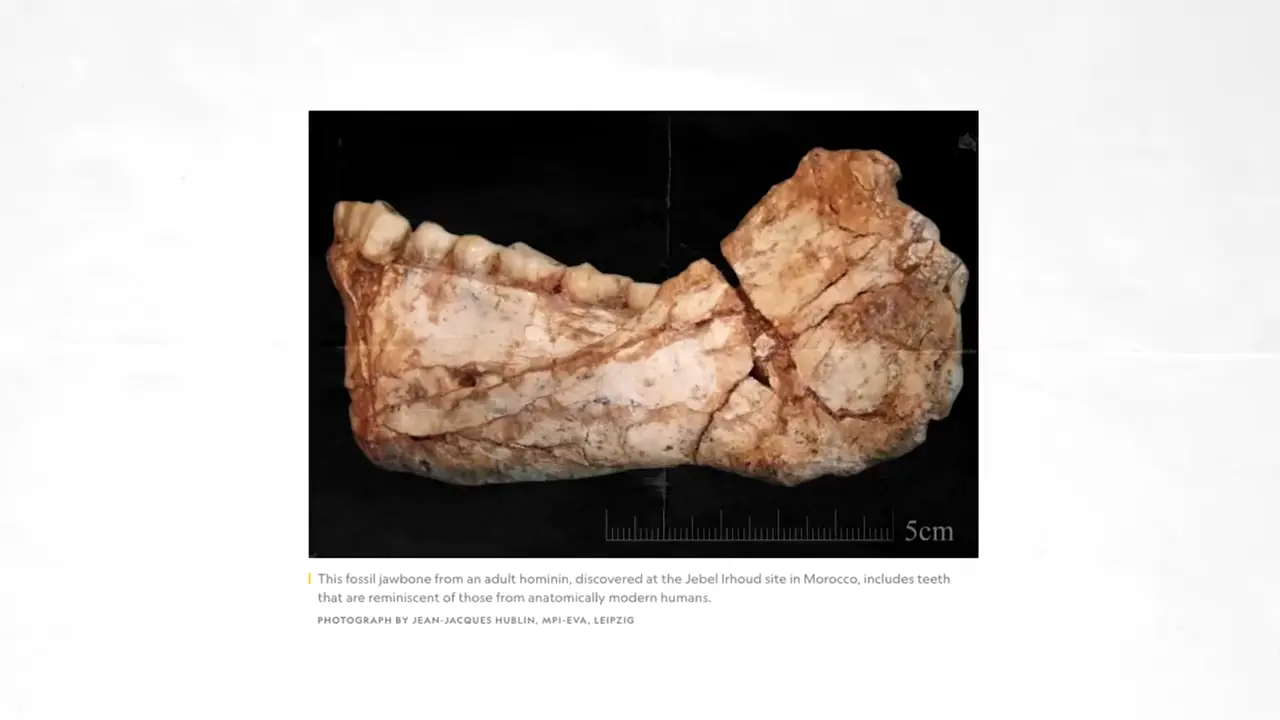
In 2017, researchers discovered Homo sapiens remains at Jebel Irhoud in Morocco with modern-looking skulls, faces, and teeth dated to around 300,000 years ago—pushing back human origins by roughly 100,000 years. This site lies thousands of kilometers from traditional East African origin theories. Genetics confirm deep population structures across sub-Saharan Africa, with Khoisan peoples carrying genetic signatures branching off earlier than any other living population, possibly representing 200,000 years of separate lineage.
Jebel Irhoud fossils push Homo sapiens origin back to 300,000 years ago
Site mentioned
📍 Jebel Irhoud🌍 Show on the globe
Key facts
- Fossil remains discovered at Jebel Irhoud in Morocco in 2017
- Bones identified as Homo sapiens with modern-looking skulls, faces, and teeth
- Dated to approximately 300,000 years ago, pushing back origin of modern humans by around 100,000 years
- Morocco is thousands of kilometers from traditional East African origin sites
- Genetics confirm deep population structures across sub-Saharan Africa with multiple lineages diverging hundreds of thousands of years ago
- Khoisan peoples carry genetic signatures branching off earlier than any other living population, possibly 200,000 years of separate lineage
Sources
New fossils from Jebel Irhoud, Morocco and the pan-African origin of ...pubmed.ncbi.nlm.nih.gov
Fossil evidence points to an African origin of Homo sapiens from a group called either H. heidelbergensis or H. rhodesiensis.
Jebel Irhoud - Wikipediaen.wikipedia.org
Originally thought to be Neanderthals, the specimens have since been assigned to Homo sapiens and, as reported in 2017, have been dated to a "weighted average ...
Our species arose at least 300000 years agohumanorigins.si.edu
Fossils from Jebel Irhoud cave, Morocco, are now considered the oldest members of our species yet found. Dating to about 300,000 years old, the ...
The age of the hominin fossils from Jebel Irhoud, Morocco, and the ...ui.adsabs.harvard.edu
The earliest fossil attributed to a modern form of Homo sapiens comes from eastern Africa and is approximately 195 thousand years old, therefore the emergence ...
World's oldest Homo sapiens fossils found in Morocco - Sciencescience.org
New dates and fossils from Jebel Irhoud in Morocco suggest that our species emerged across Africa. The new findings may help researchers sort ...
Was this story useful?
Keep exploring
Every site on this page sits on the globe, and the people who research them are on the Discord.
3D Globe · Sites by country · Story Archive · Research Library · Weekly Journal · Search
AI-generated text · images from the original sources · always verify with the sources.