

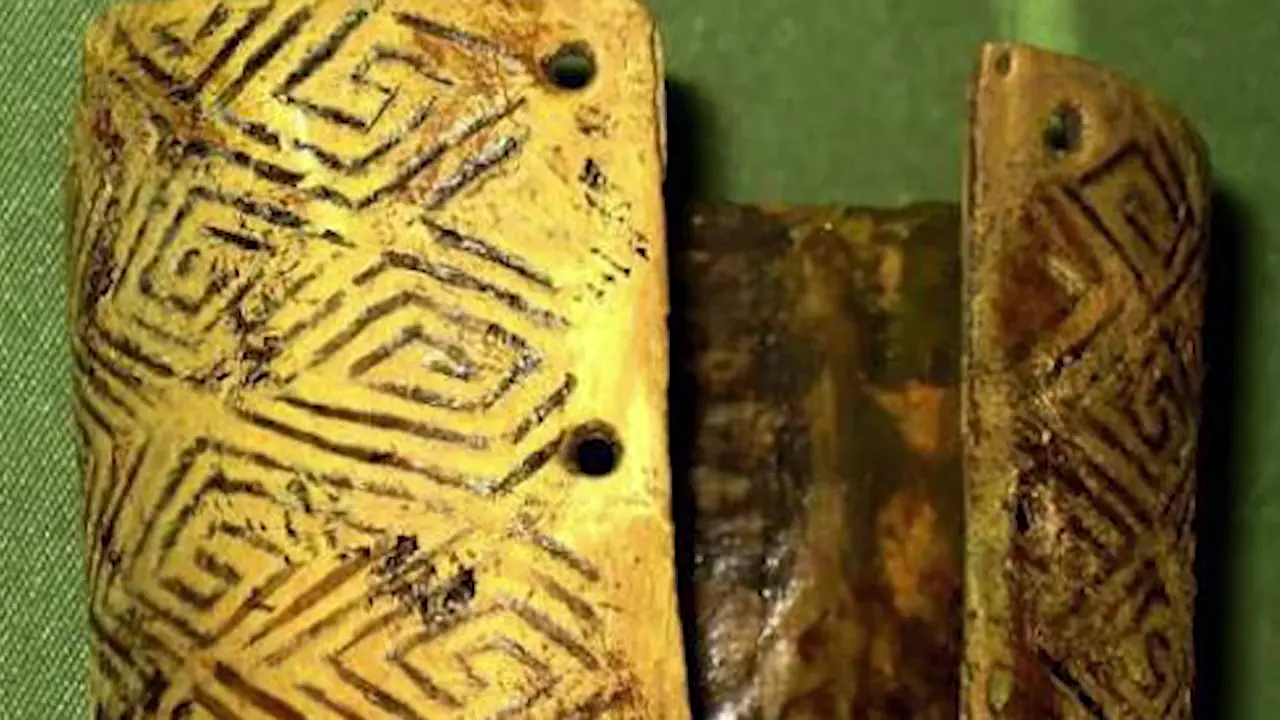
Mammoth tusks contain Owen's lines, concentric curved growth bands in dentine resembling tree rings, but on conical tusks the circles tighten toward tips and widen at the base. Schreger lines come from microscopic dentinal tubules following wavy 3D paths; flat cuts through them produce alternating light and dark bands. Two intersecting systems create characteristic diamonds, chevrons, and V-shapes.
Internal ivory structure: Owen's lines and Schreger lines in mammoth tusks
 UkraineArt
Site mentioned
Key facts
- Owen's lines are incremental growth lines in dentine, appearing as concentric curved bands like tree rings
- Tusk geometry differs from tree trunks because tusks are long cones rather than cylinders
- Tighter Owen's line circles appear toward tusk tips; wider circles toward the base
- Schreger lines are produced by microscopic dentinal tubules following regularly changing wavy 3D courses
- When a flat cut intersects these tubules, alternating light and dark bands form
- Two intersecting systems of bands create characteristic cross-hatched diamond, chevron, and V-shaped patterns
- The paper documents standardized symbolic conventions followed across figurines, indicating structured cultural approaches
Sources
JAIC 1993, Volume 32, Number 3, Article 3 (pp. 241 to 248)cool.culturalheritage.org
2. Tusks and Ivorypocketdentistry.com
Ivory & Tooth - Condition Reportinglam.alaska.gov
Schreger lineen.wikipedia.org
Ice Age carvers used mammoth tusk patterns to create ...eurekalert.org
Cavemen Used Mammoth Tusk Patterns to Create Unique ...goodnewsnetwork.org
Was this story useful?
Keep exploring
Every site on this page sits on the globe, and the people who research them are on the Discord.
3D Globe · Sites by country · Story Archive · Research Library · Weekly Journal · Search
AI-generated text · images from the original sources · always verify with the sources.