

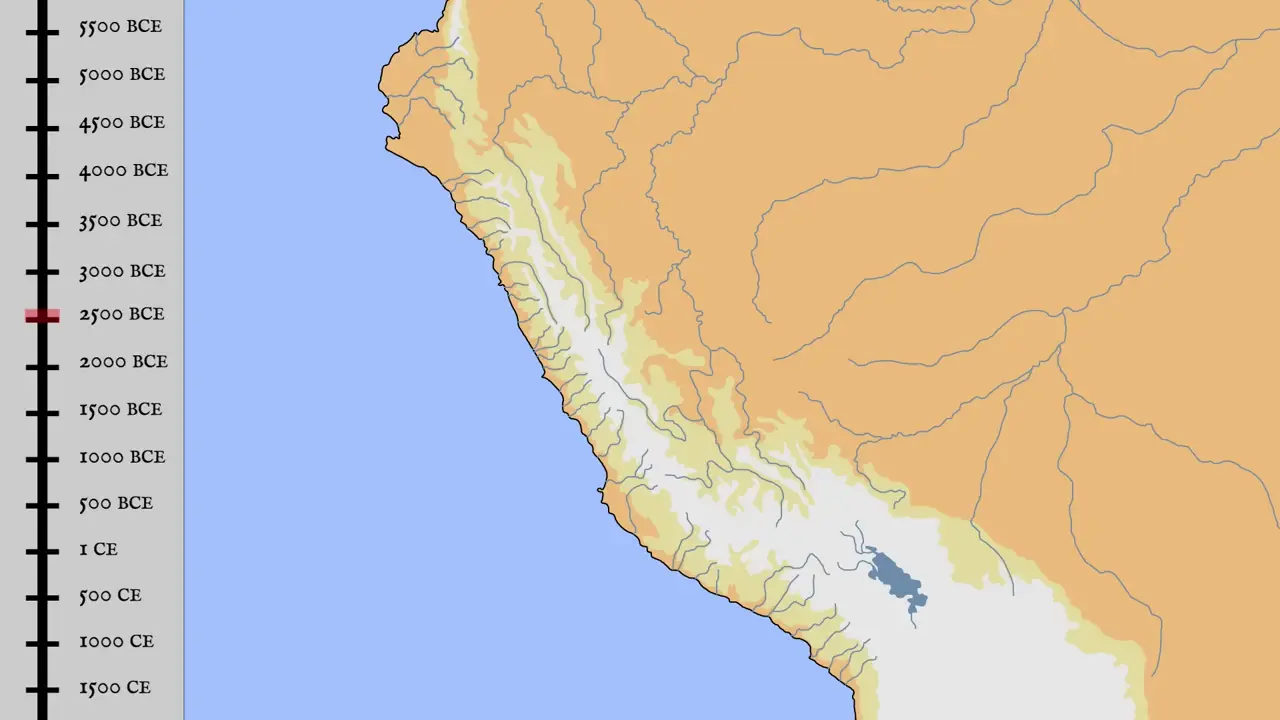
Inca masonry didn't appear from nowhere! It drew on more than two millennia of Andean stoneworking. Chavín's 4.5m granite Lanzón, Wari's fine ashlar work and Tiwanaku's fitted polygonal stones all predate Inca construction by centuries. Caral, dated to 2600 BCE, shows early monumental architecture, but mainly in adobe; later Andean cultures developed the stone techniques the Inca refined and deployed through the mit'a labor system.
Inca masonry drew on over two millennia of Andean stoneworking
Key facts
- Caral-Supe has a major monumental center dating to about 2600 BCE, but its architecture was primarily adobe; it should not be described as the earliest monumental stoneworking tradition.
- Chavín de Huántar was occupied around 1200–500 BCE, while Chavín culture flourished around 900–200 BCE; the Lanzón stela is about 4.5m tall and carved from granite.
- The Wari state, established around 600 CE, used and refined finely cut stone and ashlar masonry at its capital near Ayacucho.
- Tiwanaku refined highly fitted polygonal and rectangular ashlar masonry with carved stone decoration.
- Inca masonry drew on earlier Andean precedents, including Wari and Tiwanaku, separated from Inca construction by centuries.
- The mit'a labor system enabled the Inca state to mobilize large workforces for construction and other public works.
Sources
Caral–Supe civilizationen.wikipedia.org
Sacred City of Caral-Supewhc.unesco.org
Caral: The Oldest Civilization in the Americasperuforless.com
Caralen.wikipedia.org
Caral-Supe: the Oldest Civilization in the Americascountryreports.org
Was this story useful?
Keep exploring
Every site on this page sits on the globe, and the people who research them are on the Discord.
3D Globe · Sites by country · Story Archive · Research Library · Weekly Journal · Search
AI-generated text · images from the original sources · always verify with the sources.