

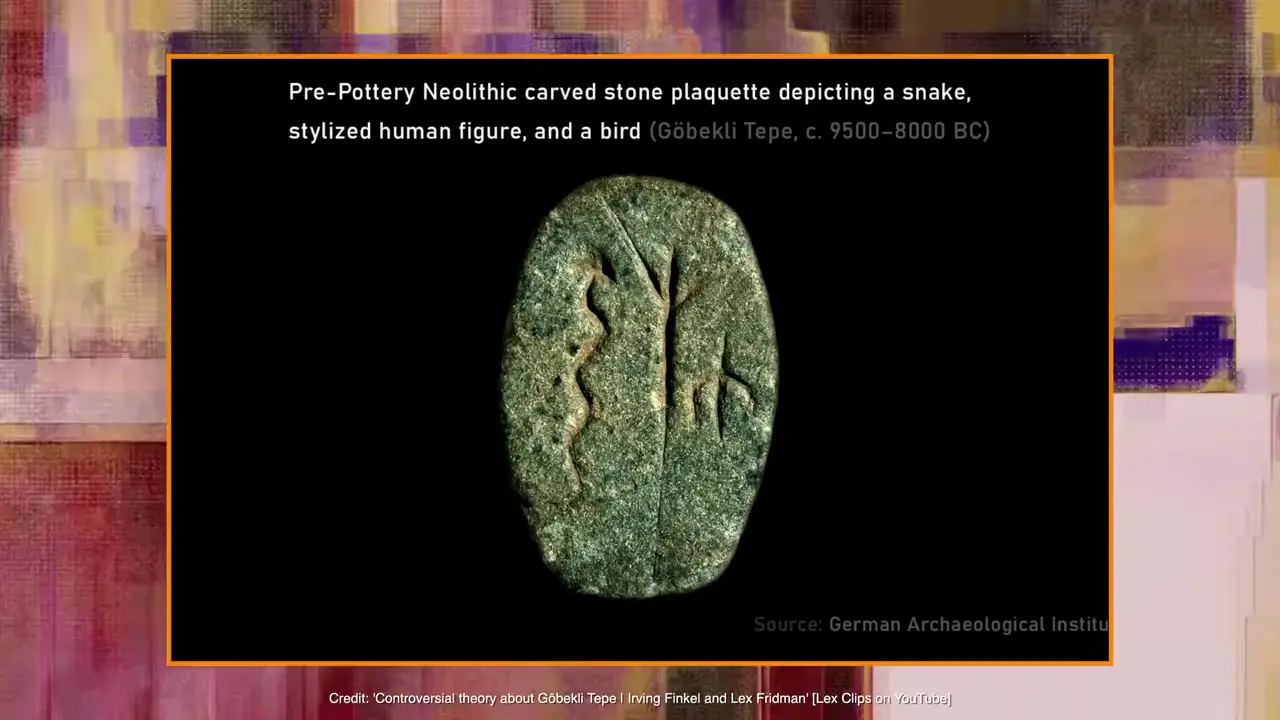
A video argues that a seal-like artifact from Göbekli Tepe, dated to about 9,000 BC, bears hieroglyphic-style signs and may push pictographic writing back millennia before cuneiform. The site's age and organizational complexity are well established; the artifact's status as writing is not. 🏛️
Göbekli Tepe began c. 9,600 BC; a video links a 9,000 BC artifact to early writing
 TürkiyeArtifact
Key facts
- Göbekli Tepe's earliest occupation and monumental enclosures date to roughly 9,600–9,500 BC, before widespread farming, cities and cuneiform.
- Some T-shaped pillars stand more than 5 metres high and weigh over 10 tonnes; they were arranged in organized circular enclosures bearing animal reliefs and abstract signs.
- A small green stone object with an incised flat face, commonly treated as seal-like and assigned to around 9,000 BC, bears signs that the video compares with hieroglyphs.
- The video argues that these signs represent early pictographic writing. Archaeologists have not established that interpretation as a writing system.
- The scale of the complex supports coordinated labor and long-term planning, while its symbols demonstrate symbolic behavior whose exact meaning remains unresolved.
- Less than 5% of the site has been excavated, not 10%.
Sources
Göbeklitepe | The Tepe Telegramstepetelegrams.wordpress.com
Göbekli Tepeen.wikipedia.org
Incised palette from Göbeklı Tepe. (Photograph courtesy of ...researchgate.net
Was this story useful?
Keep exploring
Every site on this page sits on the globe, and the people who research them are on the Discord.
3D Globe · Sites by country · Story Archive · Research Library · Weekly Journal · Search
AI-generated text · images from the original sources · always verify with the sources.