

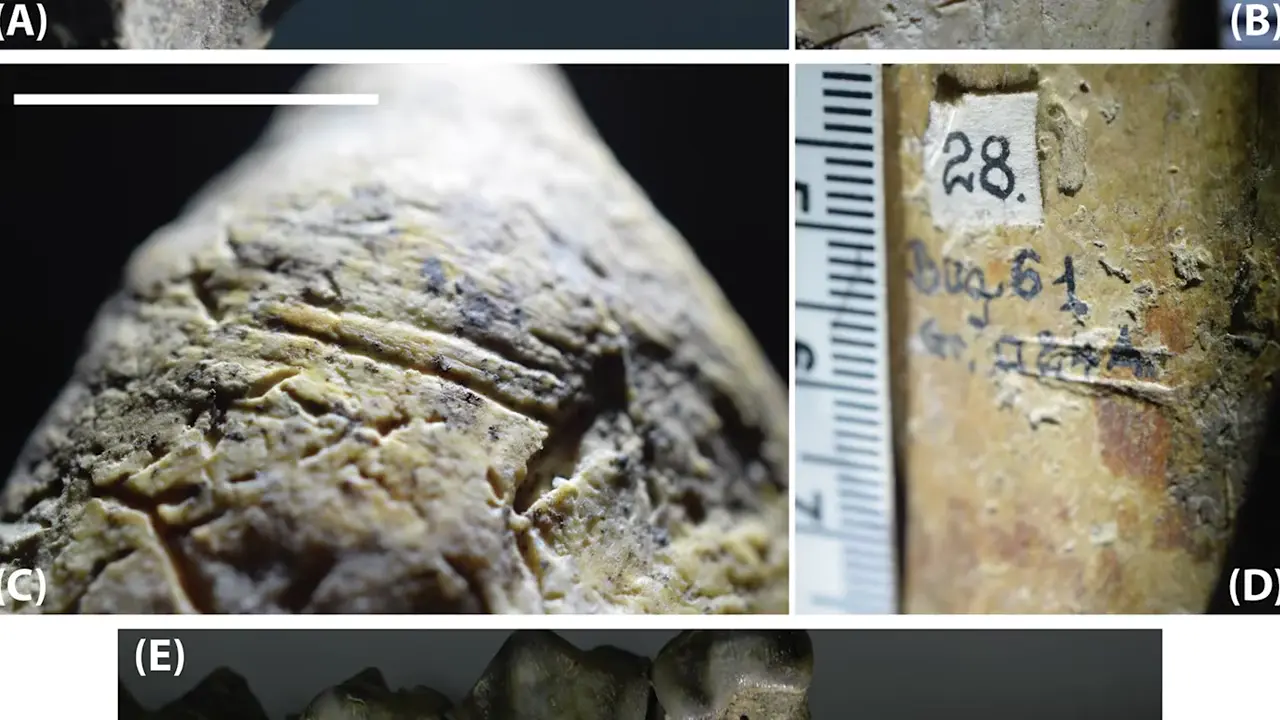
Grăunceanu in southern Romania yielded 4,983 animal bones originally thought river-deposited. But cut marks on 20 of them date to ~1.95 million years ago — among Europe's oldest hominin evidence. No tools or remains found, hinting that small-brained hominins (perhaps Homo habilis-like) had greater habitat flexibility than expected. 🔪
Grăunceanu: 1.95-million-year-old cut marks push back European hominin date
Site mentioned
📍 Grăunceanu
Key facts
- Site at Grăunceanu in southern Romania, on the border with Bulgaria
- Archaeologists recovered 4,983 ancient animal bones
- Bones were initially thought to be naturally deposited by a river
- Clear cut marks and scratch marks were identified on 20 of the bones
- Cut marks dated to approximately 1.95 million years ago, making this among the oldest evidence of hominins in Europe
- No stone tools or hominin remains were found at the site
- If correct, the first hominins in Europe may have been small-brained, resembling Homo habilis, showing greater habitat flexibility than expected
Sources
Oldest Human Traces in Europe Found in Romaniaromaniajournal.ro
The presence of homini about 2 million years old on Romanian territory has been confirmed in a recent study in Nature Communications.
Tiny cut marks on animal bone fossils reveal that human ancestors were in ...leakeyfoundation.org
Our team's first evidence that hominins butchered several animals at the site of Grăunceanu, in Romania, at least 1.95 million years ago.
Hominin presence in Eurasia by at least 1.95 million years agonature.com
by SC Curran · 2025 · Cited by 20 — Grăunceanu was originally excavated in the 1960s and is one of the best known Early Pleistocene sites from East-Central Europe. Biochronological ...
Context matters: Grăunceanu (Romania) is not an archaeological siteresearchgate.net
Grăunceanu (Romania) is not an archaeological site. The archaeological site of "Magura Uroiului" is one of the most complex sites in Romania
Oldest hominin evidence in Europe found in Romania, dating back 1.95 ...archaeologymag.com
New research at Romania's Grăunceanu site has uncovered evidence of hominin activity at least 1.95 million years ago, marking the oldest known hominin presence ...
Was this story useful?
Keep exploring
Every site on this page sits on the globe, and the people who research them are on the Discord.
3D Globe · Sites by country · Story Archive · Research Library · Weekly Journal · Search
AI-generated text · images from the original sources · always verify with the sources.