

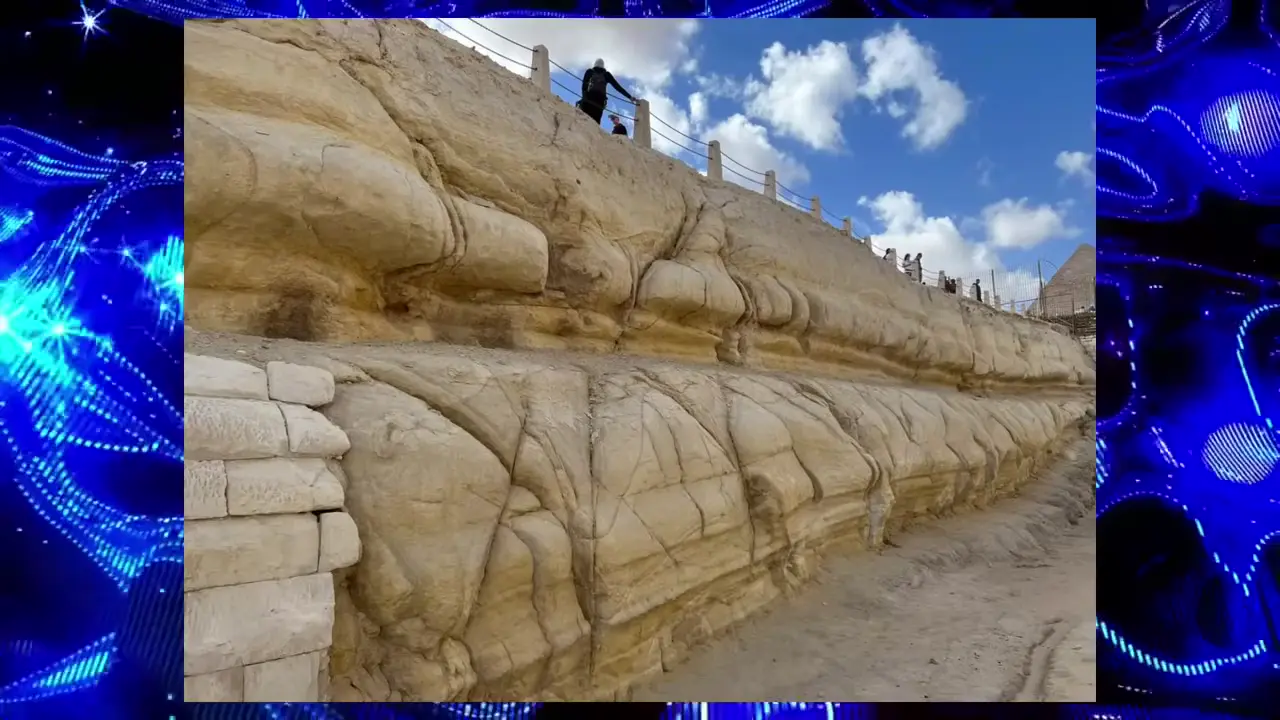
Great Sphinx carved from primordial mound during Green Sahara period 12,000-6,000 years ago. During the Green Sahara period (12,000-6,000 years ago), the Nile often reached the base of the rock outcrop that became the Great Sphinx The water was only a few inches deep, making the outcrop appear as an island piercing the Nile River This aligns with Egyptian mythology of the primordial mound (Benben) emerging from waters at creation
The theory proposed by Graham Hancock and Robert Schoch suggests that during the Green Sahara period (12,000-6,000 years ago), the Nile may have reached closer to the Giza plateau, where the rock outcrop that became the Great Sphinx is located. Schoch's water erosion hypothesis proposes the Sphinx enclosure shows water erosion patterns consistent with heavy rainfall that ended around the Green Sahara period. This aligns with Egyptian mythology of the primordial mound 'Benben' emerging from waters at creation. The Sphinx faces due east, oriented to the rising sun, and ancient Egyptians associated it with Harmakhet, meaning 'Horus of the horizon.' However, most mainstream scholars date the Sphinx to the 4th Dynasty (c. 2472–c. 2448 BCE), placing its construction thousands of years after the Green Sahara ended.
Note: The original claim about the Nile having only inches of deep water making the outcrop appear as an island lacks scholarly consensus and has not been established through mainstream geological research. The specific claim that the Nile 'often reached the base of the rock outcrop' is an extrapolation from Hancock and Schoch's controversial theories, not verified fact.
Key Facts
- During the Green Sahara period (12,000-6,000 years ago), the Nile often reached the base of the rock outcrop that became the Great Sphinx
- The water was only a few inches deep, making the outcrop appear as an island piercing the Nile River
- This aligns with Egyptian mythology of the primordial mound (Benben) emerging from waters at creation
- The Sphinx faces due east, oriented to the rising sun
- Ancient Egyptians believed Harmakhet means 'Horus of the horizon' or 'Horus in the horizon'
- The sun and Leo met on the horizon during Nile flooding season around June
- The pit around the Sphinx enclosure was likely dug to maintain the symbolic primordial mound as water receded
Related site: Great Sphinx of Giza — view location, images, and history on the Ancient Nerds map.
Source: The Second Egyptian Sphinx is in the Sky #archaeology #egypt #sphinx #ancientastronomy #history by DeDunking