

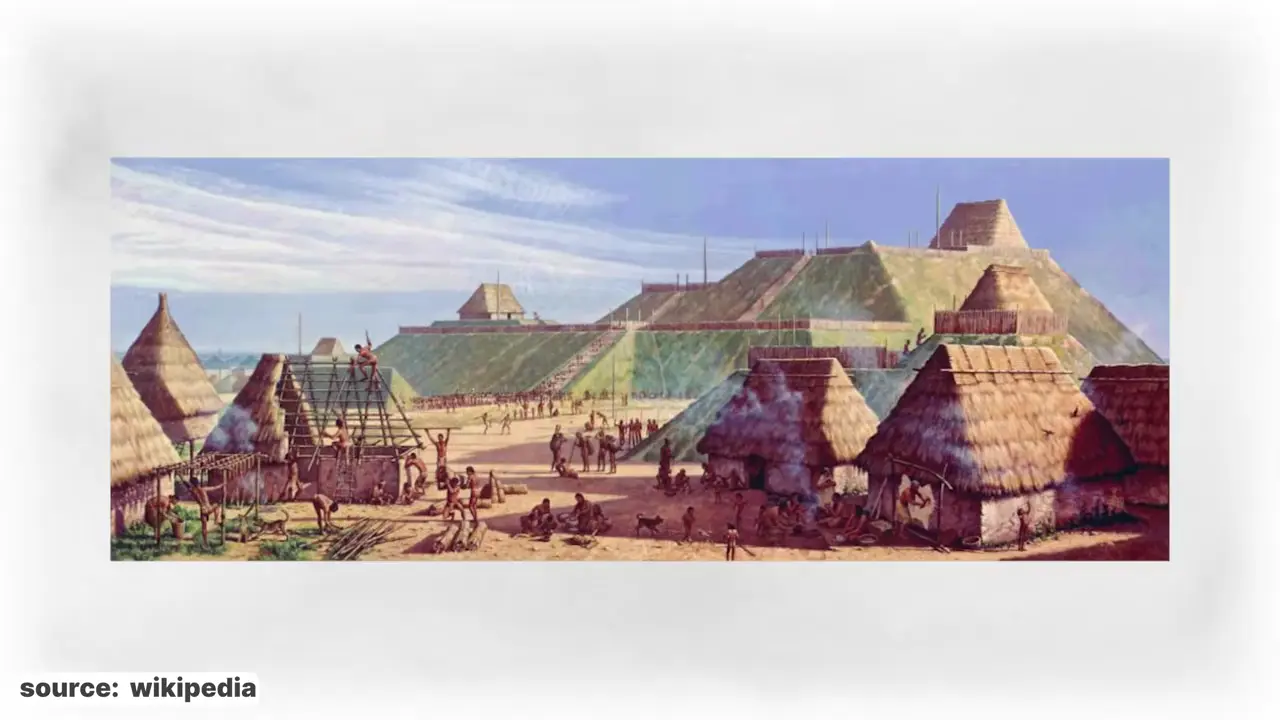
Mississippian civilization is usually dated from around 900 CE until European contact — the 1539–1541 de Soto expedition met city after city. Cahokia is called the first Mississippian city, with 20,000 people by 1100 CE and over 50,000 including satellite towns; dozens of other cities reached 5,000–10,000. Scholars use the "Mississippian Shatter Zone" to describe how a shared cosmology fragmented among descendant communities displaced from their lands, linking SECC art with living Native American myth. Five recurring concepts: a three-tiered cosmos (sky, earth, underworld) with the sun passing through below at night; a Great Spirit creator — solar on a hill amid water for Muscogee, Creek and Choctaw, a hands-off creator for Ho-Chunk and Ojibwe; the Ho-Chunk culture hero Red Horn, matching a ceramic figurine rolling a chunkey disk, the Gottschall Rockshelter painting in Wisconsin and an SECC arrow-with-lungs symbol; twins like Civilized Boy and Afterbirth Boy in the Caddo story, carved into conch shells and painted on ceramics; and the Milky Way as the road of the dead, attested from Chile to Alaska. A snake-wrapped frame around an open hand with an eye in the palm may show the Milky Way and its dark patch — but it's not proof of pre-Columbian contact with Asia or the Middle East. Adena ancestors were building charnel houses by 500 BCE, a practice later used by Hopewell and still by the Mississippians. 🌌
Five Mississippian cosmological concepts tied to descendant oral traditions
Key facts
- Mississippian civilization is described as beginning around 900 CE and lasting until European contact, with the 1539-1541 de Soto expedition encountering city after city; Cahokia is called the first Mississippian city, with a population of 20,000 by 1100 CE and over 50,000 counting satellite towns, while dozens of other cities reached 5,000-10,000 people.
- The 'Mississippian Shatter Zone' term describes how a formerly shared cosmology fragmented among descendant communities displaced from their ancestral lands; linking SECC art with modern Native American mythology is the key research approach.
- Point one: a three-tiered cosmos of sky, earth surface and underworld, with the sun passing through the underworld at night.
- Point two: a Great Spirit creator, described by Muscogee, Creek and Choctaw as a solar deity on a hill surrounded by water, and by Ho-Chunk and Ojibwe as a hands-off creator not depicted in ancient art.
- Point three: the Ho-Chunk culture hero Red Horn, whose story correlates with Mississippian art - a ceramic figurine rolling a chunkey disk, the Gottschall Rockshelter cave painting in Wisconsin showing Red Horn, the turtle and the thunderbird, and an SECC arrow-with-lungs symbol.
- Point four: twins, including Civilized Boy and Afterbirth Boy in the Caddo story, with twins carved into conch shells and painted on Mississippian ceramics.
- Point five: the Milky Way as the road of the dead to the underworld, attested from Chile to Alaska; in some Mississippian art a snake body wraps a round frame around an open hand with an eye in the palm, possibly the Milky Way and its dark patch.
- The video argues the hamsa-like hand-and-eye symbol is not proof of pre-Columbian contact with Asia or the Middle East.
- Ancestors of the Mississippians, the Adena, began building charnel houses around 500 BCE, a practice later used by Hopewell and still by the Mississippians.
Sources
Mississippian period (archaeology)en.wikipedia.org
this urban center likely peaked in population and power around 1124 [8] with at least 22,400 people, and possibly a few thousand more in St. Louis.
Cahokia Mounds | History, Location, Age, Map, Illinois, & ...britannica.com
Cahokia reached its peak between 950 and 1350 CE, with a population of possibly 20,000 individuals, though some estimates reach 40,000. Cahokia was the most ...
Cahokia: A Pre-Columbian American Citygilderlehrman.org
By 1200, the population of the city had probably fallen to less than 5,000 people; by 1250, that figure was probably no more than 2,000.
Cahokia - ORIAS - UC Berkeleyorias.berkeley.edu
Cahokia reached its highest population around 1100 CE with about 15,000-20,000 people, which was probably a little more than the populations of London and Paris ...
Ancient Cahokia and the Mississippian Culturemythicmississippi.illinois.edu
between AD 700-1000, At its peak, between approximately AD 1050-1150, Perhaps 15,000 – 20,000 people resided in Greater Cahokia. Another 30,000-40,000 people ...
Was this story useful?
Keep exploring
Every site on this page sits on the globe, and the people who research them are on the Discord.
3D Globe · Sites by country · Story Archive · Research Library · Weekly Journal · Search
AI-generated text · images from the original sources · always verify with the sources.