

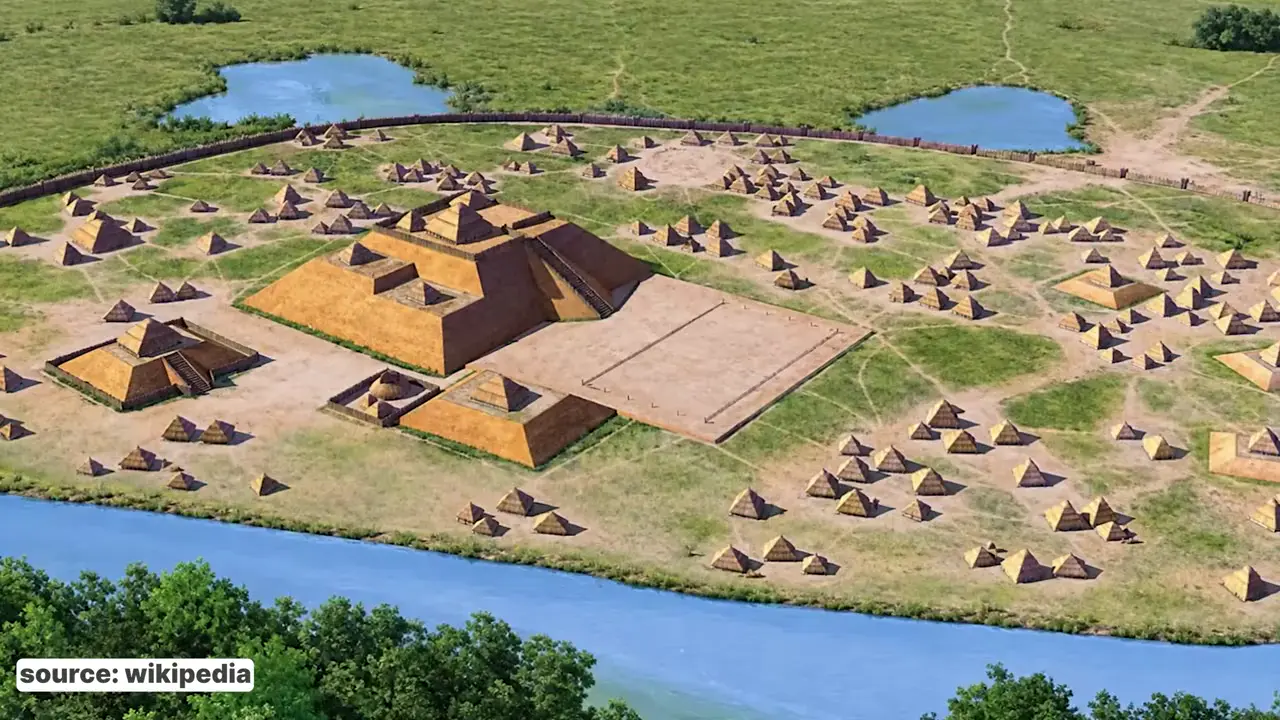
Etowah in northwestern Georgia flourished from about 1000 CE into the 1540s, peaking in the 1300s with several thousand residents, six earthen pyramids, a 54-acre plaza and a palisade 12 ft tall with watchtowers every 80 ft and a 10-ft-deep moat. A deliberately planted grove of walnut, hickory, chestnut and persimmon formed an arrow screen. Mound A rose 63 ft over 3 acres, and 140 houses inside the walls suggest just under 1,000 inhabitants inside, thousands more outside. Over a hundred V-shaped fishing weirs were recorded along the Etowah River, and corn, beans and squash filled the valley. The Rogan plates show Etowah warriors as thunderbirds with maces and severed heads, scalps hanging from their belts; Mound C yielded ten stone statues about 2 ft tall, the finest pair carved in white marble from a log tomb and possibly elite portraits. The site ran from a village at 200 BCE through a transformation around 1000 and a 50-year abandonment near 1200. Colonel Lewis Tumlin bought the land in 1832; Cyrus Thomas and Joe Rogan worked there from 1883; Warren Moorehead led the biggest dig from 1925; the family sold to the Georgia Historical Commission in 1953, and it became a National Historic Landmark in 1965. The Muscogee Nation is recognized as Etowah's direct descendants, with thousands of artifacts repatriated in 2022. And a cacao DNA claim? The sherds were collected in the 1950s, sat for 70 years, and were deteriorated and fragmentary, with modern cacao DNA used to fill gaps — earlier chemical work found theobromine and caffeine, but yaupon holly black drink contains the same alkaloids. Treat it as disputed. 🍫
Etowah's marble statues and a disputed DNA claim for chocolate
 USAGeneral
Key facts
- Etowah flourished in northwestern Georgia from about 1000 CE into the 1540s; at its 1300s peak it had several thousand residents, six earthen pyramids, a 54-acre plaza and a palisade wall.
- The palisade stood 12 ft tall with watchtowers every 80 ft and a 10-ft-deep moat outside; a deliberately planted nut-tree grove of walnut, hickory, chestnut and persimmon formed a screen against arrows.
- Mound A, the largest pyramid, stood 63 ft tall and covered 3 acres; 140 houses were found within the walls, with an estimated just under 1,000 inhabitants inside the walls and thousands more outside.
- Over a hundred V-shaped fishing weirs were recorded along the Etowah River, and corn, beans and squash were farmed along the valley.
- Art included Braden style copper and ceramic pieces identified as Cahokia trade goods, with much copper from the Great Lakes; the Rogan plates are copper plates showing Etowah warriors as thunderbirds holding maces and severed heads, with scalps hanging from their belts.
- Hundreds of carved shell gorgets and cups were recovered, with twins, spiders, piasa, swastikas and sunbursts among the motifs; Mound C yielded 10 stone statues about 2 ft tall, the finest pair from a log tomb carved in white marble and thought to be portraits of elite families.
- A village existed at Etowah as early as 200 BCE; transformation into a Mississippian site began around 1000 with pyramids, small rectangular houses and new fishing weirs, and after a 50-year abandonment around 1200 the community regrew from 1250 to 1375 when the palisade and nut-tree buffer were added.
- Colonel Lewis Tumlin bought the land in 1832 and protected the mounds; Smithsonian archaeologists Cyrus Thomas and Joe Rogan worked there from 1883 for two years; Warren Moorehead led the largest excavation beginning in 1925, digging Mound C.
- The Tumlin family sold Etowah to the Georgia Historical Commission in 1953; it became a public park with a site museum and was designated a National Historic Landmark in 1965.
- The Muscogee Nation was recognized as Etowah's direct descendants, and in 2022 thousands of artifacts were repatriated to the Muscogee Nation.
- A DNA study reported evidence of cacao consumption at Etowah, suggesting trade with Central America; the video notes the DNA came from potsherds collected in the 1950s and stored for 70 years, was deteriorated and fragmentary, and that modern cacao DNA was used to fill gaps.
- Earlier chemical analyses had found theobromine and caffeine in Mississippian ceramic cups, but the same alkaloids occur in the black drink brewed from yaupon holly leaves, which had been the standard interpretation.
Sources
Etowah | Grove Artoxfordartonline.com
The site was surrounded by palisades with outworks. Within the village area were three large mounds arranged around an open plaza. Mound A, the largest, has ...
Etowah Mounds - Ditch and Palisade Earthwork, Georgiamegalithic.co.uk
The ditch at Etowah Mounds is considered to be a defensive structure that forms a discontinuous, roughly semi-circular boundary around the site.
Etowah Mounds and village site | Environmental Sciencesebsco.com
Spanning 50 acres along the Etowah River, the settlement was fortified with a stockade and moat, featuring two large plazas and seven mounds, including three ...
The Etowah Mounds Metropolis of the South Appalachian ...heritagedaily.com
Many archaeologists believe that the palisade functioned as a defensive structure to protect the Etowah from the chiefdom polity of the ...
Etowahdennisrhollowayarchitect.com
The site was protected on three sides by a curved wooden palisade and moat and on the south by the river. The people of Etowah may have battled with the people ...
Was this story useful?
Keep exploring
Every site on this page sits on the globe, and the people who research them are on the Discord.
3D Globe · Sites by country · Story Archive · Research Library · Weekly Journal · Search
AI-generated text · images from the original sources · always verify with the sources.