

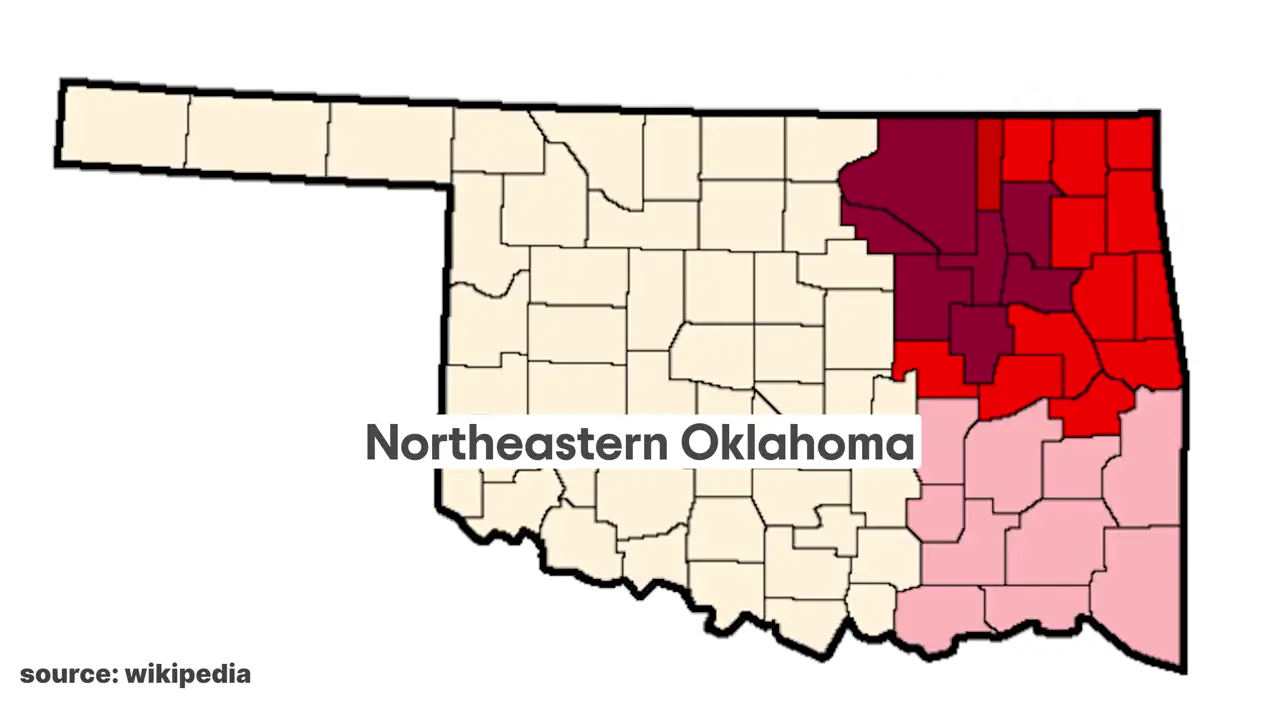
Spiro in northeastern Oklahoma peaked in the 14th century with over 10,000 people, at least 12 earthen pyramids, an 80-acre grand plaza, hundreds of rectangular multi-family houses and a chunkey court. Occupation began around 800 CE, pyramid building around 900 — and Plum Bayou ceramics appear in Spiro's earliest pyramid phases, alongside Coles Creek wares from eastern Louisiana, giving Spiro a pedigree from two earlier mound-building cultures. By about 1000 CE it traded tens of thousands of Olivella shell beads from the Channel Islands off California and green obsidian from the Pachuca mines north of Mexico City — the only known Mesoamerican artifacts in the Mississippian world. Spiro never built a palisade. Art included Braden style copper and shell, marine carvings with piasa and underwater panther motifs, a wooden deer-antler mask, humanoid spiders, and hands with eyes in their palms; weapons included thousands of color-grouped arrowheads and 30 copper-headed axes with carved wooden handles. Then the looting: in 1933 George Evans sold the land to the Pocola Mining Company for $100, and miners dug Craig Mound for three years, opening the Great Mortuary — a shaft tomb with cedar-trunk walls and a floor covered in mats and textiles, whose sealed chamber preserved perishable material that crumbled on exposure to air. Witnesses saw feathers and textile fragments blowing across the excavation. The Kansas City Star called it the "King Tut of the Arkansas Valley." The University of Oklahoma and CCC crews cleaned up in 1936, revealing the sequence: one mound and charnel house, then four mounds with buried charnel houses, the Great Mortuary added in the late 1300s, and a clay plaster cap around 1400. Since NAGPRA, the Caddo Nation and Wichita tribe have been recognized as Spiro's direct descendants. 🏺
Spiro's Craig Mound Great Mortuary looted for shells and copper
 USAGeneral
Key facts
- Spiro, in northeastern Oklahoma, had over 10,000 people at its 14th-century peak, with at least 12 earthen pyramids, an 80-acre grand plaza, hundreds of rectangular multi-family houses and a chunkey court.
- Occupation began around 800 CE as a farming village on the Arkansas River; pyramid building started around 900, at the same time as Cahokia's first pyramids.
- Plum Bayou ceramics appear in Spiro's earliest pyramid phases, as do Coles Creek ceramics from eastern Louisiana, giving Spiro a pedigree from two earlier pyramid-building cultures.
- Spiro marks a decline around 1200, connected with Cahokia's abandonment, then rebounded into its peak between 1250 and 1350 with long-distance trade ties to Moundville and Etowah.
- By around 1000 CE Spiro had a far-reaching western trade network: tens of thousands of Olivella shell beads from the Channel Islands off California and green obsidian from the Pachuca mines north of Mexico City, the only known Mesoamerican artifacts in the Mississippian world.
- Spiro never built a palisade wall and its houses were larger multi-family structures; its region is termed Caddoan Mississippian.
- Art included Braden style copper and shell pieces, marine shell carvings with piasa and underwater panther motifs, a wooden deer-antler mask, humanoid spiders and hands with eyes in their palms; weapons included thousands of color-grouped arrowheads, 30 axes with copper heads and wooden handles carved with birds, stone effigy axes and long-nose copper ear ornaments.
- In 1933 George Evans sold the Spiro land to the Pocola Mining Company for $100, and for three years miners dug artifacts out of Craig Mound, a group of four mounds under a final cap containing dozens of graves and the Great Mortuary, a shaft tomb dug from the top with cedar-trunk walls and a floor covered with mats and textiles.
- The sealed chamber preserved perishable materials that were destroyed on exposure to air; witnesses reported feathers and textile fragments blowing around the excavation.
- The Kansas City Star called the chamber the 'King Tut of the Arkansas Valley'; the University of Oklahoma with CCC crews cleaned up Craig Mound in 1936, revealing its construction sequence - a single burial mound and charnel house, then four mounds with buried charnel houses, the Great Mortuary added in the late 1300s, and a clay plaster cap around 1400.
- Since NAGPRA, the Caddo Nation and Wichita tribe have been recognized as Spiro's direct descendants and some burial goods have been repatriated.
Sources
Spiro Mounds; Oklahoma's Past Indian History Lesson Planeduref.org
The Spiro site reached its peak as an inhabited ceremonial center between A.D. 900 and 1200 when the village and public buildings covered nearly 100 acres, with ...
Investigating Spiro Mounds - Arkansas Archeological Surveyarcheology.uark.edu
During the height of its looting in the winter of 1935, the Spiro site—located in northeastern Oklahoma just 10 miles west of Fort Smith—was catapulted to fame
Spiro Moundsen.wikipedia.org
Harlan Phase (1050–1250 CE) Norman Phase (1250–1350 CE) Spiro phase (1350–1450 CE) dramatically around 1250 CE, the mounds were built during the Harlan Phase. ...
Spiro Mounds Archaeological Centertravelok.com
Spiro Mounds were created and used by Caddoan speaking Indians between 850 and 1450 AD. The site features one burial mound, two temple mounds and nine house ...
Spiro Mounds Archaeological Centerokhistory.org
until AD 800 and was used until about AD 1450. The site was added to the National Register of Historic Places in 1969, and Spiro Mounds Archaeological Center ...
Was this story useful?
Keep exploring
Every site on this page sits on the globe, and the people who research them are on the Discord.
3D Globe · Sites by country · Story Archive · Research Library · Weekly Journal · Search
AI-generated text · images from the original sources · always verify with the sources.