

The Harbin “Dragon Man” cranium, found in 1933 during bridge work over the Songhua River in northeastern China, is at least 146,000 years old. An international paleoproteomics team identified it as Denisovan in 2024. A Chinese-led team had proposed Homo longi as a distinct species in 2021, but did not establish that it was unrelated to Denisovans. If accepted as a distinct taxon, H. longi could be the formal species name for the Harbin population. Local stories of “walking black dragons” in Manchuria have been suggested as possible memories of Denisovans, but that connection remains speculative; Denisovans survived until roughly 45,000 years ago.
Dragon Man skull identified as Denisovan; Homo longi may name the Harbin population
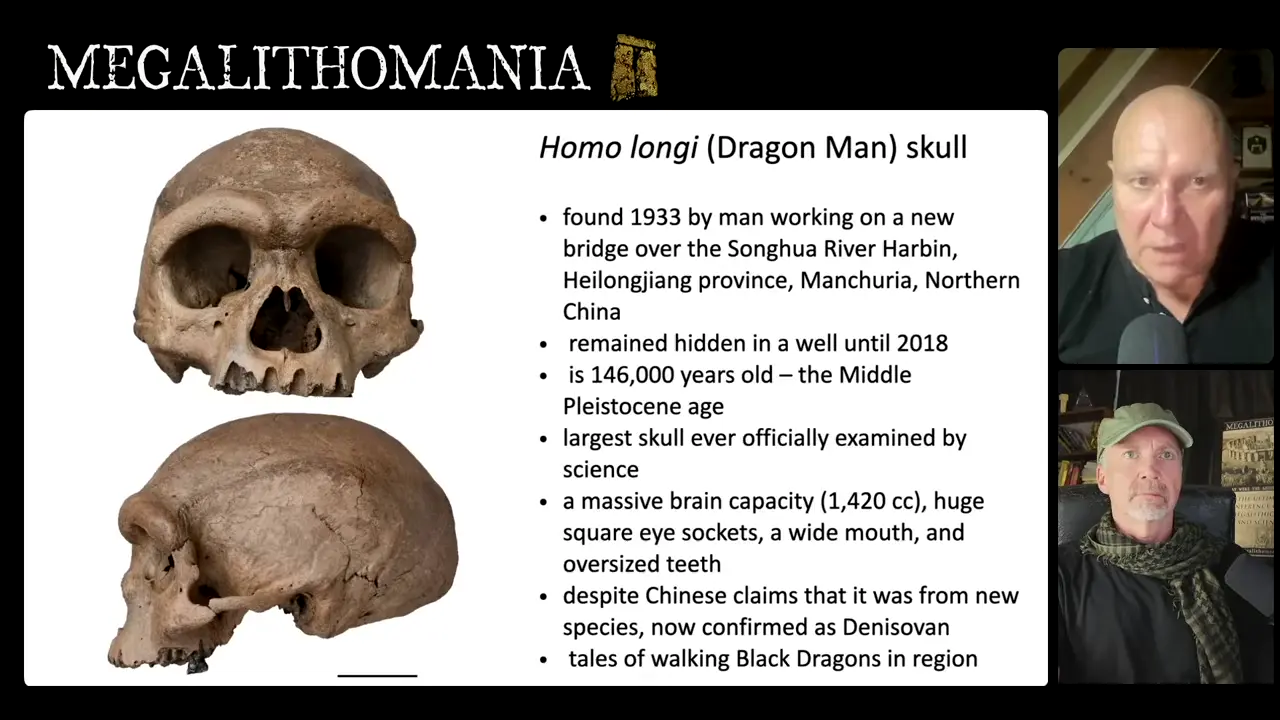
Key facts
- The Harbin cranium was discovered in 1933 during bridge construction over the Songhua River in Harbin, Heilongjiang, China.
- It is at least 146,000 years old and is among the largest known human crania, with an estimated brain volume of about 1,500 cm³.
- A Chinese-led team led by Qiang Ji proposed Homo longi (“Dragon Man”) as a new species in 2021; the work did not establish that it was unrelated to Denisovans.
- An international team using paleoproteomics identified the specimen as Denisovan in 2024.
- If taxonomically accepted, Homo longi could be the formal species name for the Harbin population, but it would not automatically apply to every Denisovan fossil.
- Stories of “walking black dragons” in Manchuria have been suggested as possible memories of Denisovans, but that connection is speculative; Denisovans survived until roughly 45,000 years ago.
Sources
Ancient 'Dragon Man' skull from China isn't what we thoughtlivescience.com
Scientists have determined that a giant skull from an ancient human relative named the "Dragon Man" is actually Denisovan.
Scientists hail stunning 'Dragon Man' discoverybbc.com
Chinese researchers unveil an ancient skull that could belong to a completely new species of human.
Harbin craniumen.wikipedia.org
The Harbin cranium is a nearly complete skull of an archaic human thought to originate from sediments of the Songhua River near Harbin on the Northeast China ...
'Dragon Man' skull belongs to mysterious human relativescience.org
He dubbed the skull Homo longi—derived from the Mandarin word for dragon. Yet other bones that might eventually be identified as Denisovan ...
This is the first ever confirmed skull of a Denisovannationalgeographic.com
Artist John Gurche created this model, based on the "Dragon Man" skull, depicting how Homo longi may have appeared when they lived during the ...
Denisovanen.wikipedia.org
Based on the Harbin cranium, like other archaic humans, the skull is low and long, with massively developed brow ridges, wide eye sockets, and a large mouth.
A Denisovan skull–at last!whyevolutionistrue.com
The Harbin skull was first made known to science in 2018, and was named Homo longi in 2021. I have been able to access only the DNA paper, not ...
Denisovans: The enigmatic ancient humans who finally ...nhm.ac.uk
The Harbin cranium or Dragon Man skull, found in the sediments of the Songhua River in northeastern China, is the holotype for Homo longi.
Was this story useful?
Keep exploring
Every site on this page sits on the globe, and the people who research them are on the Discord.
3D Globe · Sites by country · Story Archive · Research Library · Weekly Journal · Search
AI-generated text · images from the original sources · always verify with the sources.