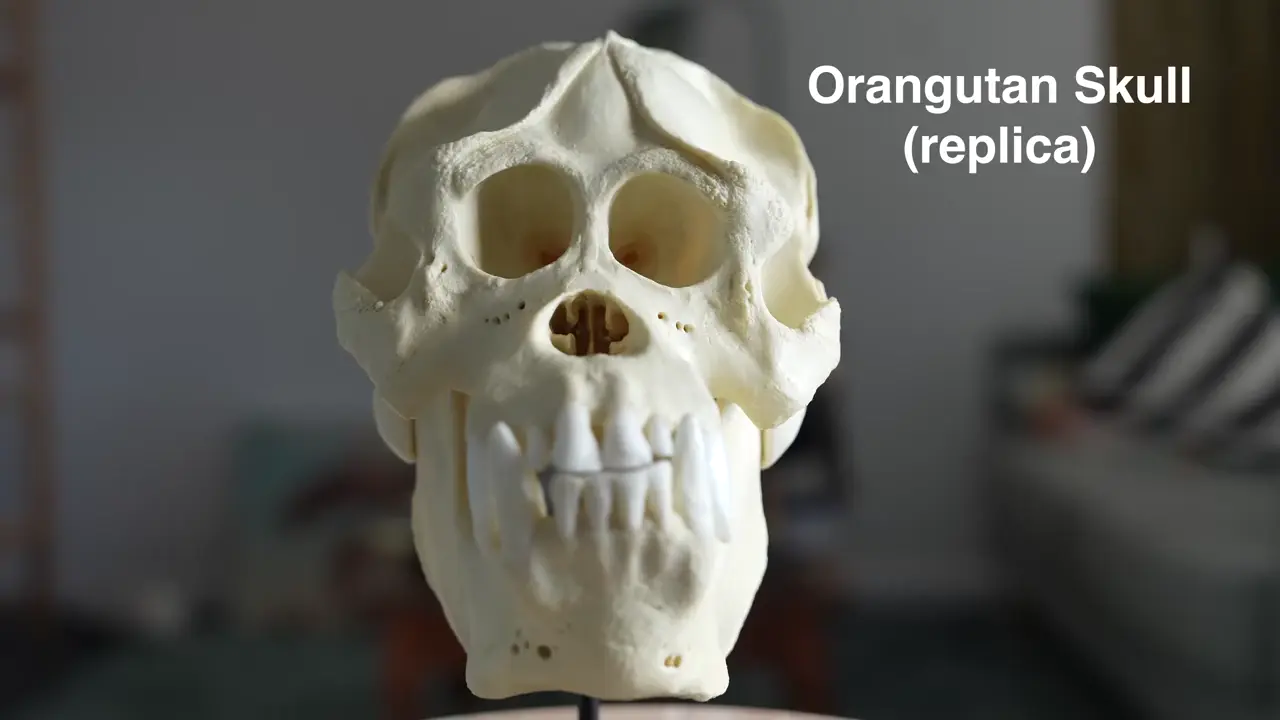
What makes a primate? Forward-facing eyes for depth perception, a post-orbital bar or complete post-orbital closure (bony ring or full enclosure behind the eye), broad-based posterior teeth, diverging thumbs and big toes, and flat nails instead of claws. These shared traits define our entire primate family. 🐒
Key facts claimed:
- Primates have forward-facing eyes for depth perception
- Primates have a post-orbital bar (strepsirrhines) or complete post-orbital closure (haplorhines) — not all primates have fully encased eye sockets
- Primates have broad-based posterior teeth
- Primates have diverging thumbs and big toes, with friction pads on hands and feet
- Primates have nails instead of claws — flattened distal digits on fingers and toes
Sources
Postorbital bar - Wikipediaen.wikipedia.orgIt is a trait that occurs in some mammalian taxa, such as most strepsirrhine primates and the hyrax, while haplorhine primates have evolved fully enclosed ...
Reoriented Use of Sensesluna.cas.usf.eduAs a result, primate skulls are shaped in a way to maximize their vision. The eyes of primates are located in the front of the face, rather than on the side of ...
Evolution: Why do your eyes face forwards? - BBCbbc.com... primate ancestors grabbing an insect from the branch of a tree. ... Not all predators, after all, have forward facing eyes. Cats, primates ...
Stereopsis in animals: evolution, function and mechanisms - PMCpmc.ncbi.nlm.nih.govFor many years, stereopsis was thought to be confined to primates and other mammals with front-facing eyes. ... vision in non-primate and non-mammalian systems.
AI-generated text · images from the original sources · always verify with the sources.