

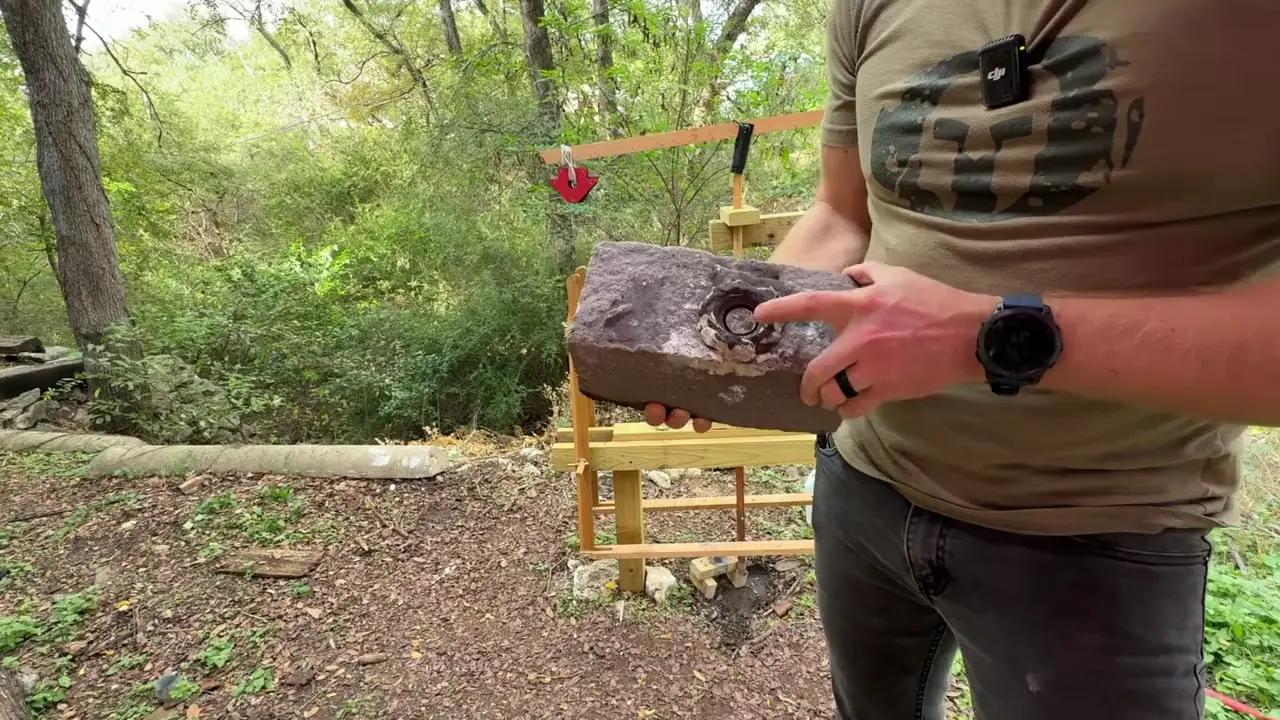
Building a small clay collar at the rim to hold grit and water roughly doubled the cutting rate compared with a wide moat. By day four: over seven hours logged, hole about 3/8 inch deep, and only an eighth inch of copper lost from a plumbing pipe bit 🏺💧
Clay collar holding grit doubles cutting rate in experimental granite drilling
Key facts
- Building a small clay collar or dam close to the rim of the hole, to retain grit and water, roughly doubled the cutting rate compared with a wide moat that let grit spread into a puddle.
- A constant column of grit above the work keeps the abrasive feeding in and reduces copper wear; without enough grit underneath, the copper bit wears down quickly.
- Loose grit that can be recharged is preferred; the presenter's batch is rinsed out and replaced about every five minutes, and gluing grit to the copper is considered unnecessary and impractical.
- Quartz sand is noted as readily available locally in Egypt for use as abrasive.
- By day four he had logged over seven hours of cutting (about four hours on the best day) and measured the hole at roughly 3/8 inch deep with a toothpick marker.
- He reported only about an eighth inch of copper loss after replacing the copper teeth once, using ordinary plumbing copper pipe, and observed the start of a taper roughly three times the pipe's wall thickness.
- Grinding was stopped twice by rain, which diluted the grit and reduced cutting consistency.
Sources
Expedition Magazine | Ancient Egyptian Stone-Drillingpenn.museum
This occurred when sand and crushed quartz were used with either a copper rod or copper tube. No lines occurred when these were added loose, either dry or wet ( ...
5300-year-old 'bow drill' rewrites story of ancient Egyptian ...phys.org
A new study reveals that Egyptians were using a mechanically sophisticated drilling tool far earlier than previously suggested.
Ancient Egyptian drill bit - Press Officencl.ac.uk
A new study reveals that Egyptians were using a mechanically sophisticated drilling tool far earlier than previously suggested.
Egyptian copper drill changes historical crafting timelinejpost.com
The tool, he argues, suggests that Egyptian craftspeople mastered reliable rotary drilling more than two millennia before the best-preserved ...
Ancient Egyptian Copper Coring Drillshallofmaat.com
The drilling was conducted by a team of three workman using dry sand as an abrasive. Two workmen operated the bow at either end, and the third held the capstone ...
Was this story useful?
Keep exploring
Every site on this page sits on the globe, and the people who research them are on the Discord.
3D Globe · Sites by country · Story Archive · Research Library · Weekly Journal · Search
AI-generated text · images from the original sources · always verify with the sources.