

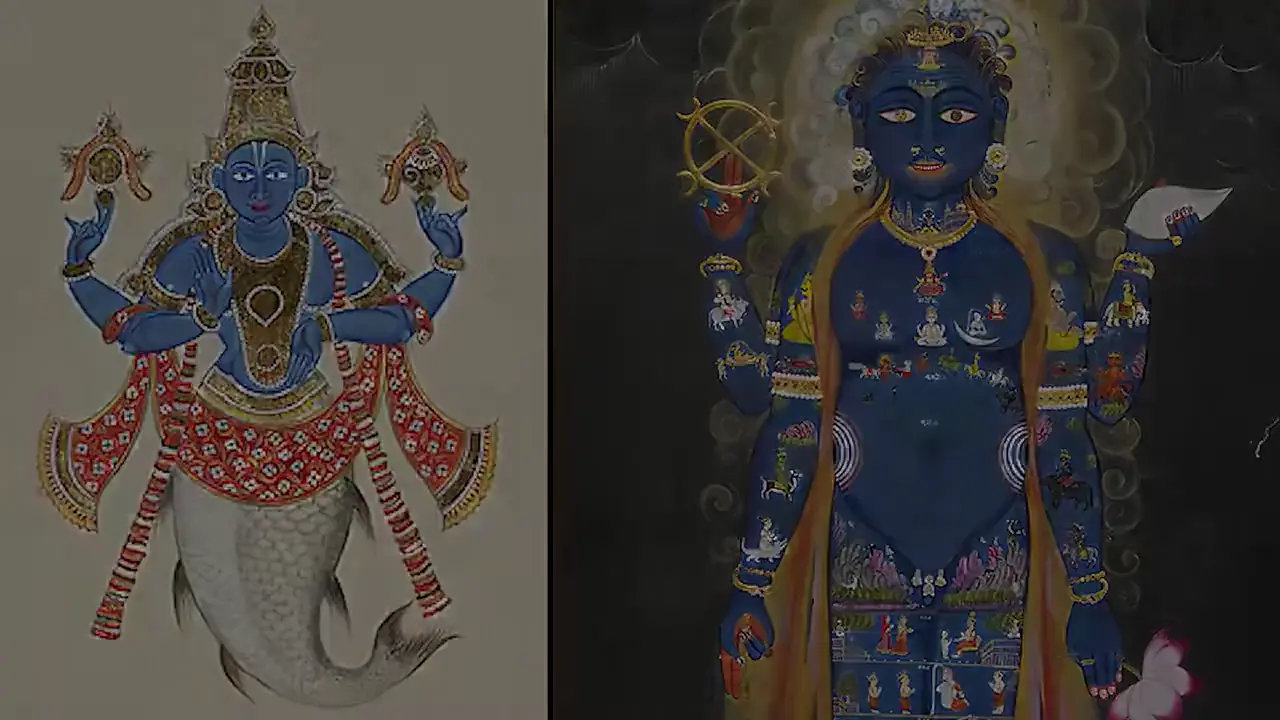
Blue gods were not unique to India: Amun was usually blue and sometimes black, while Hapi and several Aztec gods had blue imagery; Osiris is more often green. The oldest surviving Vedic hymns, especially the Rigveda (c. 1500–1200 BCE), refer to deities with blue or dark associations. Sanskrit shyama and nila cover dark blue or blackish and blue, azure or blue-green. The 1st-century CE claim is wrong: blue deities appeared in much earlier art, and indigo from Indigofera tinctoria was used in India before the Common Era. The video argues for three shades—cosmic shyama, nila and destructive shyama—but this is its own interpretive framework, not an established classification. Shiva may be ash-white and blue-throated, though he is also often shown blue-skinned. The video also proposes methemoglobinemia, which can turn skin blue at around 15%, as a possible influence; that remains a hypothesis, not an established explanation.
Blue deities: ancient examples and the video’s three-shade theory
Key facts
- Amun was usually blue and sometimes black, supporting the cross-cultural comparison. Hapi and some Aztec gods also had blue iconography, but Osiris is more commonly green, while colors for Thoth and Quetzalcoatl vary by depiction.
- The earliest surviving Vedic hymns, especially the Rigveda (c. 1500–1200 BCE), contain blue or dark color descriptions associated with deities—about 3,500 years ago, not a full 4,000.
- Sanskrit shyama can mean dark blue or blackish; nila can mean blue, azure or blue-green.
- Blue deities were depicted long before the 1st century CE, and indigo from Indigofera tinctoria was used in India before the Common Era. The claim that blue visual depictions first became possible in the 1st century CE is incorrect.
- The video argues for three shades—cosmic shyama, nila and destructive shyama. This is the presenter’s interpretive scheme, not an established canonical classification.
- Brahma and Ganesha have varied iconographic colors. Shiva can be ash-white and blue-throated, but is also frequently represented with blue skin, so “only his throat blue” is not generally correct.
- Methemoglobinemia can cause a cyanotic skin tint at levels around 15%. The video presents it as a possible influence on blue deity imagery, not a demonstrated origin.
Sources
Amunen.wikipedia.org
Amun was a major ancient Egyptian deity who appears as a member of the Hermopolitan Ogdoad. Amun was attested from the Old Kingdom together with his wife Amunet ...
Amun - Explore Deities of Ancient Egyptegyptianmuseum.org
Amun, god of the air, was one of the eight primordial Egyptian deities. Amun's role evolved over the centuries; during the Middle Kingdom he became the King ...
Ancient Egyptian God Amun Illustrations & Vectorsdreamstime.com
Download 189 Ancient Egyptian God Amun Stock Illustrations, Vectors & Clipart for FREE or amazingly low rates! New users enjoy 60% OFF.
A Brief Visual Guide to Ancient Egyptian Godsbrewminate.com
Thoth, the god of wisdom, science, and magic. He was traditionally depicted with the head of an ibis, a wetland bird native to Egypt. Some ...
Ancient Egyptian gods and goddessesbritishmuseum.org
By the Middle Kingdom, Amun became linked with the king and was considered a protector of the royal family – and king of the gods. Amun was married to Mut, and ...
Amun Ra Pharaohsoundandlight.show
According to the Pyramids texts, Amun was the local god of Thebes, ruling with his wife, Amaunet. Amun became the King of the Egyptian gods during the Middle ...
Amun-Re and the Theban Triad - Hypostylememphis.edu
Amun was the chief god of ancient Thebes, original blue skin (right). it was usually blue and sometimes black; to the Egyptians, both colors symbolized the ...
Was this story useful?
Keep exploring
Every site on this page sits on the globe, and the people who research them are on the Discord.
3D Globe · Sites by country · Story Archive · Research Library · Weekly Journal · Search
AI-generated text · images from the original sources · always verify with the sources.