

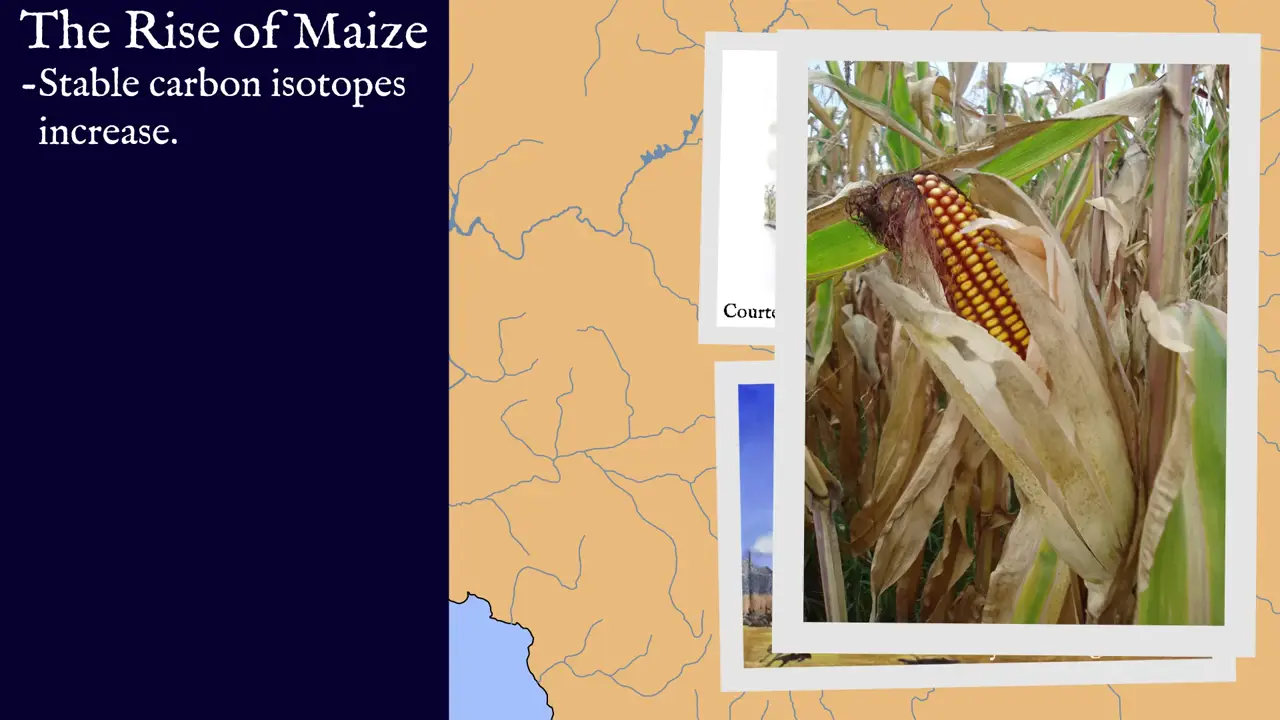
The Three Sisters weren't always in the Southwest! Carbon-13 isotopes show Early Agricultural Period diets had no maize, but Basketmaker II diets became maize-dependent. Around 1000 BCE, genetic studies reveal a new wave of maize arrived from Mexico, and cobs grew slightly larger with 10-12 row varieties appearing. Squash joined the diet after 1000 BCE, then beans around 500 years later. Beans proved crucial for companion planting, growing up maize stalks while adding nitrates back to depleted soil. At Turkey Pen Ruins, turkey coprolites reveal these birds were domesticated on corn-heavy diets. Interestingly, domesticated turkeys came from Texas and Oklahoma populations, not local wild turkeys, suggesting long-distance trade in animals! 🦃
Basketmaker II Agriculture: Maize Domestication and Introduction of Squashes, Beans, Turkeys
Site mentioned
📍 Turkey Pen Ruins
Key facts
- Carbon-13 isotope ratios show EAP diets lacked maize; by Basketmaker II period, values rose substantially showing maize-dependent diets
- Maize cobs became slightly larger with 10 and 12 row cobs appearing with increasing frequency in Basketmaker II
- Genetic studies show around 1000 BCE, a new wave of maize arrived from Mexico
- After 1000 BCE, squash started appearing in diets; 500 years later, beans entered Southwestern diets
- Beans complement maize by growing up the stalk for support and adding nitrates back into depleted soil
- Wild plants exploited include wolfberry, Mexican crucillo, goosefoot, amaranth, ground cherry, tansy mustard, and hog potato
- Turkey Pen Ruins site yielded turkey coprolites showing they were domesticated on a diet of maize
- Genetic material shows domesticated turkeys came from populations in Texas and Oklahoma, not locally
- Turkeys were useful for meat, bones and feathers
Sources
docs.google.com
Linked in video description
Was this story useful?
Keep exploring
Every site on this page sits on the globe, and the people who research them are on the Discord.
3D Globe · Sites by country · Story Archive · Research Library · Weekly Journal · Search
AI-generated text · images from the original sources · always verify with the sources.